
Why “Doing Everything” Is Costing your Firm Money
For many South African accounting firms, growth has traditionally meant one thing: do more. More services, more clients, more industries. Say yes to every opportunity because cash flow matters and the economy is tough.
That approach made sense ten or fifteen years ago. Today, it is quietly eroding profitability, capacity and long-term sustainability — particularly for small and medium practices.
South African firms are operating in a market defined by intense price sensitivity, rising compliance pressure from the South African Revenue Service, and rapid advances in automation and AI. Yet many practices are still structured as if volume alone will protect them. It won’t.
The uncomfortable truth is this: trying to serve everyone makes it harder to serve anyone well.
The generalist trap in the South African context
Most firms don’t choose to be generalists strategically. They become generalists by default. A new practice needs revenue, experience and referrals, so it takes on whoever walks through the door. Over time, however, this creates a client base with nothing in common — different industries, systems, deadlines and compliance risks.
The consequences show up slowly, then all at once.
Pricing becomes a constant battle because services appear interchangeable. Clients compare firms based on fees rather than expertise. Internally, workflows become inefficient because every engagement is different. Staff are forced to switch context constantly, increasing errors and burnout. Marketing becomes vague, because it is impossible to speak clearly to “everyone”.
Large firms absorb this complexity through scale and internal specialisation. Small firms cannot. They feel it in longer hours, tighter margins and a persistent sense of being undervalued.
Why specialisation works
There is a perception that niche specialisation is a luxury for overseas firms or large practices. In reality, South African conditions make specialisation more relevant, not less.
Local SMEs are under immense pressure — from cash-flow volatility, regulatory complexity and economic uncertainty. What they increasingly want from their accountants is not just submission of returns, but guidance. Someone who understands their business model, anticipates risks and helps them make better decisions.
At the same time, compliance work is being steadily automated. Cloud accounting platforms, SARS eFiling integration and AI tools are reducing the time required for routine processing. As this continues, general compliance services will face even greater price pressure.
Specialisation allows firms to respond to both trends at once: by moving away from commoditised work and toward high-trust, high-value advisory services.
What niche specialisation actually means in practice
Specialisation is often misunderstood. It does not mean locking a firm into a single service forever, or turning away every non-niche client overnight. It also does not mean choosing a niche so narrow that one regulatory change wipes out the practice.
In practice, specialisation means intentionally focusing on a defined client group with shared problems, and building deep, repeatable expertise around those problems. That focus allows firms to standardise processes, deepen technical understanding and speak directly to the clients they serve best.
In South Africa, successful niches often emerge around shared regulatory or operational pain points — property investors navigating tax and cash-flow issues, medical professionals managing practice compliance, NPOs dealing with governance and donor requirements, or owner-managed businesses in a specific industry.
The strength of a niche lies not in its popularity, but in its repeatability.
How specialisation improves profitability and resilience
When firms work with similar clients facing similar challenges, conversations change. Prospective clients stop asking only about fees and start asking whether the accountant understands their business. Pricing shifts away from hours and toward outcomes — fewer penalties, better decisions, stronger controls and peace of mind.
Internally, operations become simpler. Onboarding is standardised. Templates actually work. Staff are trained faster and more confidently. Errors decrease. Margins improve without increasing headcount — a critical advantage in a cost-constrained economy.
Perhaps most importantly, specialist firms become easier to refer. Other professionals know exactly who to send their way, and why. Over time, this creates a steady, reliable pipeline of better-fit clients.
The fear of choosing wrong — and why it’s overstated
Many firms resist specialisation because they fear turning away work or choosing the wrong niche. In practice, specialisation rarely reduces opportunity. It filters it.
Most firms transition gradually, keeping legacy clients while building a niche pipeline. Niches can evolve as markets change. What firms cannot afford is remaining vague while technology and client expectations move on.
Turning specialisation from theory into practice
For many firms, the idea of specialisation makes sense intellectually but feels difficult to implement. In reality, the transition is usually far more practical than expected. Most successful firms approach it incrementally and deliberately.
In practice, implementation usually follows these steps:
Start with the clients you already have.
Look for patterns in your existing client base. Which clients are easiest to service? Which engagements are most profitable? Where do you consistently add value beyond basic compliance? A niche often already exists — it simply hasn’t been named yet.Standardise before you advertise.
Once a focus area emerges, refine how you serve those clients. Standardise onboarding, build templates, document recurring issues and common risks. This improves quality, reduces effort per engagement and builds internal confidence.Let positioning follow process.
Firms do not need to rebrand overnight. Small changes in language — on proposals, websites and in client conversations — are often enough. Saying “many of our clients are property investors” or “we work extensively with medical professionals” signals focus without shutting doors.Transition gradually, not abruptly.
Specialisation does not require immediately disengaging from existing non-niche clients. Most firms allow the niche client base to grow organically while legacy clients remain. Over time, the balance shifts naturally.Revisit pricing as confidence grows.
Specialisation creates insight, and insight supports value-based fees. When a firm understands the risks, cycles and decision points of a specific client group, it stops selling time and starts selling certainty and reduced risk.
Why this matters beyond individual firms
CIBA’s view is that accountants are not merely compliance technicians — they are contributors to economic stability and growth. When accountants specialise, they deliver better advice, stronger governance and more sustainable businesses. That protects jobs, improves voluntary compliance and supports entrepreneurship.
In an economy like South Africa’s, that role is not optional. It is essential.
Final thought
The most successful South African accounting firms of the next decade will not be the ones offering the widest menu of services. They will be the ones who decide — deliberately — who they serve best, and build their systems, skills and messaging around that decision.
In a crowded market, clarity is not a constraint.
It is leverage.
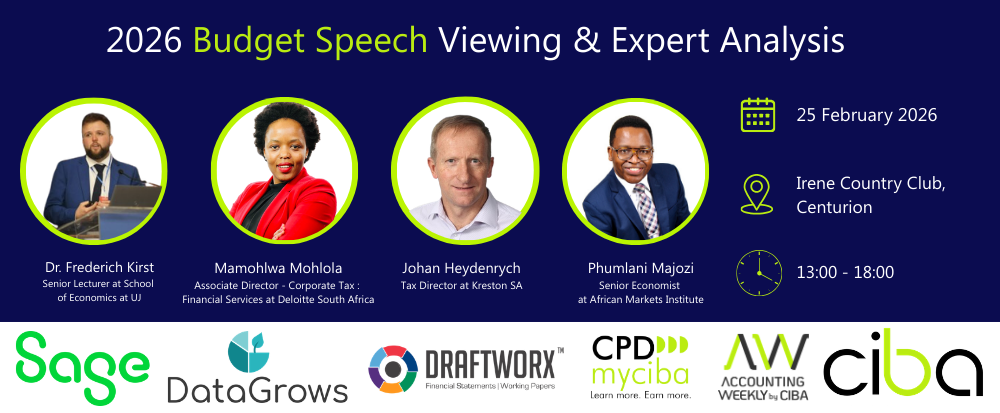
South Africa’s 2026 National Budget Speech will set the tone for the country’s economic direction, tax landscape, and fiscal priorities. With potential tax increases and key policy shifts on the horizon, finance professionals cannot afford to simply watch the speech, you need to interpret it.
That’s why CIBA is hosting a live Budget Speech Viewing & Expert Analysis Event designed to unpack the announcements as they happen. Join us in Menlyn for an afternoon of insight, analysis, and meaningful professional connection.
🎙️ Our expert panel includes:
Johan Heydenrych, Tax Director at Kreston SA
Dr. Frederich Kirst -Senior Lecturer at School of Economics at UJ
Phumlani Majozi – Senior Economist at African Markets Institute
Mamohlwa Mohlola – Associate Director – Corporate Tax : Financial Services and Other at Deloitte South Africa
Together, they will translate policy into practical takeaways for your clients, your advisory role, and your strategic planning.
🍸 After the session, enjoy a cocktail networking event to engage with peers and discuss the road ahead for South Africa’s economy.
📅 Date: Tuesday, 25 February 2026
📍 Venue: Irene Country Club Centurion
⏰ Time: 13:00 – 16:00 (Networking 16:00 – 17:30)
💼 CPD: 3 Units (Taxation)
💰 In-person ticket: R350
💻 Prefer online? Book the virtual option for R250.
Why attend?
✔ Understand real-time tax implications from top experts
✔ Gain clarity on anticipated tax changes
✔ Learn how fiscal decisions will affect SMEs, compliance, and advisory
✔ Strengthen your strategic insights for 2026
✔ Connect with other finance professionals and leaders
➡️ Secure your seat for the in-person event here