
Most accounting practices in South Africa are not struggling because of a lack of technical competence. In fact, many CIBA members deliver work of exceptional quality, maintain strong compliance standards, and operate with integrity and professional discipline. Yet despite this, a significant number still experience slow or inconsistent growth, constant fee negotiations, and the ongoing pressure of being operationally busy without gaining real strategic momentum.
The uncomfortable truth is that the problem is rarely technical. It is almost always positioning.
You can understand IFRS better than your competitors. You can meet every SARS deadline. You can prepare accurate financial statements and provide technically correct advice. But if your practice is positioned as interchangeable with every other firm offering accounting and tax services, your expertise becomes invisible. When expertise is invisible, price becomes the deciding factor.
That is where growth stalls.
Clients Do Not Buy Compliance. They Buy Certainty.
Business owners do not wake up thinking about tax returns or annual financial statements. They think about survival, cash flow, risk, expansion, staffing, and protecting what they have built. Compliance is simply a requirement along the way.
If your service offering is positioned as “we do accounting, tax, payroll and compliance,” you are describing activities. You are not communicating value. When everything is listed, nothing stands out. Clients hear capability, but they do not hear impact.
What clients are actually paying for is peace of mind. They want to avoid penalties and audits. They want clarity in their numbers so they can make confident decisions. They want governance structures that protect them from personal liability. They want someone who can identify risk before it becomes a crisis.
When compliance is framed purely as submission and sign-off, it becomes a commodity. When it is framed as protection, oversight and strategic insight, it becomes valuable. The technical work may be similar, but the perceived value is dramatically different.
Positioning determines which conversation you have.
The Critical Difference Between Being Busy and Truly Growing
Many practice owners describe themselves as busy. They have a full client list, constant deadlines, and very little free capacity. Yet busyness is not the same as growth.
A busy practice often carries too many small clients, operates on thin margins, and experiences continuous pressure around fees. There is frequent scope creep, reactive communication, and little time to think strategically about the future of the firm. Revenue may increase slightly each year, but stress levels rise at the same pace.
A growing practice, on the other hand, is deliberate. It works with clients who are aligned with its standards and values. It delivers higher value work that fully utilises professional expertise. Fees are sustainable because they are connected to outcomes, not just hours. Client relationships are long term and built on mutual respect.
Growth is not about doing more work. It is about doing better work for better clients at better margins.
If the quality of your client base does not improve over time, your growth is fragile.
Your Ideal Client Strategy Determines Your Stress Level
One of the most damaging positioning mistakes is defining your ideal client too broadly. If your answer is “all SMEs” or “anyone who needs accounting services,” you do not have a positioning strategy. You have a reactive intake process.
An ideal client values advice, not just compliance. They respect deadlines and processes. They understand that professional expertise has a cost. They are willing to implement recommendations rather than ignore them.
The wrong client constantly negotiates fees, submits records late, ignores risk warnings, and increases your professional exposure. They consume disproportionate time and emotional energy.
Positioning influences who responds to your practice. If your messaging focuses on affordability and general service provision, you will attract price sensitive clients. If your messaging communicates structure, governance, oversight and strategic value, you will attract business owners who are looking for long term guidance.
The difference between a stressful practice and a sustainable one often comes down to this decision.
From Service Provider to Trusted Advisor
Every accountant must decide whether they want to be seen as a service provider or a trusted advisor. Both roles require technical competence, but they are perceived very differently in the market.
A service provider reacts to client requests and completes tasks. They wait for instructions and focus primarily on deliverables. They are necessary, but they are easily replaced.
A trusted advisor proactively identifies risks, guides decisions, and protects the long term sustainability of the business. They are consulted before major transactions, restructuring decisions or governance changes are made. Their opinion carries weight because their positioning supports authority.
Trusted advisors are rarely compared on price. Their value is measured in insight and protection.
If you want to move into stronger advisory territory, you must start positioning your work in terms of outcomes, risk mitigation and business impact rather than simply technical completion.
Pricing Confidence Begins With Positioning
Fee resistance does not begin when the client sees your proposal. It begins during the first conversation about what your work actually means for their business.
If you present annual financial statements as a compliance requirement with a fixed price, the discussion will centre on cost. If you explain how those statements support director responsibilities, strengthen governance structures, and reduce regulatory exposure, the conversation shifts toward value.
The technical standard applied is the same. The qualification of the practitioner is the same. The positioning is different.
When positioning is weak, fees feel negotiable. When positioning is strong, fees feel justified.
Confidence in pricing is not about arrogance. It is about clarity in communicating the business impact of your expertise.
Positioning Is a Leadership Discipline
Positioning is not a marketing slogan. It is a leadership decision that influences client acceptance, engagement scope, risk management and internal standards.
If leadership tolerates discounting to secure work, the market learns that your fees are flexible. If you accept non compliant clients without proper screening, you increase exposure and weaken your credibility. If your engagement letters do not clearly define scope, you invite misunderstandings and liability.
Strong positioning aligns directly with professional discipline. It supports proper client screening, defined service boundaries, and clear communication of responsibilities. It reduces unmanaged risk and strengthens independence.
This alignment is fully consistent with CIBA’s philosophy that accountants are architects of economic growth. By strengthening governance, improving financial discipline and protecting SMEs from avoidable risk, your practice contributes directly to job creation, enterprise stability and broader economic resilience.
That is not theory. It is practical nation building.
Sustainable Growth Requires Clarity
You do not need a dramatic rebrand or expensive consultants to strengthen your positioning. What you need is clarity.
Clarity about who you serve best.
Clarity about the problems you solve exceptionally well.
Clarity about the outcomes you focus on.
Clarity about the standards you refuse to compromise.
When this clarity is embedded across your website, onboarding process, proposals and client meetings, your practice begins to feel different in the market. Clients sense confidence. They sense structure. They sense capability.
And capable professionals attract better clients.
If you are busy but not growing, the solution is not more activity. It is sharper positioning. Growth does not happen automatically because you work harder. It happens because you choose direction, define standards and communicate value clearly.
Growth is a decision. Positioning is the discipline that makes that decision visible.
Join Us for the 2026 National Budget Speech Viewing & Expert Analysis. 25 February 2026 | Irene Country Club, Centurion
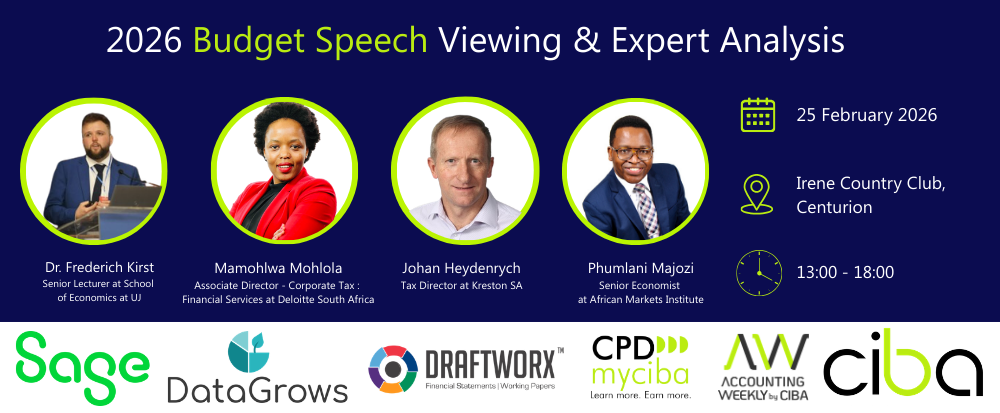
South Africa’s 2026 National Budget Speech will set the tone for the country’s economic direction, tax landscape, and fiscal priorities. With potential tax increases and key policy shifts on the horizon, finance professionals cannot afford to simply watch the speech, you need to interpret it.
That’s why CIBA is hosting a live Budget Speech Viewing & Expert Analysis Event designed to unpack the announcements as they happen. Join us in Menlyn for an afternoon of insight, analysis, and meaningful professional connection.
🎙️ Our expert panel includes:
Johan Heydenrych, Tax Director at Kreston SA
Dr. Frederich Kirst -Senior Lecturer at School of Economics at UJ
Phumlani Majozi – Senior Economist at African Markets Institute
Mamohlwa Mohlola – Associate Director – Corporate Tax : Financial Services and Other at Deloitte South Africa
Together, they will translate policy into practical takeaways for your clients, your advisory role, and your strategic planning.
🍸 After the session, enjoy a cocktail networking event to engage with peers and discuss the road ahead for South Africa’s economy.
📅 Date: Tuesday, 25 February 2026
📍 Venue: Irene Country Club Centurion
⏰ Time: 13:00 – 16:00 (Networking 16:00 – 17:30)
💼 CPD: 3 Units (Taxation)
💰 In-person ticket: R350
💻 Prefer online? Book the virtual option for R250.
Why attend?
✔ Understand real-time tax implications from top experts
✔ Gain clarity on anticipated tax changes
✔ Learn how fiscal decisions will affect SMEs, compliance, and advisory
✔ Strengthen your strategic insights for 2026
✔ Connect with other finance professionals and leaders
➡️ Secure your seat for the in-person event here