Fewer Clients, Bigger Practice: The Metric That Matters
This article will count 0.25 units (15 minutes) of unverifiable CPD. Remember to log these units under your membership profile.
If you have 80 clients, work every weekend and your income still looks like it did three years ago: the problem may not be how hard you work. It may be who you work for.
That is the message US practice adviser Joe Woodard gave firm owners last week. Speaking at Accounting Today's Firm Growth Forum East in Washington, D.C., he argued that growth does not come from more clients. It comes from the right ones and as stated in Accounting Today’s article, often, that means fewer.
Woodard advises thousands of accounting firms in the United States. He also publishes the Woodard Report and runs the Scaling New Heights technology conference. His advice is aimed at US firms, but the maths works the same in rand.
The one number to track
Woodard called it the metric that matters: how many clients you serve for every million in annual revenue. Count your clients. Divide by your annual fee income in millions. That is your number. His target is no more than 25 clients per million. In the US that works out to about $3,333 per client per month. The ratio carries straight over to rand. A practice earning R1 million a year from 25 clients earns R3,333 per client per month.
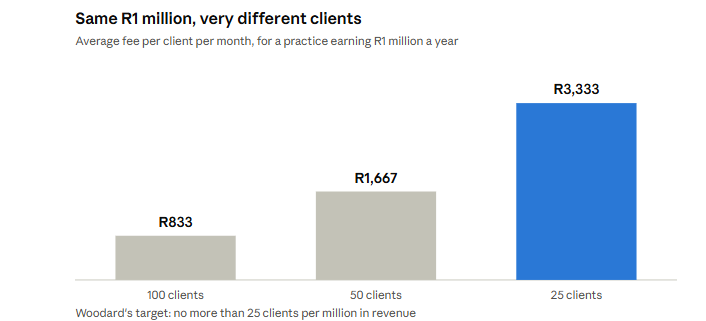
The same R1 million from 100 clients means each one pays about R833 a month. That is four times the admin, four times the SARS letters and four times the year-end files, for the same income.
Woodard said R3,333 a month is not high for a client-accounting (monthly bookkeeping and reporting) service, but would be a very strong fee for a tax-only client. Many new practices take on anyone who can pay. Over time that leaves a long list of clients who each add very little in fees.
The second number, and the AI trap
Woodard paired clients per million with a second measure: revenue per professional. That is your total fee income divided by the number of people doing client work. His US benchmark is $250,000 per professional a year. SA fee levels and salaries are very different, so do not copy that figure. Track your own number and watch which way it moves each year.
He expects AI to push revenue per professional up, because each person can get more done in less time. But he warned firms not to let AI push their clients per million up as well.
This is the trap. AI frees up hours, so it feels safe to take on 20 more small clients. Revenue goes up, but so does the workload, and the fee per client stays low. Woodard's advice is the opposite: use the time AI gives back to offer more, and more valuable, services to the same good clients. We looked at where those saved hours tend to disappear in AI, Efficiency and Burnout: The Hours Accountants Lose.
Where the better clients are: the middle market
Woodard pointed firms to mid-sized businesses. He drew on Accounting Today's Blueprint for Growth Survey. Firms growing by less than 10% a year had almost no mid-market clients. The fastest-growing firms had many of them. He gave three reasons mid-market clients are worth chasing:
They have more money and bigger budgets for professional services.
They feel less pressure to bring their finance work in-house.
As they grow, they may need a fractional (part-time) CFO. Later, you could help them build their own finance team, then advise that team.
Some accountants worry that helping clients grow means losing them. Woodard said that is a better problem than clients who never grow. If you are going to lose clients, he said, it is better to lose them because they succeeded than because you let them down.
What this means for a South African practice
Most small SA practices are far below R1 million per partner, and Woodard's figures come from the US. The exact numbers matter less than the idea. If your fee income is flat while your client list keeps growing, you are running harder to stand still.
In South Africa, the middle market is the business that has outgrown a basic bookkeeper but cannot yet afford a full-time finance manager. Think of a growing construction firm, a family-owned distributor or a franchise group with several stores. These owners need management accounts, cash flow forecasts, VAT and payroll oversight, and someone to talk to before big decisions. That is advisory work, and it carries advisory fees.
Choosing better clients also lowers your risk. Clients who send records late, ignore your warnings or will not give you FICA documents add to your professional exposure, as we explained in The Client You Keep Is the Risk You Own. Clients who argue over every invoice are often a positioning problem, covered in If Clients Haggle You Positioned It Wrong.
What you can do this week
Work out your number. Divide your active clients by your annual fee income in millions. Write it down and check it again every six months.
Rank your clients by monthly fee. Look at the bottom 20%. Ask whether each one earns its place or just fills your week.
Reprice or release. Give low-fee clients a fair new fee. If they will not pay it, help them move on with a proper handover.
Stop taking new clients at old rates. Set a minimum monthly fee for new work and stick to it.
Pick three growing clients. Offer each one a monthly package with management accounts, a cash flow forecast and a monthly meeting. Our 12-month plan from compliance shop to advisory firm shows how.
Protect the hours AI saves. Spend them on deeper work for current clients, not on adding more small ones.
👉 Join CIBA and we'll show you how to earn more from fewer, better clients.