
From Compliance Shop to Advisory Firm: The 12-Month Plan That Doubles Your Average Fee
Built for CBAPs who are tired of being the cheapest person in the room.
Let's start with something uncomfortable.
If a client called you tomorrow and asked, "What do I pay you for?" — would they say "monthly bookkeeping and annual financials" or would they say "she's the reason my business is still growing"?
If it's the first one, you're a compliance shop. And compliance shops compete on price. Forever. Because the moment a cheaper bookkeeper opens down the road with a laptop and a cloud accounting login, your client starts doing maths.
Advisory firms don't have this problem. Their clients don't shop around. They ask permission to leave.
This article is the 12-month plan to get you there. No theory. No fluff. Just the steps — and the income shift waiting on the other side.
First, let's be clear about what a CBAP can actually sell
Before we go further, a quick reality check on scope. This matters, because the plan only works if you're selling the right things.
As a CBAP in practice, your core paid work includes:
Compilation of annual financial statements (this is your bread and butter — not audit, never audit)
Bookkeeping and management accounts
Statutory and secretarial work (CIPC filings, beneficial ownership, the lot)
Advisory and consulting (cash flow, costing, pricing, profit improvement — the focus of this article)
Three things sit outside your default scope and need extra credentials:
Independent Reviews — only if you hold CIBA's Independent Review licence
Tax services (returns, objections, tax planning advice) — only if you are a registered Tax Practitioner with SARS through a recognised controlling body such as CIBA
Audits — never. Not your lane. Reserved for registered auditors with IRBA
If you have the IR licence and the SARS tax practitioner registration, your menu is enormous. If you don't, your menu is still strong — but you must stay inside the lines. Pretending otherwise is how careers end.
Right. Now the plan.
Why "compliance only" is a trap
Here is the hard truth about pure compilation and bookkeeping work in 2026.
It is being squeezed from three sides. Cloud accounting software does bank reconciliations while you sleep. AI tools can now draft a basic set of compiled financials in under a minute. And clients increasingly believe they can "do the books themselves" — until they can't.
This is not a future problem. It is happening right now.
So if your entire offer is "I do the books and compile the financials," you are selling a product that gets cheaper every year. That is why you feel the squeeze. It is not you. It is the market.
But there is a part of accounting that gets more valuable as the world gets more complex: judgement. Strategy. Knowing what the numbers actually mean for a specific business in a specific sector.
That is advisory. And that is where the money is.
What does "advisory" actually mean? (No jargon, promise.)
Forget the consulting buzzwords for a minute. Advisory is just this:
You stop telling clients what happened (last month's numbers) and start telling them what to do next (how to make more money, run leaner, and avoid disasters).
Same accountant. Same client. Different conversation. Very different invoice.
A few real examples:
A retail client doing R8 million turnover. Compliance shop sends monthly management accounts. Advisory firm spots the gross margin slipping by 4% — investigates — finds shrinkage in one store — fixes it. That's a R320 000 problem caught. Advisor fee: R15 000. Client thinks it's a bargain.
A construction sub-contractor. Compliance firm processes the books. Advisory firm structures retention payments and progress billings so cash flow doesn't collapse mid-project. Saves the business from going under. Fee: many times what the bookkeeping cost.
A hospitality group with three restaurants. Compliance shop captures the transactions. Advisory firm tracks cost-per-cover and food cost percentage weekly, flags the kitchen losing money, and helps the owner re-price the menu. The owner now considers you a partner.
Notice what's different.
The work is not harder. It is more useful. And usefulness is what doubles fees. None of it requires you to be an auditor, an independent reviewer, or a tax practitioner — though if you are a registered tax practitioner, you can layer tax planning on top and charge even more.
The 12-month repositioning roadmap
Here is the plan. Do not skip months. The order matters.
Months 1–2: Audit and choose
Go through your client list. Be honest about each one.
Group them into three buckets:
Anchor clients — pay well, respect you, would be open to more services.
Steady but stuck — pay average fees, but the business is interesting.
Drainers — late payers, scope creep, treat you like an admin clerk.
Now pick one sector to specialise in. Look at where most of your anchor clients sit. Retail? Construction? Hospitality? Logistics? Healthcare? Pick one. Specialists charge more than generalists. Always.
Months 3–4: Build your advisory product
This is the part most accountants skip — and it's why they stay stuck.
You need a productised advisory offer. Not "we offer consulting" (nobody buys that). Something specific.
For example, a "Cash Flow Forecast & Profit Review" package: monthly 13-week cash flow forecast, gross margin analysis by product or service line, one strategy meeting per month. Priced as a fixed monthly retainer, not hourly.
Build the templates. Build the meeting agenda. Build the report. Once. Then reuse it for every client.
Months 5–6: Pilot with three clients
Pick three anchor clients. Offer them the new package at a discount in exchange for honest feedback.
This stage is the most uncomfortable. You will discover what works and what is fluff. Fix it. Tighten it. Get the report down to one page that the client actually reads.
By end of month 6, you should have testimonials. Real ones. Specific. "Sipho found R280 000 of hidden costs in my business in the first three months." That sort of thing.
Months 7–8: Raise prices on new clients
Stop accepting new clients at old rates. Full stop.
New clients get the advisory package as a default. Bookkeeping and compilation become your entry-level offer, not your only one. Pricing should reflect outcomes, not hours. A R6 500 monthly retainer that saves a client R200 000 a year is the bargain of the century — and they know it.
Months 9–10: Have the conversation with existing clients
This is the one accountants dread. Don't dread it.
Sit down with each anchor client. Show them what your new advisory clients are getting. Show them what their business is missing. Offer to move them across at a fair transition price.
Some will say yes immediately. Some will say no — and that's fine, because you've already replaced their fee with two new advisory clients in months 7 and 8.
Months 11–12: Drainers go, and credentials get stacked
Cut your drainer clients. Politely. Refer them somewhere else.
You will feel guilty for about a week. Then you will feel free.
Use the time you've reclaimed to stack credentials that unlock new fee tiers:
CIBA Independent Review licence — if you're not already licensed. Independent reviews are required for many companies with a public interest score between 100 and 350. Currently many of these go to auditors who don't need or want them. As a licensed CBAP, you can charge proper review fees and own that work.
SARS Tax Practitioner registration through CIBA — if you're not already registered. This unlocks tax planning, returns, and SARS representation as a paid service line.
With one or both of these added to your CBAP, your menu — and your average fee — moves up another level.
The identity shift
Here is the part nobody talks about.
The biggest barrier to moving from compliance to advisory isn't technical skill. It's identity.
Most accountants in practice were trained to be careful, accurate, and modest. Those are great traits. But they create a problem: you undervalue the very thinking that clients need most.
You already know which of your clients are heading for trouble. You already know which ones are running their stock badly. You already know who needs to restructure their pricing. You see it in the numbers every month.
The shift is letting yourself charge for seeing it. Not just for compiling the financials.
CIBA exists for exactly this reason. The CBAP designation says you are not a "bookkeeper with extra steps". You are a Chartered Business Accountant in Practice — qualified, recognised by SAQA, and entitled to charge accordingly. The title gives you the standing. The plan gives you the work. The clients give you the income.
What this is really about
When you charge what you're worth, you can hire properly, take on better clients, and grow.
When your clients get advisory support, they don't fail. They expand. They hire. They contribute more to the economy — to SARS through honest tax, to their workers through wages, to their suppliers through trade.
Multiply that by every CBAP doing this across South Africa, and you have a measurable contribution to GDP. FASSET estimates each qualified business accountant adds roughly R1.2 million in SME productivity per year. That is not a slogan. That is the maths.
You are not doing admin. You are keeping businesses alive — and growing the economy in the process.
So the question isn't really "should I move to advisory?"
The question is: how much longer can you afford not to?
🚨 CPD Opportunity for Accountants Working with Medical Practices 🚨
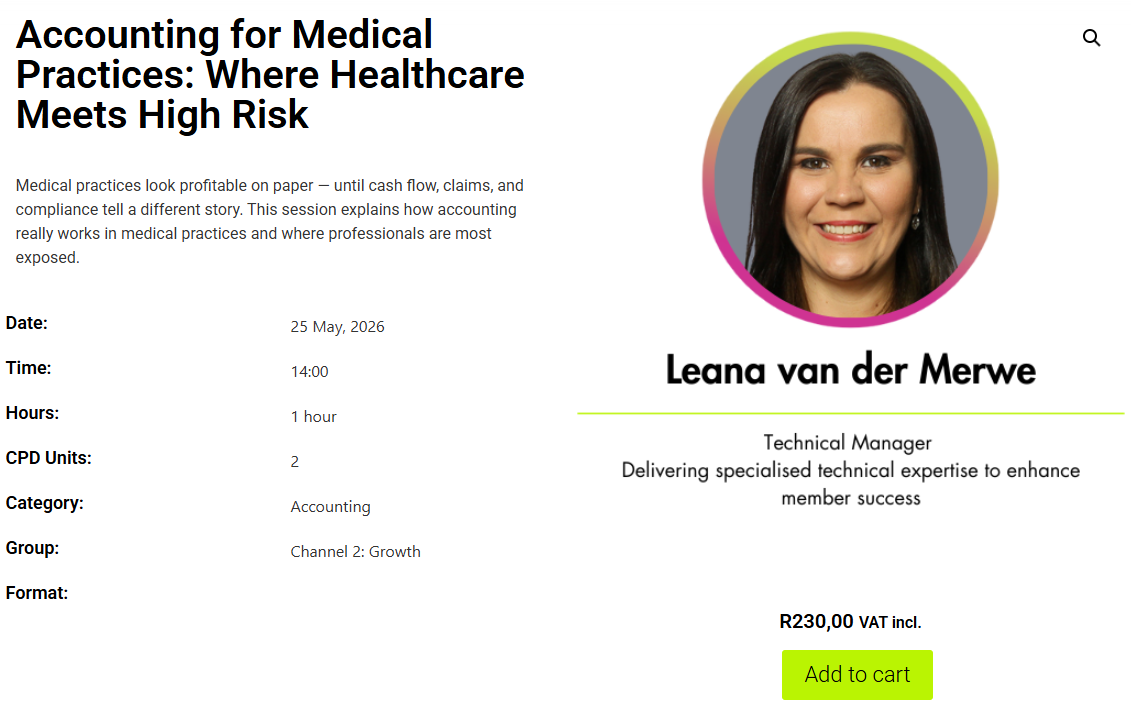
Medical practices often look profitable on paper — but behind the numbers are complex risks involving medical aid claims, debtors, cash flow pressure, and billing controls.
Join for this practical CPD session:
Accounting for Medical Practices: Where Healthcare Meets High Risk
📅 25 May 2026
⏰ 14:00
🕒 1 Hour
🎓 2 CPD Units
📚 Category: Accounting
📍 Channel 2: Growth
💻 Online Session
Many accountants apply normal business principles to medical practices — and that is where problems begin. Medical practices operate differently. Income timing is unpredictable, medical aid claims delay collections, debtors become complex, and profitability can easily be distorted.
This session will unpack the real financial and accounting risks inside healthcare practices and help accountants better understand how to support doctors and healthcare businesses with confidence.
During this CPD session, delegates will learn:
✔️ How medical practices differ from traditional businesses
✔️ Why profit and cash flow often do not align
✔️ How medical aid claims impact debtors and collections
✔️ Common accounting mistakes in healthcare practices
✔️ Key controls needed to protect income and cash flow
✔️ Financial reporting considerations unique to medical practices
✔️ How to reduce professional risk when advising healthcare clients
Presented by Leana van der Merwe, who brings more than 18 years of experience in accounting, governance, compliance, and technical advisory.
If you work with doctors, healthcare professionals, or medical businesses, this session will give you practical insights that can immediately improve the quality of your advice and reporting.