UK plans to scrap audits for medium companies
This article will count 0.25 units (15 minutes) of unverifiable CPD. Remember to log these units under your membership profile.
On 7 September 2026, the UK Department for Business, Innovation, Science and Trade published a consultation called Modernising Corporate Reporting. It reviews almost every part of UK company reporting, including size thresholds, audit exemptions, accounting standards and dividend rules. One key proposal would extend the audit exemption to medium-sized companies. Comments close on 30 November 2026.
The proposals raise the same questions South Africa answers through the Public Interest Score, audits and independent reviews. This update covers the reasons for reform, the guiding principles, the main proposals, the concerns raised and what it means for accountants.
Why the UK says change is needed
The government's starting point is blunt. In its own words, the purpose of the annual report and accounts "has become obscured". Reports now try to serve too many audiences and too many policy goals, so they have grown longer and harder to use.
The consultation names four practical problems:
Too many rulebooks. Requirements sit in company law, accounting standards and regulator rules at the same time. That creates duplication, inconsistency and extra compliance cost.
Too many size tests. In its feedback, KPMG told government it had counted more than ten different size threshold tests for narrative reporting alone.
Built for paper. Much of the law was designed before digital reporting, and it has not kept up.
Costs that may outweigh benefits. The government says it is not clear that many requirements are worth what they cost, especially for small and medium-sized companies.
This builds on earlier changes. Raising the size thresholds in 2025 saves about £185 million a year, and changes already announced, such as removing the strategic report for most medium-sized private companies, should save another £230 million a year.
The five principles behind the reform
The government says every proposal is tested against five principles. In plain language, they are:
Clarity of purpose. The annual report should have one clear audience: investors and creditors, including future lenders and investors.
Flexibility and trust. Directors should be trusted to decide what is important and tell their own business story.
Simplicity and coherence. A rule should live in one place only, not be repeated across the law and the standards.
Proportionality. Reporting should match a company's size, ownership and economic impact. The cost must be justified by the benefit.
Fit for the future. The law should work for the next decade, including digital reporting and new technology such as AI.
Proportionality is the principle that matters most for audit.
What is actually on the table
Today, a UK company's size category depends on meeting two of three tests. Small companies can skip the audit. Medium-sized companies cannot.
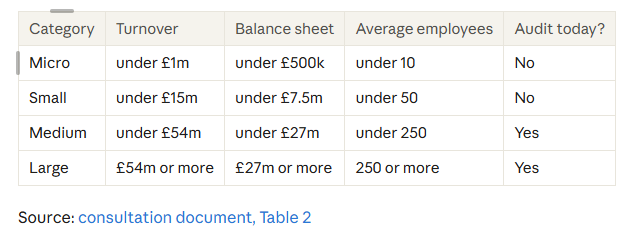
Here are the main proposals that affect accountants and auditors:
One SME category. Small and medium-sized companies would merge into a single SME band. Micro-entities would stay separate.
Audit exemption for all SMEs. The small company audit exemption would be extended to medium-sized companies. An audit would only be required where the risk to investors and creditors justifies the cost.
A new lighter assurance option. A new voluntary assurance standard would give lenders confidence in SME accounts. South African readers will recognise this as an independent review.
Simpler accounts. SMEs would not need a cash flow statement, and SME-sized groups would not need consolidated accounts.
No "true and fair" test for SMEs. SMEs would simply comply with the SME accounting standard.
Other changes. Four accounting standards instead of many, easier audit exemptions for wholly-owned subsidiaries, and auditors named on the Companies House register.
Not everyone gets a pass. Public Interest Entities are out of scope, and government proposes that investment firms, UCITS managers, e-money issuers and other regulated financial services firms stay excluded from the exemptions.
The concerns, including the government's own
The consultation is open about the risks, and the profession has added more.
Losing access to finance. Government accepts that audited accounts give lenders and investors more confidence. They can help a company get a loan, or get it cheaper. Its biggest worry is timing. A company may only discover it needs three years of audited accounts when it applies for a loan. By then it is too late to fix. That is why the consultation asks for hard evidence on the role of audits in getting credit.
What would an auditor even sign? If directors no longer have to present a "true and fair" view, an auditor cannot give an opinion on one. Government admits the audit proposal and the true and fair proposal depend on each other.
Group and financial crime risk. Allowing more group companies to use exemptions could make it harder for regulators to supervise financial services firms. Government also lists reduced transparency and the risk of hiding financial crime as issues it must weigh.
The legal duty goes, the business need stays. RSM UK makes the sharpest practical point. An exemption removes the legal obligation, but not the commercial need. Banks, investors, customers and suppliers may still ask for assured numbers.
A shrinking audit market. AccountingWEB asked whether this is another nail in the coffin for audit. It points out that the number of UK audit firms has already fallen sharply since audit exemptions were first introduced. Fewer audits could mean fewer firms, less competition and fewer places to train.
The detail is still missing. Crowe UK notes that the scope and safeguards are still open.
The professional bodies are broadly supportive of the direction. ICAEW welcomed the consultation, with its Corporate Reporting and Governance Director, Sally Baker, saying the institute has "long been calling for the purpose and audience" of the annual report to be clarified (ICAEW). Support for clearer reporting, though, is not the same as support for removing the medium-sized audit. That fight will play out in the comment letters.
What this means for the profession
Governments are asking if a full audit is always the right level of assurance for mid-sized, privately owned businesses. The answer they are leaning towards is NO. For UK firms, this could mean compulsory audit shifting to work clients choose to buy, such as lighter assurance and advisory services. Firms that can explain why a client still needs assurance will keep the work.
If we look at South Africa, it already works this way. Our system does not use size alone. It uses the Public Interest Score, who compiled the statements, and whether the company is owner-managed. As we explained in Independent Reviews Explained, a private company that is not owner-managed, scores between 100 and 349, and has internally compiled statements may need an independent review rather than an audit. A score of 350 or more still means an audit. In other words, the "lighter assurance for lenders" that the UK now wants to invent already exists here. It is the independent review under ISRE 2400.
Three lessons stand out for South African practitioners:
The middle tier is being validated. When a major economy designs a new standard to sit between audit and nothing, it confirms that independent reviews are a credible, cost-effective option, not a lesser one.
"Not required" does not mean "not needed". The UK's worry about businesses finding out too late that the bank wants assured numbers applies here too. Your client may be exempt today and still need reviewed statements for a loan, a tender or a funder tomorrow. Our guide to helping clients choose the right level of assurance shows how to have that conversation.
Reform will reach us. Any future review of the Companies Act or the PIS system will look at what the UK does. Linking assurance to real risk, rather than paperwork, is an argument CIBA members can help shape.
What you can do this week
Check who is "exempt" on your client list. For every client below the review or audit line, ask one question: will a bank, funder or big customer want assured numbers in the next three years? If yes, start the conversation now, not when the loan application is due.
Sell assurance on value, not on law. The UK debate proves the point. When the legal requirement goes, the work stays only if clients see why they need it. Practise explaining what an independent review gives a lender.
Get licensed if you are not. Our 12-month plan from compliance shop to advisory firm explains how the CIBA Independent Review licence opens a new fee tier for CBAPs.
Watch the outcome. The UK consultation closes on 30 November 2026. Government aims to publish its response within six months after that.
👉 Join CIBA and we'll show you how to turn independent reviews into recurring, well-priced work that lenders trust.