SARS VAT e-Invoicing: What It Means for Your Practice
This article will count 0.25 units (15 minutes) of unverifiable CPD. Remember to log these units under your membership profile.
Imagine your client's VAT is simply correct. Nobody captured nor reconciled anything. All of it happent automatically. The invoice went out, the system checked it, SARS saw both sides, the return filled itself, and the refund landed. Doesn’t is sound wonderful?
That is not a hypothetical. "Tax just happens" is SARS's own phrase, written into its Consultation Paper on VAT Modernisation published in August 2026. It is the stated end goal. Compliance becomes invisible, folded into the ordinary running of a business, so that a compliant taxpayer barely notices it happening at all.
For your clients that is a gift. For a practice that bills for capture, reconciliation and cleaning up after SARS letters, it is a slow demolition of the fee base. And it is not a distant threat. Comment on the paper closes on 16 October 2026, and the design starts hardening after that. Below we look at what is proposed and what this may mean for your practice.
The paperwork you built your fees on is being replaced
Right now, VAT is a self-assessment tax. Your client invoices, you capture, you reconcile, you file a VAT201, and SARS checks afterwards if something looks odd. That "afterwards" is where most of your VAT work lives. Verification letters. Supporting document requests. Refund delays that turn into three phone calls and an unbilled hour.
SARS wants to remove the "afterwards" entirely.
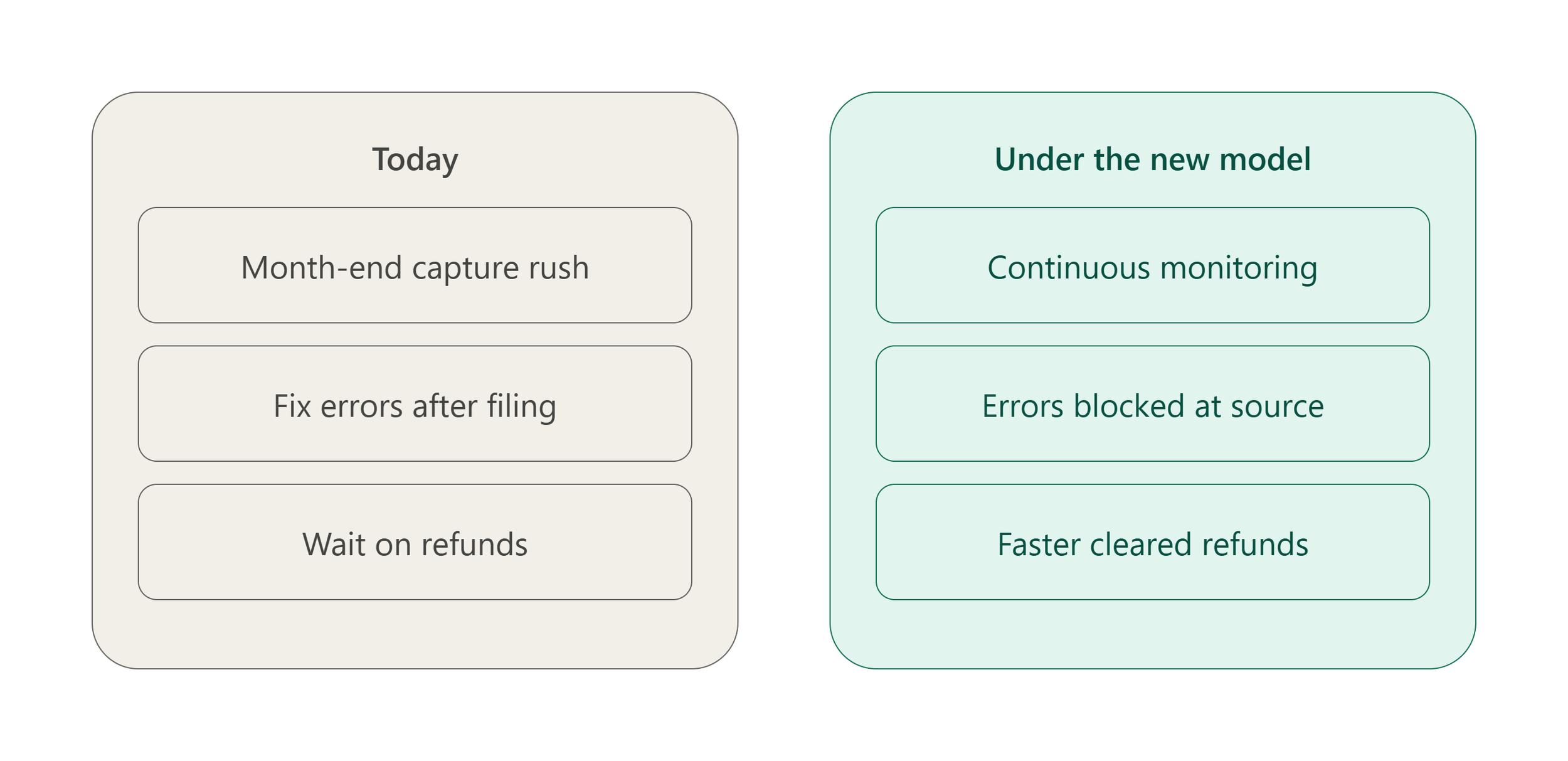
The new model is built on three things. A real e-invoice, which is structured machine-readable data, not the PDF your client emails from a template. An interoperability framework, which is a network of accredited service providers that pass those invoices around, roughly the way email providers pass mail between each other. And e-reporting, where the VAT data reaches SARS as the transaction happens instead of six weeks later.
If your clients are still issuing invoices from a Word template, this is the moment that habit becomes expensive. The tax invoice requirements you already check for will stop being a checklist you apply after the fact and start being a validation gate the invoice must pass before it can even be delivered.
So, how will it work?
The mechanics matter, because your clients will ask you to explain them.

Your client, a plumbing supplier, sells R50,000 of pipe fittings to a construction company. Today that means printing an invoice, emailing a PDF, and hoping the customer's accounts department captures it correctly. Under the new model, five things happen instead, mostly in under a minute.
Step one, C1. The invoice is created as data, not a document.
Your client's accounting software generates a structured file that has fields, like a form, so a computer can read every part of it without a human retyping anything. This is not a PDF which is a picture of an invoice. This is the invoice itself, in a format machines understand. At this point SARS calls it an "uncleared" invoice, because nobody has checked it yet.
Step two, C2. The invoice goes to a middleman for checking.
Your client will have to appoint an accredited service provider from a list SARS publishes. Think of it like an internet service provider, but for invoices. That provider checks the invoice against the rules. Is the VAT number valid? Is the VAT calculated correctly? Are all the required fields there? If it passes, the invoice is "cleared" and moves on. If it fails, it bounces straight back to your client to fix.
That bounce is the single biggest change this modernisation brings. Today an invalid tax invoice gets discovered months later, usually by SARS, usually when your client is claiming input VAT on it. Under this model an invalid invoice cannot leave the building.
Step three, C3. It crosses to the buyer's side.
The construction company (the buyer) has also appointed its own accredited provider. The two providers talk to each other over a shared network. The buyer's provider checks the invoice again on its side, then delivers it.
There is no central government platform that everything must pass through. This is deliberate, allowing service providers compete. Both parties can choose their own, and if one goes down the others keep working.
Step four. The buyer confirms what it is doing with the VAT.
The construction company's system receives the invoice and sends a response saying how it is treating the input VAT. Claiming it in full, claiming part of it, or not claiming at all. This is new. Today SARS has no idea what the buyer did with an invoice until a return arrives weeks later.
Step five. SARS gets told twice.
Both providers report the cleared invoice to SARS, i.e. the seller's side and the buyer's side. SARS now holds both halves of the same transaction and can match them automatically.
That fifth step is the whole point of the design. Today a fraudulent input VAT claim works because SARS has to go looking for the other half of the transaction, and often cannot find it. Under this model there is no other half to go looking for. It is either there or it is not, and the mismatch shows up the same day.
Once SARS holds every matched invoice, filling in a VAT201 becomes a formality. That is why the paper talks about pre-filled returns first and auto-assessment later. The return is just a summary of data SARS already has.
The timeline is longer than you think, and shorter than it feels
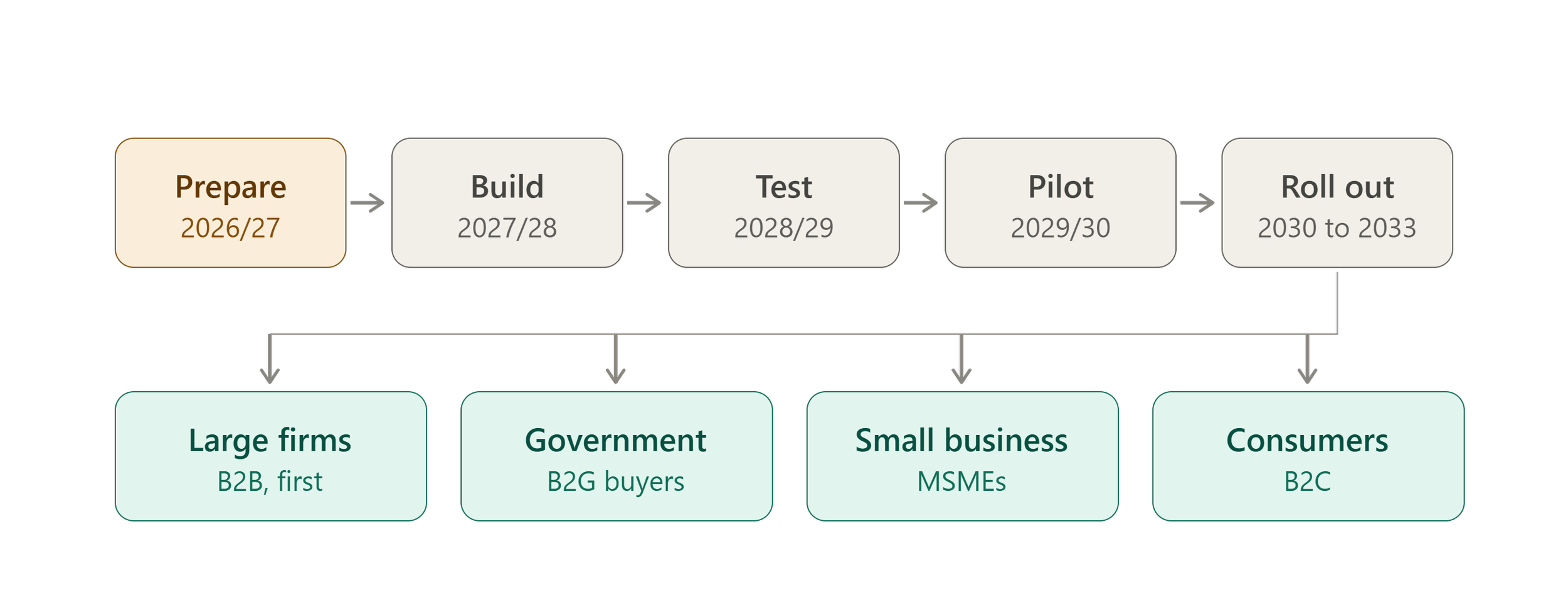
SARS is not switching this on next year. It is a five-phase build running to roughly 2033.
If you have watched what happened to income tax, efiling and auto-assessments, you already know how this ends. SARS moved to auto-assessment and pre-populated returns, and the work shifted from capturing data to checking what SARS already holds. VAT is heading the same way. The paper says so plainly: pre-filled VAT returns first, auto-assessment later.
The lesson from income tax is also a warning. When SARS pre-populates from third-party data, bad data becomes your problem. Missing employer submissions caused more than 125,000 verification cases in one year. Now imagine that at invoice level, across every transaction your client makes.
What does this leave the work of accountants?
If you are honest about where your VAT fees come from, a lot of it is capture, reconciliation, chasing missing invoices, and firefighting verification queries. SARS is proposing to automate most of that.
If you have watched what happened to income tax, you already know how this ends. SARS moved to auto-assessment and pre-populated returns, and the work shifted from capturing data to checking what SARS already holds. VAT is heading the same way. The paper says so plainly: pre-filled VAT returns first, auto-assessment later.
The lesson from income tax is also a warning. When SARS pre-populates from third-party data, bad data becomes your problem. Missing employer submissions caused more than 125,000 verification cases in one year. Now imagine that at invoice level, across every transaction your client makes.
What we do not know yet
Give SARS credit for consulting early. But be clear-eyed about the open questions, because they are the ones that will cost your clients money.
There are no cost estimates. None. SARS admits smaller businesses will carry the heaviest burden and says it will "explore appropriate support mechanisms" and talk to software vendors about subsidised pricing. That is a plan to make a plan.
We also do not know who the Network Authority will be, which invoice standard gets adopted, or what "near real-time" means in actual minutes. Deemed supplies, apportionment and sector-specific transactions are all listed as still to be worked out. And legacy systems will run alongside new ones for years, which is its own compliance headache.
Do these four things before 16 October
Audit your client base for invoice maturity. Split them into three groups: proper accounting software, spreadsheets, and Word or handwritten. The third group is your revenue risk and your biggest advisory opportunity.
Find out which clients supply large firms or government. They will be forced to comply years before the MSME phase reaches them. That is a conversation you should be having in 2027, not 2031.
Submit a comment. The survey link is in the consultation paper and closes 16 October 2026. If practitioners who actually service small business do not comment, the cost assumptions get set by people who have never onboarded a client with a shoebox of invoices.
Reprice now, not later. If your VAT fee is built on capture and reconciliation, that fee has a shelf life of about six years. Start moving clients onto advisory and system-readiness work while you still have the leverage of being the one who saw it coming.
The practitioners who read this paper in 2026 will be selling e-invoicing readiness projects in 2028. The ones who wait will be explaining to clients in 2031 why their invoices are being rejected.



Trending