Six Tax Changes CIBA Asked Treasury to Amend
This article will count 0.25 units (15 minutes) of unverifiable CPD. Remember to log these units under your membership profile.
National Treasury and SARS published two draft Bills for comment: the Draft Taxation Laws Amendment Bill and the Draft Tax Administration Laws Amendment Bill. Comments closed on 28 August.
Most of it is housekeeping. But six proposals will land directly on the desks of accountants advising small businesses, schools and retirees. CIBA supported the objectives of both Bills and then told Treasury exactly where the drafting goes wrong.
This is the second year running that CIBA has done this. Last year's submission covered five issues including school VAT and ring-fenced losses, and one of those decisions has now come back to bite.
The one that should worry you most - VAT on leasehold improvements
Section 18C of the VAT Act deals with leasehold improvements. When a tenant builds something on a landlord's property for free, the landlord gets taxed on the value.
Until now that only applied to landlords who are VAT vendors. The 2026 draft Bill extends it to landlords who are not registered for VAT.
This matters even more now with last year's amendments forced schools out of the VAT system from 1 January 2026. SARS has already confirmed the exit process and told schools to apply for deregistration. Those schools are now non-vendors. To demonstrate the issue, picture a school that leases part of its grounds on a twenty-year lease. The tenant spends R5 million putting up a building and claims the input tax. On the day the building is finished, the school owes roughly R750,000 in output VAT.
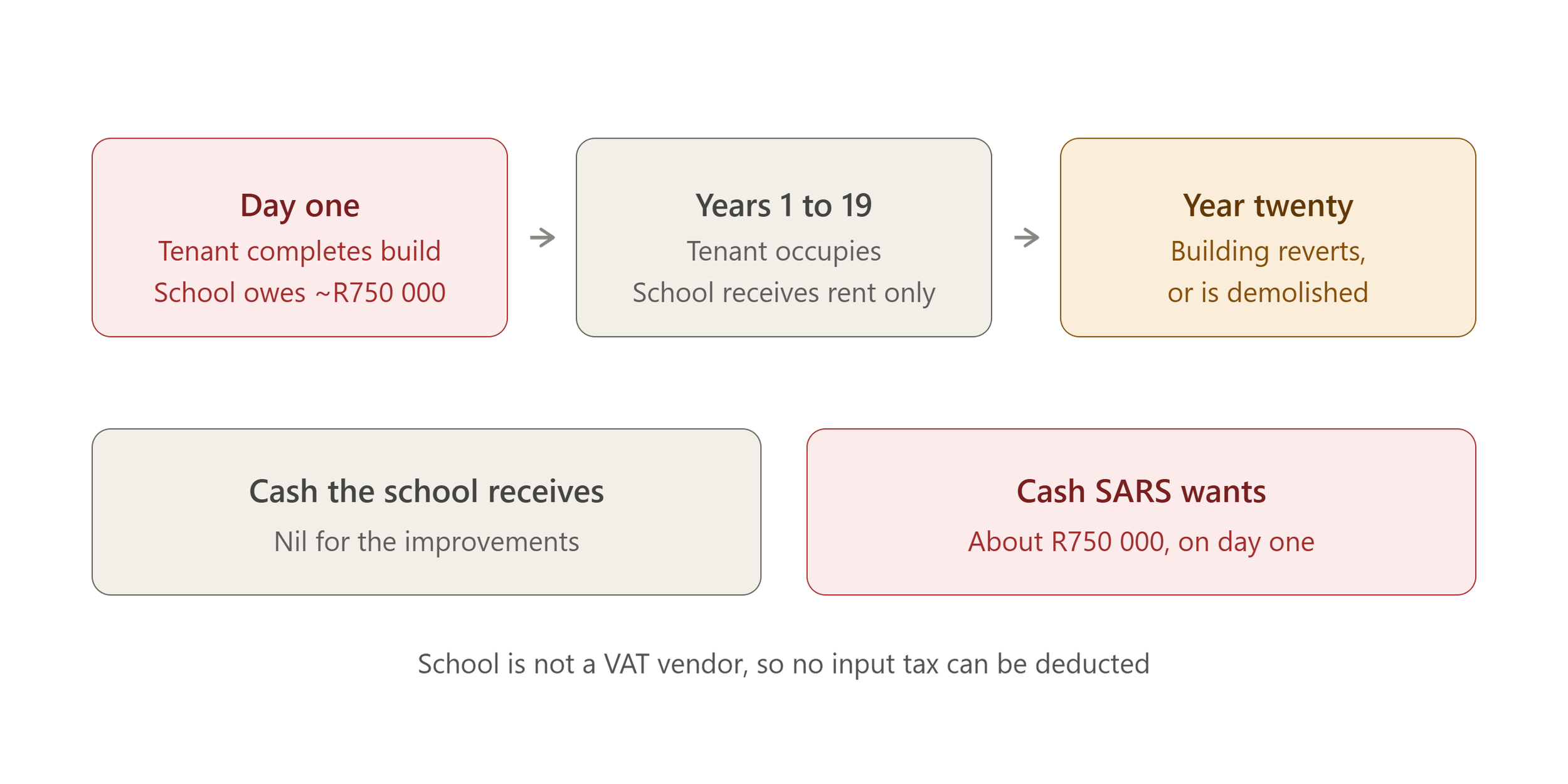
The school receives no cash as it cannot claim input tax. It will not use that building for twenty years, and if the lease says the tenant must demolish it at the end, the school never uses it at all.
Worse, the draft says the non-vendor must complete and keep a form. It does not say they must submit it, pay anything, or by when. There is no assessment, no objection, no appeal. A person outside the VAT system gets a tax bill with no way to pay it and no way to argue.
CIBA asked for four things:
A complete rule for non-vendors
An exclusion for schools
Relief where the value exceeds what
The landlord actually gets, and payment by instalment.
Backdating that catches your clients
Two proposals take effect from 25 February 2026, being Budget day, even though the Bills were only published on 30 July.
The first removes the donations tax exemption for a gift to a spouse who is not a South African tax resident. So a client who donated to their spouse in March 2026 had to submit an IT144 and pay by end April, under a law nobody had seen.
The second is the provisional tax one. A new rule says your estimate is deemed to equal what you actually paid, or nil if you paid nothing. Fair enough in principle, because some taxpayers were filing an accurate IRP6 and simply not paying, wearing the 10% late payment penalty instead of the 20% underestimation one.
But a February year-end taxpayer had their second payment due on 28 February 2026. Three days after the rule supposedly started. Five months before anyone could read it.
CIBA's position on both: announcing something in the Budget is not the same as passing it.
The penalty trap nobody can escape
This is the detail that should make you sit up.
Paragraph 20(2) lets SARS remit an underestimation penalty if the estimate was seriously calculated. That test is about the quality of the estimate.
But the new rule triggers the penalty on the timing of the payment. So your client whose estimate was perfect and whose payment was one day late cannot use paragraph 20(2), because there was nothing wrong with the estimate.
Chapter 15 of the Tax Administration Act does not save them either. Remission needs a first incidence, meaning no penalty in the previous 36 months, and an amount under R2,000. A group with several VAT and PAYE numbers that picked up a R250 penalty two years ago is locked out, no matter how big the current penalty is.
CIBA asked for a 10 business day grace period where the delay was outside the taxpayer's control, and for the remission grounds to be widened.
The other three, quickly
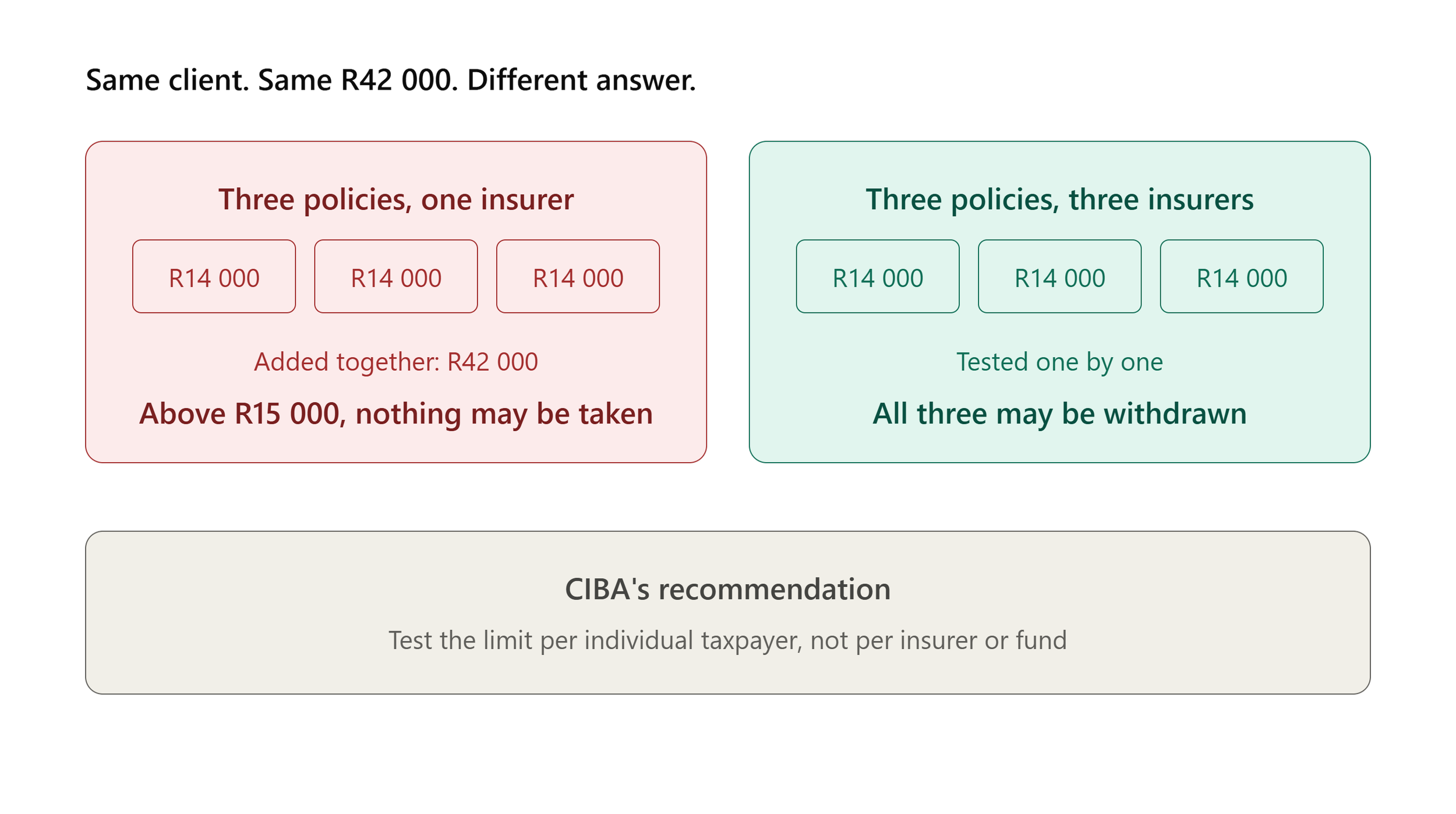
Small retirement policies. A client with three R14,000 retirement annuity policies can cash all three if they sit with three different insurers, and none if they sit with one. Same person, same savings, different answer. CIBA said test the limit per taxpayer, not per insurer.
Turnover tax, quietly good news. Micro businesses no longer need a February year end, and can register any time before the year of assessment ends instead of within two months of starting up. Two traps that catch new business owners gone. CIBA supported both.
Collection period cut. The window before SARS takes collection steps after refusing a remission request drops from 21 business days to 10. Treasury says it is for consistency with section 164. CIBA said consistency works just as well by extending section 164 to 21 days.
What to do on Monday
Check your provisional tax clients with February year ends. If any submitted an accurate IRP6 for the 2026 year and paid late, flag the file now. If this proviso passes as drafted, they are exposed to 20% on top of the 10% they have already paid, and the usual remission argument will not work.
Then check any school, church, body corporate or welfare organisation on your books that leases out property. If a tenant is building anything, get the lease out and look at who owns the improvements and when. From 1 April 2027, that could be a VAT bill with no cash behind it.
Neither of these is billable panic work. Both are the kind of call that turns you from the person who files returns into the person the client phones first.
Join CIBA and enjoy free tax webinars. For more go go the cpd@myciba.org website and browse the tax webinar selection here.




Trending