Construction VAT: Why It Never Matches Revenue, and the Mistake SARS Waits For
This article will count 0.25 units (15 minutes) of unverifiable CPD. Remember to log these units under your membership profile.
You have a builder on your books. Every month someone in your practice takes his revenue figure, raises the output VAT on it, and files the VAT201. It feels right. It is how you handle every other client.
For a construction client it is wrong, and it is the exact error a SARS auditor is trained to find. It can cost your client cash he needed on site, and it can cost you a client, or a professional liability headache, when the assessment lands.
Whether you capture the return yourself or review it for a team, the fix is the same, and once you have it you are doing something most practices in this country get wrong. That is not admin. That is advisory you charge for
Why the VAT does not match the revenue (and why that is correct)
Every contract runs two clocks, and they are not meant to agree.
The first clock is the accounts. Section 23 of IFRS for SMEs recognises contract revenue as the work is done, spread across the months of the job, based on progress the accountant or quantity surveyor measures. That figure answers one question: how much has the contractor earned so far. It says nothing about VAT.
The second clock is section 9(3)(b) of the VAT Act. Construction is treated as a progressive supply, so each stage is deemed supplied at the earlier of the date the progress payment becomes due, is received, or is invoiced. A progress payment only becomes due once the work is certified. So the payment certificate is the trigger: output VAT falls due when the claim is certified or the money comes in, whatever the accounts show that month.
So the two numbers pull apart. You might see R1.6 million of revenue in a month the certificate was R2 million, or R2 million of revenue in a month with no certificate at all. File your output VAT off the revenue journal and you declare tax in months nothing was certified, and under-declare in the months it was. SARS matches VAT to certificates and invoices, not to the income statement. That gap is the first thing an audit tests.
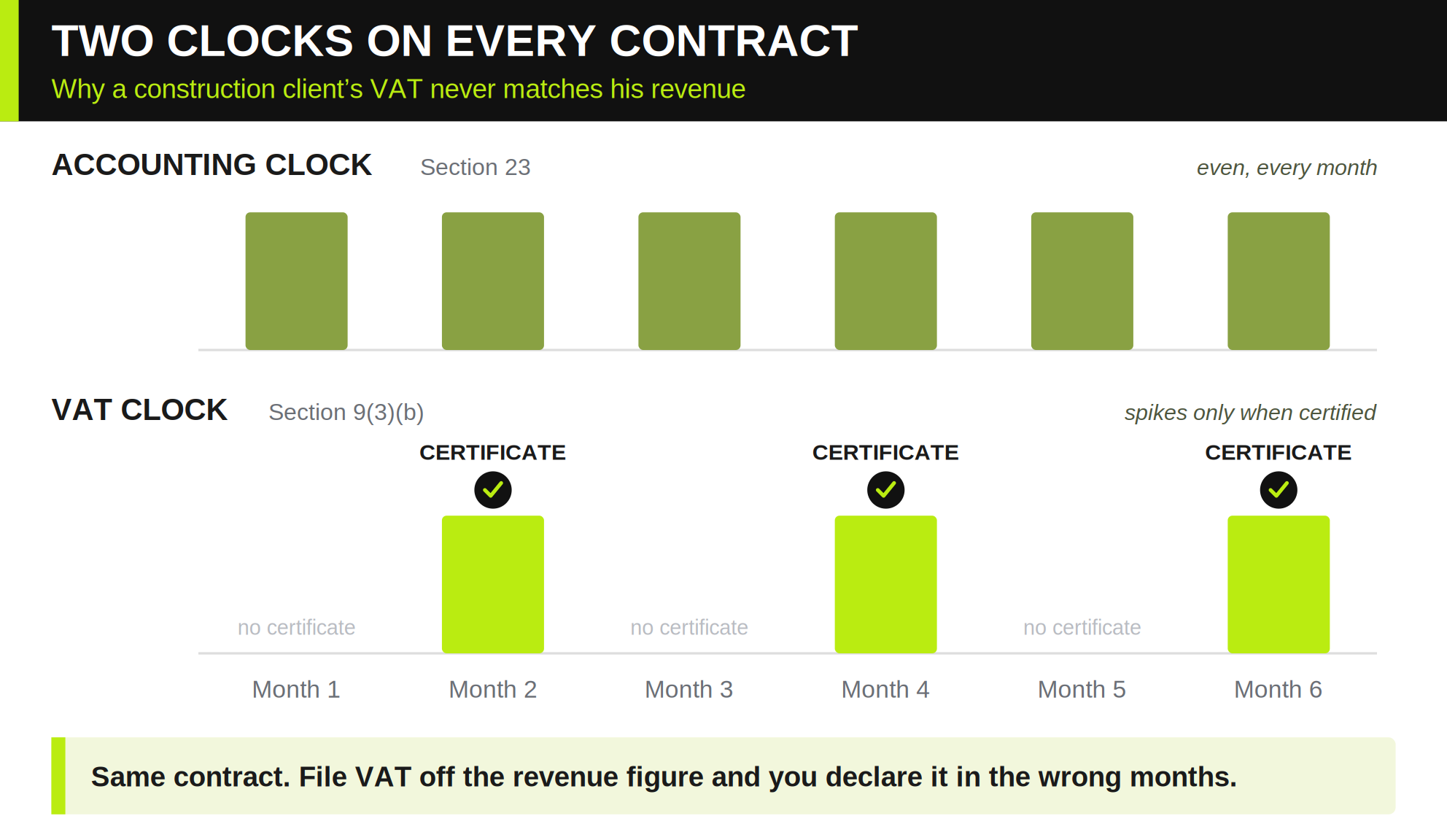
Figure 1. The accounting clock spreads revenue evenly; the VAT clock fires only when a certificate is issued. The two never line up.
The retention rule that keeps your client’s cash where it belongs
Now the part that puts money back in your client’s pocket, if the practice gets it right.
Take a R2 million certificate on a contract with 10% retention. The client holds back R200,000 as security until the job is signed off and defects are fixed, and pays R1.8 million now. The retention is not lost, it is money your client collects later, so it sits on the balance sheet as retention receivable.
Here construction hands the contractor a rule in his favour, and most practices throw it away by accident. Output VAT on the retained portion is deferred. The SARS VAT 409 Guide is clear: the contractor accounts for output tax on retention only at the earlier of the date he invoices the retention, the date it becomes due, or the date it is paid. Not before.
So you raise VAT on the R1.8 million now, which is R270,000. The R30,000 on the retention waits, sometimes many months, until the retention is invoiced or falls due. Declare that R30,000 now and you have paid SARS early on money your client has not received, and drained cash off a site that needed it. Across several contracts and several months, the number stops being small.
Retention runs both ways. Your client withholds it from his own subcontractors too, and the input VAT on that retained slice follows the same clock: you claim it when the retention becomes payable, not when the subcontractor first invoices. Same rule, opposite direction. Getting both sides right is exactly what a contractor will pay a premium to have handled properly.
The refund months are your client’s money, not a red flag
Output VAT is half the return. Your client spends hard and early: materials before they are built in, subcontractor certificates, plant hire, guarantee and bond fees. Each one carries input VAT that can be claimed, as long as the practice holds a valid tax invoice.
Because the money goes out before the certificates come in, some months the input VAT beats the output VAT and the VAT201 is a refund. For most small clients that rings an alarm. In construction it is normal, and it is your client’s money. Declare output only when it is certified, claim input promptly on valid invoices, and do not flinch when the return swings to a refund.
Two paperwork points decide whether those claims survive a review. The invoice must be a valid tax invoice in your client’s name, not the foreman’s, not a delivery note, not a statement. And watch the categories SARS treats differently: its update to the evidence needed for zero-rating supplies shows how hard the proof is now checked. A client with any zero-rated work needs the documentation SARS specifies, within its deadline, or the claim falls away.
Before any of this, check the registration itself. With the compulsory threshold now at R2.3 million, a smaller contractor near the line needs a real decision on whether to stay registered, weighed against the input VAT he claims on plant and materials. If he is registering for the first time, the PAYE and VAT registration traps are worth clearing first.
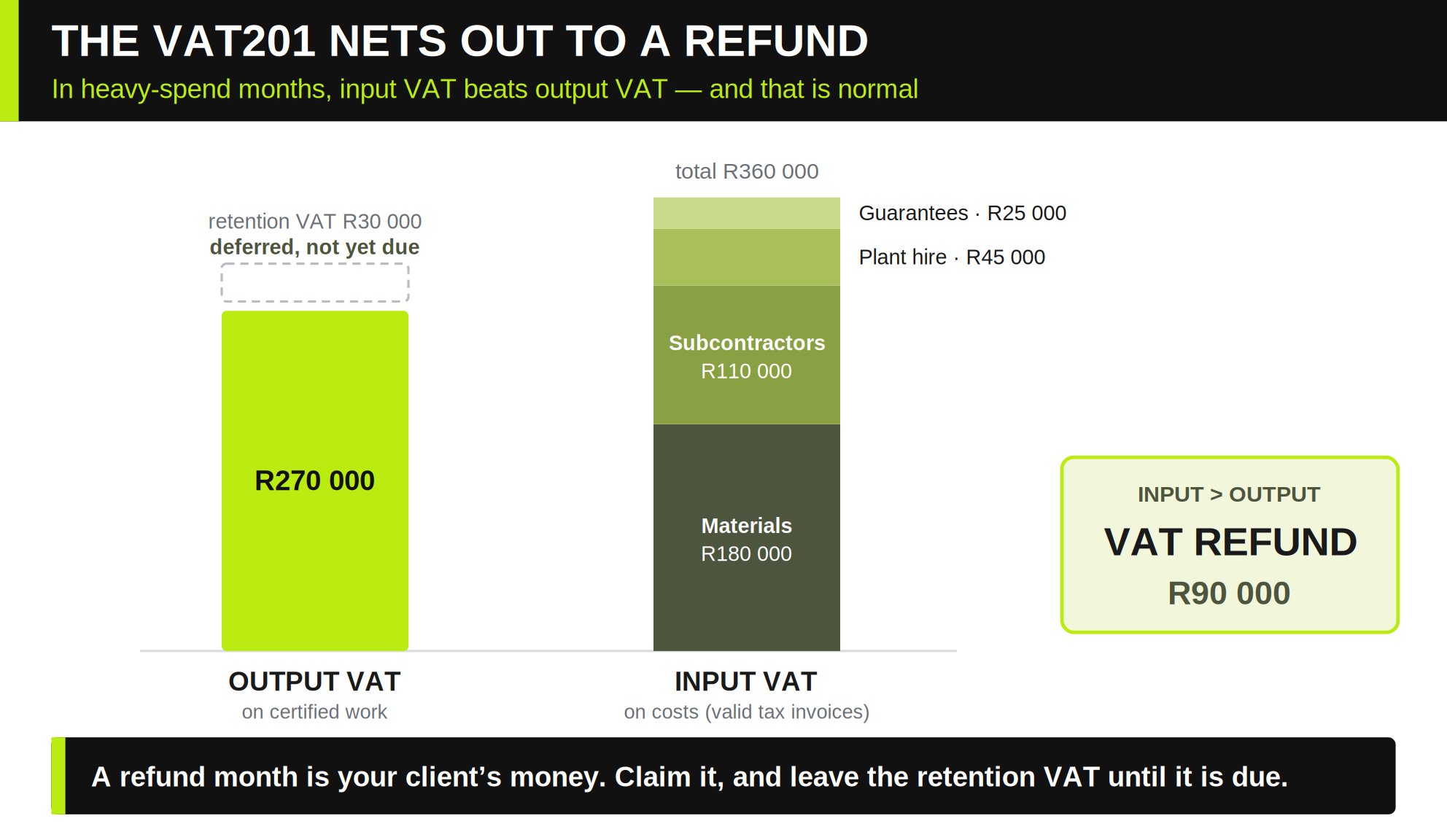
Figure 2. In a heavy-spend month, input VAT on costs outweighs output VAT on certified work, so the VAT201 is a refund. The retention VAT stays deferred
The gap widens in 2027. Get ahead of it now.
There is a change coming, and it makes this matter more. The third edition of IFRS for SMEs, issued in February 2025, rewrites Section 23 into a simplified five-step model, effective for periods beginning on or after 1 January 2027, with early adoption allowed. It changes how and when the accounts recognise contract revenue.
It does not touch section 9 of the VAT Act. The VAT clock keeps running off the certificate exactly as before. So from 2027 the revenue figure moves onto a new basis while the VAT figure stays put, and the distance between them grows. Any practice still filing VAT off the revenue journal gets more wrong, not less. Build the habit now: reconcile the VAT201 to certificates every month, and treat the revenue figure as a separate number answering a separate question.
Steps to get this right in your practice
Knowing the rule is one thing. Building it into how the practice runs, so it holds whether the file is done by a junior or reviewed by you, is what protects the client and lets you charge for it. Six steps:
Reconcile the VAT201 to certificates, not the ledger. Change the working paper so output VAT is built up from the payment certificates issued that month, and the revenue figure sits alongside as a separate check. The two will differ. That is the point.
Build a retention register. One schedule per client: retention receivable from customers and retention payable to subcontractors, each with a deferred-VAT column, released only when the retention is invoiced or falls due. Split it current and non-current for the year-end.
Tighten the input-VAT checklist. Valid tax invoice in the client’s name, the 90-day rule for any zero-rated work, and prompt claiming so refund months come through when they should. Make it a standing checklist, not a memory test.
Review the last six to twelve months for exposure. Pull recent returns and check whether output VAT was raised off certificates or revenue, and whether retention VAT was declared early. Where the exposure is material, correct the prior returns through the proper channel. That call sits with the practitioner or reviewing accountant, not the person who captured the entry.
Set the review gate and train the team. Add a construction-VAT review step before submission, and give junior staff the one rule that prevents most of the damage: output VAT follows the certificate, never the revenue journal.
Have the client conversation, and price it. Explain the timing to the contractor in plain terms, position it as construction VAT advisory rather than routine capture, and charge for the review and the register. A client who understands why his VAT and revenue differ is a client who values the work.
Package this into a priced service
The firms that earn well from construction clients do not bury this work in a flat monthly fee. They name it, scope it, and price it for the expertise it takes. Explain the timing and the risk to the contractor once, and the ongoing work becomes something he values rather than a line he queries.
Three ways to package it in your firm:
✅ A monthly construction VAT service. The VAT201 reconciled to certificates, the retention register maintained, and input VAT claimed on time so refund months come through. Price it as a retainer above your standard bookkeeping rate, because it carries audit risk your other clients do not.
✅ A construction VAT health check. A one-off review of the last six to twelve months for exposure, with a written plan to correct anything that is wrong. Fixed fee, and the easiest way to win the monthly work that follows.
✅ A quarterly advisory session. Sit with the contractor on deferred-VAT timing, refund forecasting and the cash flow around retention. This is the layer where a firm charges like an adviser rather than a processor.
A contractor who understands why his VAT and his revenue differ is a client who values the work, and pays for it. That is the difference between capturing his invoices and advising his business.
👉 Join CIBA and we will show you how to turn construction VAT into a service clients pay more for.
To get more information on construction accounting for bookkeepers please enroll in the Construction Accounting for Bookkeepers short learning programme





Trending