Most clients only discover how their retirement money is taxed on the day the tax directive comes back. By then it is too late to fix anything.
The rules are not complicated. The problem is that they sit in five different places:
The deduction on the contributions to the funds
The withdrawal before retirement
The savings component
The lump sum at retirement, and
The annuity income afterwards.
Each one has its own table, its own directive form, and its own trap. Below is the practical map, the numbers that apply for 2026/27, and the mistakes that keep landing practitioners in trouble.
1. Money going in: the deduction changed this year
What clients can claim for retirement contributions
Money paid into a pension, provident or retirement annuity fund is deductible under section 11F of the Income Tax Act 58 of 1962. It does not matter which of the three funds it goes into, or how many. They all fall under one combined limit. The limit works as a two-step test, and the client gets whichever is lower.
Step one: 27.5%. Take the client's remuneration, take their taxable income, use whichever is bigger, and multiply by 27.5%.
Why the choice of two figures? Because a salaried employee is measured on their salary, while someone with rental income, freelance work or a business would be short-changed if only salary counted. Using the greater of the two makes sure the deduction reflects everything the client actually earns.
Step two: the rand ceiling. Whatever step one produces, the deduction cannot exceed the annual cap. From 1 March 2026 that cap is R430,000, up from R350,000. It had been stuck at R350,000 since 2016, so this is the first movement in ten years.
In practice, the cap only bites once income passes roughly R1.56 million, because 27.5% of that already reaches R430,000. Below that level, the 27.5% figure is the real constraint.
Nothing is wasted. A client can contribute more than the limit. The excess is simply not deductible this year. It carries forward to the next year, and if it is still unused when they retire, it reduces the taxable portion of their lump sum or their annuity income under section 10C. This is the part most often forgotten, sometimes a decade later.
Two figures to exclude when doing the sums. Retirement fund lump sums and severance benefits do not form part of the income used in the calculation. Neither does a taxable capital gain when you test against the cap.
Two things practitioners must remember:
Employer contributions are a taxable fringe benefit in the employee's hands first, then treated as contributed by the employee. Payroll must show both sides.
Contributions above the cap are not lost. They carry forward and can be set off later under section 10C or against a lump sum. This is the deduction most often forgotten when a client retires years later.
Where this earns you money: clients in construction, transport and retail often have variable income and irregular contributions. Timing an additional RA contribution before year end is advisory work you can charge for, not admin.
2. Money growing inside the fund
Retirement funds generally do not pay income tax, capital gains tax or dividends tax on investment growth. This is the real benefit and it is worth explaining to clients who only see the deduction.
3. Taking money out before retirement
This is where the damage happens.
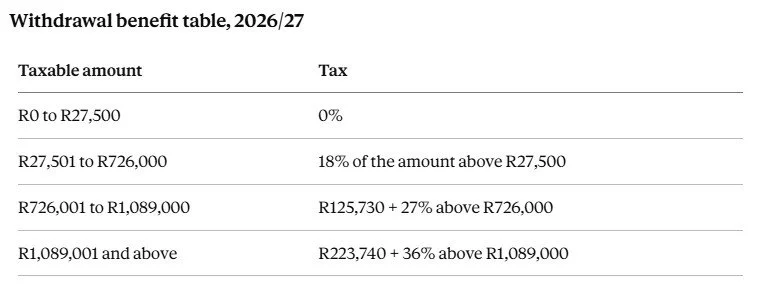
The R27,500 is a lifetime amount, not an annual one. Every retirement fund lump sum and taxable severance benefit received since 1 October 2007 is added together to find the rate. Credit is given for tax already paid, but the tax free slice is granted once in a lifetime. A client who took R400,000 on resignation in 2015 does not start again at zero in 2026. They start at R400,000.
4. The savings component withdrawal: a different tax method entirely
Savings component withdrawals are not taxed using the retirement fund lump sum tax tables. Instead, SARS issues a tax directive requiring the fund to withhold tax at an estimated rate based on the information available at the time of the withdrawal. The amount withdrawn is then included in the taxpayer's taxable income for the year of assessment and taxed at their marginal rate when their annual income tax return is assessed. As a result, the final tax liability may differ from the amount initially withheld. The IRP5 source code for these withdrawals is 3926.
The key rules are:
One withdrawal per retirement fund per tax year
Minimum withdrawal amount: R2,000
Seed capital was 10% of the vested component as at 31 August 2024, subject to a maximum of R30,000.
The biggest problem taxpayers face right now: the fund applies a directive rate based on the income SARS can see. Where the client has rental income, a second job, freelance work or investment income, the directive can under-deduct. The shortfall appears on assessment and may result in additional tax and, if not paid on time, interest.
Clients do not connect the two events. They took R25,000 out in October and now they owe SARS in July. You get the call.
Practical fix: check every client's savings withdrawals before you file, and warn clients in advance to hold back roughly the difference between the directive rate and their real marginal rate.
The Taxation Laws Amendment Act gazetted on 1 April 2026 cleaned up several two-pot anomalies, including access to the savings component on resignation where a withdrawal has already been taken in the same tax year. Check the current position before advising, because the industry guidance from 2024 is now out of date.
5. At retirement
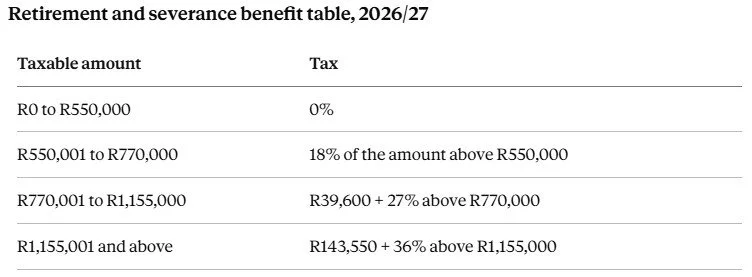
Qualifying severance benefits and retirement fund lump sums use this table below is the retirement and severance benefit table, which applies whenever a client permanently exits a fund at the end of their working life, whether they retire by choice, retire early through ill health, or are retrenched.
How much can be taken in cash?
The vested component generally continues to be governed by the pre-two-pot rules, while the savings and retirement components are subject to the two-pot retirement system introduced on 1 September 2024.
The savings component may be taken in cash
The retirement component must be annuitised
One third of the non-vested portion of the vested component may be taken in cash.
Small pots: when a client can take the whole thing in cash
The normal rule: hen a client retires, they cannot take all their retirement money as cash. Most of it has to buy a monthly pension, called an annuity. Only part of it can be taken as a lump sum.
The exception. If the amount is small, forcing the client to buy a monthly pension makes no sense. The pension would be tiny and the admin costs would eat it. So the law lets them take the lot in cash. This exception is called the de minimis, which just means "too small to bother with".
What changed. On 1 March 2026 the threshold went up from R247,500 to R360,000. More clients now qualify to take everything in cash.
Normally a retiring client cannot take all their retirement money as cash. Most of it has to buy a monthly pension, called an annuity.
The exception is for small amounts, where a monthly pension would be tiny and the admin costs would eat it. The law calls this the de minimis, which just means too small to bother with. On 1 March 2026 the threshold rose from R247,500 to R360,000, so more clients now qualify.
You will see two numbers quoted, R360,000 and R240,000. Both are correct. R360,000 measures the whole benefit. R240,000 measures only the part that would otherwise have to buy a pension, and it is two thirds of R360,000.
Use the R240,000 test, because it is the one SARS applies. Add two thirds of the non-vested part of the vested component to the full value of the retirement component. If that comes to R240,000 or less, the client can take everything in cash.
The R360,000 shortcut can mislead you, because the retirement component counts in full rather than at two thirds. A client can sit below R360,000 in total and still be forced to annuitise.
Cashing in a small living annuity
A client already drawing a living annuity can sometimes stop the payments and take the balance as cash. That is commutation, and it is only allowed once the value drops below the threshold, which rose from R125,000 to R150,000 on 1 March 2026.
The catch is that the test applies per insurer, not per policy. Two living annuities of R100,000 with the same insurer come to R200,000, so neither can be commuted. Split across two insurers, both would qualify. And commutation is only for living annuities. A guaranteed life annuity cannot be commuted at any value.
6. The income years
Annuity income is normal taxable income at the pensioner's marginal rate. Living annuity or guaranteed life annuity, the tax treatment is the same. Only the flexibility differs.
The recurring problem: a pensioner with two or three income sources has PAYE deducted correctly by each payer and still owes SARS at assessment, because no single payer sees the total. Ask SARS to apply a higher fixed PAYE rate rather than letting the client absorb an annual shortfall.
The problems that come up most often
Aggregation is ignored.
Advising on a withdrawal without first establishing the lifetime total since October 2007 produces the wrong answer every time.
Section 10C is missed.
Disallowed contributions built up over years are not claimed against the lump sum or the annuity income. This is real money left with SARS.
Directive and IRP5 do not match.
The information on the IRP5 or IT3(a) must correspond with the directive application. Mismatches cause reconciliation failures and delayed refunds.
Quotes are treated as directives.
Simulations and quotes are not stored on SARS systems, so the call centre cannot help with queries about them. Only the actual directive counts.
The IT88 surprise.
Where the client has outstanding tax debt, SARS can attach a third party appointment to the directive and the fund must pay that amount over. The client receives less than expected and blames the accountant.
Old thresholds used.
The R350,000 cap, the R247,500 de minimis and the R125,000 commutation figure are all out of date from 1 March 2026.
No directive applied for.
A tax directive is required for every lump sum benefit, whatever the amount.
SARS guides worth keeping open
These are the documents to work from rather than relying on fund administrator summaries:
LAPD-IT-G03, Guide on the Calculation of the Tax Payable on Lump Sum Benefits. The core reference. Worked examples, aggregation rules and the tax tables in an annexure.
IT-AE-41-G02, Guide to Complete the Tax Directive Application Forms. Covers Form A&D and Form B for pension and provident funds, Form C for retirement annuity funds, and Form E for after retirement and death annuity commutations.
Completion Guide for IRP3(a) and IRP3(s) Forms. The IRP3(a) now covers gratuities and two-pot savings withdrawal benefits. Note that the policy number is mandatory on savings withdrawal benefit applications.
Completion Guide for IRP3(q) Directives. Use this for a variation in the withholding of employees' tax, which is the practical answer to the multiple income source problem.
Guide to the Tax Directive Functionality on eFiling. For hardship and fixed amount applications, which only a taxpayer or their tax practitioner can submit.
SARS Tax and Retirement page and the Retirement Lump Sum Benefits rates page. Fastest way to confirm current tables and thresholds.
SARS Budget 2026 Frequently Asked Questions. Confirms the 2026/27 figures, including that the lump sum tables themselves did not change.
Your pre-advice checklist
Confirm the lifetime aggregate of lump sums since 1 October 2007
Check for savings component withdrawals already taken this tax year
Compare the directive rate against the client's real marginal rate
Look for disallowed contributions available under section 10C
Confirm which component the money is coming from before quoting a tax number
Check for outstanding SARS debt that could trigger a third party appointment
Verify the threshold you are using against the current SARS page, not last year's notes
Retirement decisions are irreversible. A client who withdraws in the wrong year, from the wrong component, without checking their aggregate, cannot undo it.
That makes this one of the few areas where getting the advice right is visibly worth paying for. Price it accordingly.
Figures reflect the 2026/27 year of assessment, 1 March 2026 to 28 February 2027. Confirm current thresholds on the SARS website before advising, and consider CIBA CPD on retirement fund taxation to keep your team current.
Read more in the SARS Guide on the calculation of the tax payable on lump sum benefits and visit the Retirement Lump Sum Benefits website.
Frequently asked questions
What is the retirement contribution deduction limit for 2026/27?
27.5% of the greater of remuneration or taxable income, capped at R430,000 a year from 1 March 2026. The cap was R350,000 from 2016 until February 2026.
What happens to contributions above the limit?
They are not lost. The excess carries forward to later years, and anything still unused at retirement reduces the taxable part of the lump sum or annuity income.
Do employer contributions count?
Yes. They are a taxable fringe benefit for the employee first, and are then treated as contributions made by the employee for the deduction.
Do retirement funds pay tax on investment growth?
Generally not. Funds do not pay income tax, capital gains tax or dividends tax on their investment returns.
Related reading
👉 Join CIBA and get the compliance knowledge, CPD, and professional recognition to turn changes like these into value for your clients.




Trending