The Biggest Trust Tax Myth: Trusts Don't Save Tax. You, as a Tax Practitioner Do.
This article will count 0.25 units (15 minutes) of unverifiable CPD. Remember to log these units under your membership profile.
It is February. A client walks in convinced their family trust is a tax shelter. You open the file and find a trust that has quietly paid 45% on every rand it earned, because nobody signed a resolution before year-end. That is not a tax structure. That is a tax penalty with a fancy name.
Here is the truth most clients never hear: a trust does not save tax on its own. The person who saves the tax is the accountant who understands three things and gets the timing right. Those three things are:
The conduit principle
Section 7C, and
How capital gains are taxed.
Get them right and you protect your client and earn a fee worth charging for. Get them wrong and SARS sends the bill to your client, and the blame to you. Let us look each of these in more detail.
The Conduit Principle: Income Flows Through, or It Gets Stuck
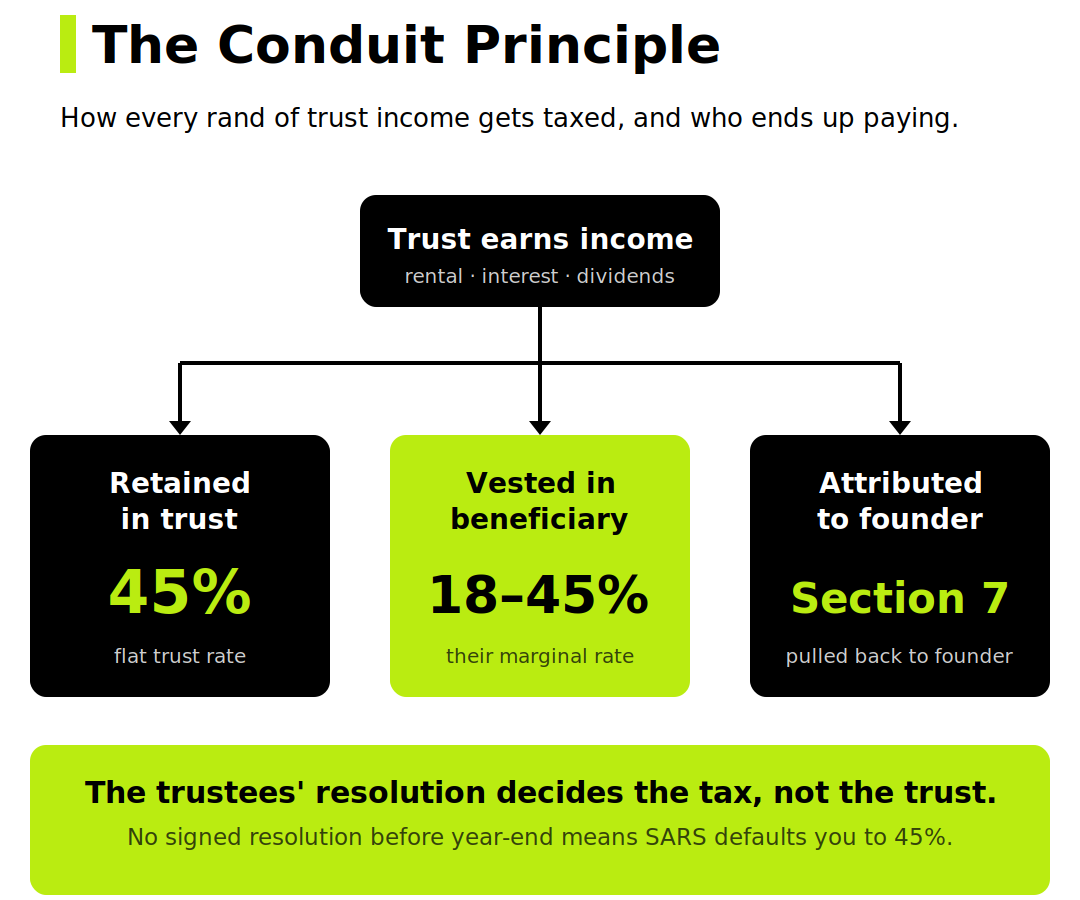
A trust is a pipe, not a bucket. Income flowing through the pipe can end up taxed in one of three places, and the trustees decide which one before the tax year closes.
If the trustees keep the income in the trust and do not vest it in anyone, the trust pays tax at a flat 45%. That is the "stuck" outcome, and it is the most expensive.
If the trustees vest the income in a beneficiary, the income flows through to that beneficiary and is taxed in their hands at their marginal rate, anywhere from 18% to 45%. This is Section 25B of the Income Tax Act doing its work. The income even keeps its nature as it flows, so rental stays rental and dividends stay dividends.
If the founder gave the assets away by donation or by an interest-free loan and still pulls the strings, Section 7 can push the income straight back to the founder, no matter what the trustees decided.
Worked example: the R1 million rental trust
A family trust owns a block of flats and earns R1,000,000 in net rental for the year.
Keep it in the trust and the tax is R1,000,000 at 45%, which is R450,000.
Vest it in a beneficiary sitting on the 36% marginal bracket and the tax is R360,000. That is R90,000 saved on a single decision. Spread the same income across two or three adult beneficiaries in lower brackets and the saving grows again.
The catch is timing. Vesting must be backed by a signed trustee resolution dated before the trust's year-end. No resolution, and SARS treats the income as retained. That is a straight jump back to 45%. As SARS reminded practitioners when the 2025 trusts filing season opened, the ITR12T now demands trustee resolutions and financial statements as supporting documents, so a missing resolution is not a paperwork problem you can fix later. It is the difference between 36% and 45%.
Section 7C: The Interest-Free Loan That Taxes Your Client Every Year
Most family trusts were funded the same way. The founder sold or lent assets to the trust and left a big loan account sitting on the books, interest-free. It felt harmless. Section 7C makes sure it is not.
Section 7C is an anti-avoidance rule. When a natural person (or a company acting for them) lends money to a connected trust and charges no interest, or interest below the official rate, SARS treats the shortfall as a deemed donation on the last day of the tax year. That deemed donation attracts donations tax at 20%.
The number that drives this is the official rate of interest. It tracks the Reserve Bank repo rate plus one percentage point, so it moves. As of 1 June 2026 it sits at 8.00%. That figure matters, because it is the rate you multiply the loan by every single year the loan stays interest-free. When SARS last adjusted the official rate, the whole Section 7C calculation moved with it, so always work off the current rate, not last year's.
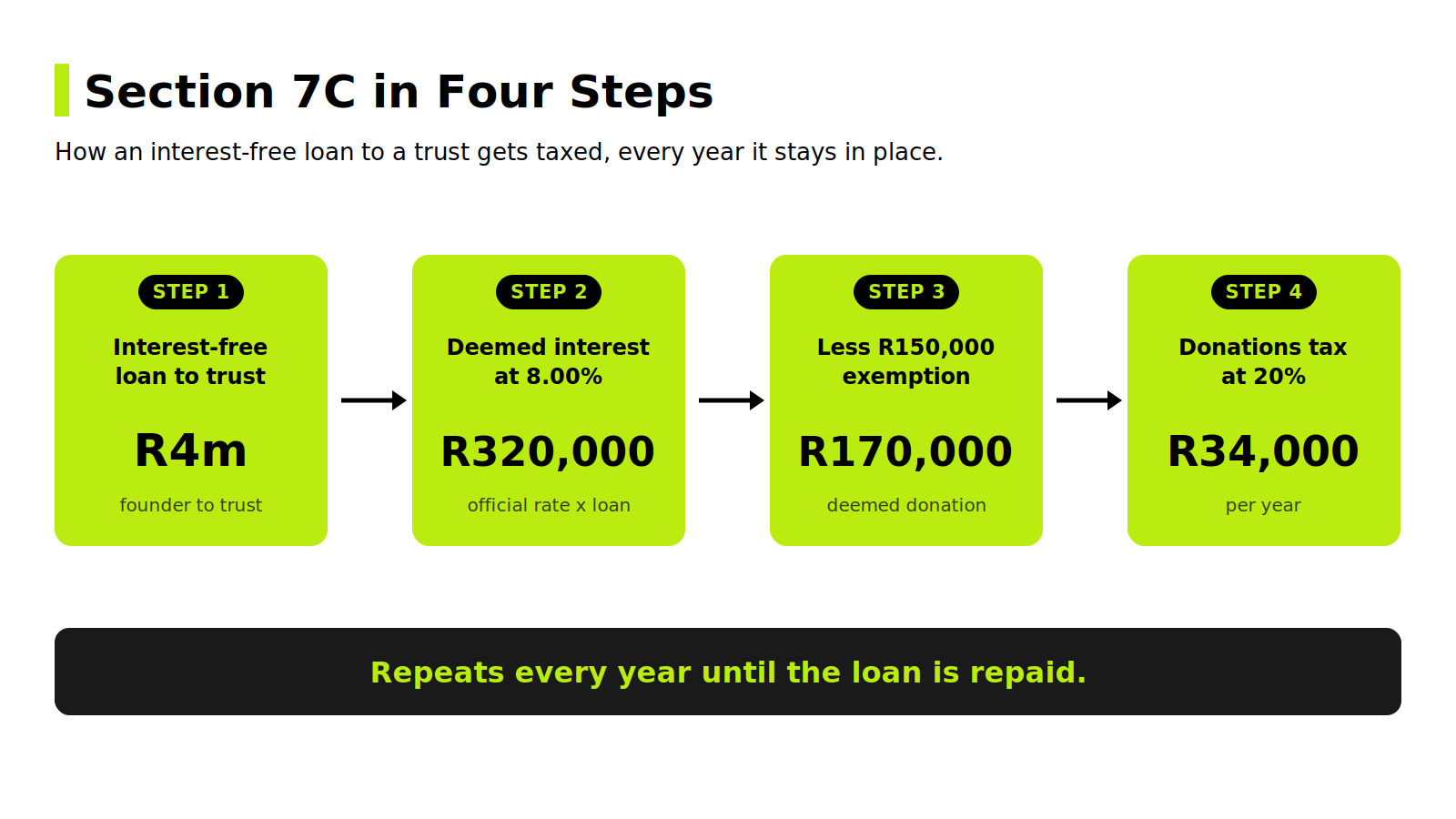
Example 1: the R4 million loan
A founder lent R4,000,000 to his family trust, interest-free.
Deemed interest at the 8.00% official rate is R320,000.
Subtract the R150,000 annual donations exemption, raised from R100,000 in the 2026 Budget and effective from 1 March 2026, and the deemed donation is R170,000.
Donations tax at 20% is R34,000 for the year. And it repeats every year until the loan is reduced or the trust starts paying interest at the official rate.
Note: The R150,000 donations exemption is a single annual exemption that covers all of a person's donations in that tax year. If the founder also makes other donations in the same year, the full R150,000 may not be available to offset the Section 7C deemed donation, so the R34,000 is a best case.
Two practical fixes to offer the client. Either charge interest at the official rate, which stops the deemed donation but creates real interest income the founder must declare, or repay the loan down over time using distributions the beneficiaries lend back. Either way, the disclosure is not optional. The loan account movement must appear in both the financial statements and the ITR12T. This is the same trap that catches company loans, as our breakdown of the consequences of an interest-free loan to a director explains: the answer is almost always to charge the official rate rather than hope SARS does not notice.
Capital Gains: Where the Trust Rate Really Bites
Capital gains are where the flat 45% rate does the most damage, and where the conduit principle saves the most tax.
An ordinary trust includes 80% of a capital gain in taxable income. Applied to the 45% rate, that is an effective CGT rate of 36%.
An individual, or a special trust, includes only 40% of the gain. At a top marginal rate that is an effective rate of just 18%. Half.
So a capital gain that stays in the trust is taxed at up to 36%. The same gain vested in a beneficiary is taxed at up to 18% in their hands, and the beneficiary may also use their annual R50,000 CGT exclusion.
Example 2: the R1 million capital gain
The trust sells an asset and makes a R1,000,000 capital gain.
Taxed in the trust: 80% included is R800,000, taxed at 45%, which is R360,000.
Vested in an individual beneficiary at the top rate: 40% included is R400,000, taxed at 45%, which is R180,000. That is a R180,000 saving, again on a resolution and correct disclosure.
Note: One more warning for the property crowd. A trust does not get the primary residence exclusion, which the 2026 Budget raised to R3 million for individuals from 1 March 2026. Put the family home in a trust and you hand that R3 million back to SARS on the day it is sold. That single mistake can cost more than a decade of estate planning was meant to save.
The Practical Takeaway
You can act on this before your next trust year-end closes.
First, diarise every trust client's year-end and get the vesting resolutions signed before that date, not after. This one habit is the single biggest tax saver you control.
Second, run a Section 7C check on every founder loan. Multiply the loan by 8.00%, subtract the R150,000 exemption, and show the client the annual donations tax they are paying for doing nothing. Then fix it.
Third, before any trust asset is sold, decide who the gain vests in and put it in writing. The difference between 36% and 18% is a conversation you should be billing for.
None of this is aggressive tax planning. SARS has no problem with a trust reducing tax. What triggers audits is form without substance: a trust that holds assets on paper but has no resolutions, no minuted meetings, and loans that never move. Do the substance, keep the records, and the tax saving is simply the reward for competent work. That competent work is a service. Price it like one.
👉 Want to learn more? Join CIBA’s webinar on Trusts Are Not Simple: Financial Reporting That Gets Scrutinised and get all the details you need to know.
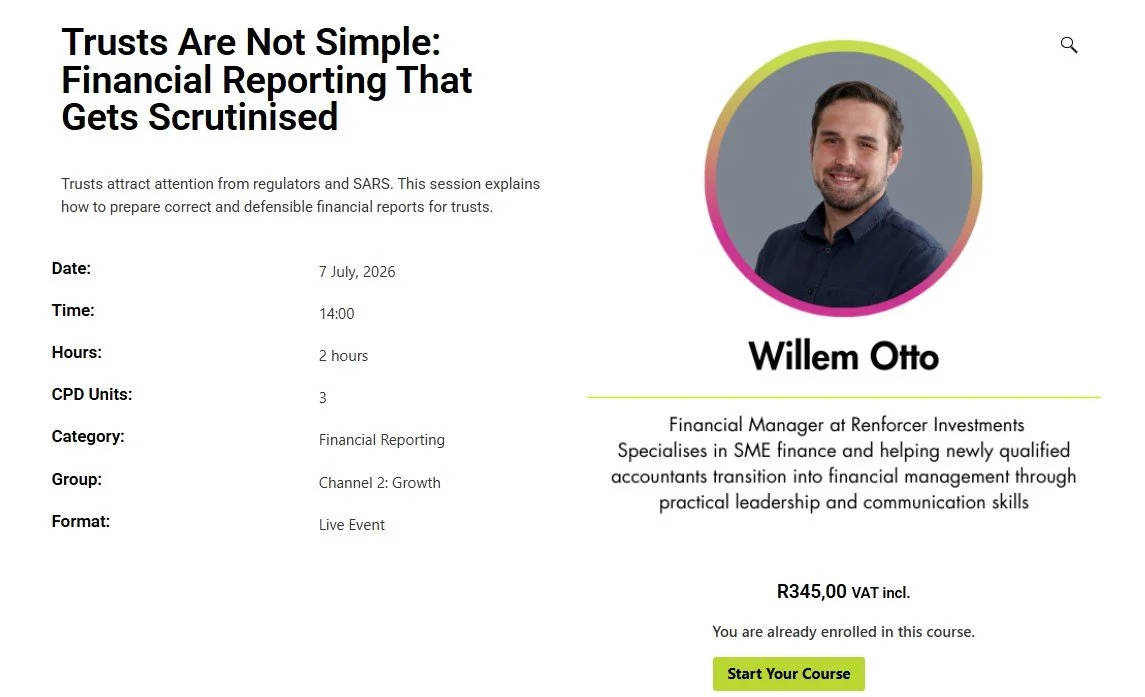
By attending this event, delegates will learn:
How trusts operate financially
Key financial reporting requirements for trusts
Common trust accounting errors
How beneficiaries affect reporting
How to present trust financial information correctly
Risk areas that attract scrutiny
How to protect yourself when working with trusts