This article will count 0.25 units (15 minutes) of unverifiable CPD. Remember to log these units under your membership profile.
From 1 April 2026, the VAT registration threshold increases from R1 million to R2.3 million. This means many businesses currently registered for VAT, with turnover between R1 million and R2.3 million, may now apply to deregister. For many SMEs, deregistration will reduce compliance costs and simplify operations. For others, it could quietly damage competitiveness or trigger a once-off VAT liability creating a new question:
Should the business stay registered, or deregister?
Just because a vendor can deregister does not mean they should. The decision has commercial and tax consequences that accountants need to consider carefully.
Below are the key issues to review before advising a client.
Understanding VAT Properly: A Tax on Value Added
VAT is a TAX on value added at each stage of the supply chain. In simple terms:
You charge VAT on your sales (output VAT).
You claim VAT on your business purchases (input VAT).
You pay SARS the difference.
That difference represents the value you added, effectively your profit margin layer. When a business deregisters:
It stops charging VAT
It stops claiming input VAT
VAT becomes a real cost on purchases, but you also saving 15% on your sales.
For some SMEs, this is beneficial. For others, it reduces competitiveness or creates hidden tax exposure. The decision must be strategic, not automatic.
Will Turnover Stay Below R2.3 Million?
The first question is the most obvious one. If a business is likely to grow above R2.3 million in the near future, deregistering now may create unnecessary disruption.
The business could end up deregistering this year and being forced to register again shortly afterwards. That means administrative effort, system changes, pricing adjustments, and potential confusion for customers.
Where growth is expected, remaining registered may be the more practical option.
Who Are the Customers and How Will They Be Impacted?
The customer base of the business plays a major role in the decision.
If customers are VAT-registered businesses, they claim input VAT on their purchases. If the supplier deregisters:
No VAT will appear on invoices
Customers cannot claim input VAT
This effectively increases the cost of the product or service to those customers. In some cases, the business may need to reduce prices to remain competitive.
If customers are individuals or non-VAT vendors, deregistration may actually help the business. Because no VAT is charged:
The business can reduce prices
Or increase margins
This is often the case in service businesses, such as consultants or small service providers.
Does the vendor supply zero-rated items?
Where a business supplies zero-rated goods or services, for example sells fresh vegetables or exports products, VAT is charged at 0%, but input VAT can still be claimed.
If the business deregisters it cannot claim input VAT any longer. This may make deregistration less beneficial.
Does the Vendor Regularly Claim Large Amounts of Input VAT?
VAT registration allows a business to claim back VAT on expenses and purchases. If a vendor regularly claims input VAT on:
✅Trading stock
✅Equipment
✅Machinery
✅Vehicles
✅Large operating costs,
Then deregistration means VAT becomes a real cost to the business. Accountants should compare:
⚖️Lost input VAT claims versus savings in compliance costs
For some businesses, deregistration saves administration. For others, it simply increases operating costs.
Do You Own Assets Where Input VAT Was Claimed?
This is one of the most important issues, and it is often overlooked. When a VAT vendor deregisters, SARS treats the business as if it sold certain assets on the day before deregistration. This is called a deemed supply.
In terms of this output VAT must be declared on the lower of:
The original cost of the asset, or
The current market value of the asset.
This rule applies to assets where input VAT was originally claimed, such as:
Trading stock
Vehicles
Machinery
Equipment
Furniture
Commercial property.
The result is that a once-off VAT liability may arise, even though the business has not actually sold anything and received no cash. This can be significant for businesses that hold:
Large amounts of stock
Vehicles or machinery
Commercial property.
Which Assets Will Trigger Output VAT on Deregistration?
Step 1: Review the Fixed Asset Register
Start with the list of assets the business owns. Consider typical items including:
🚗 Vehicles
🏭 Machinery
💻 Equipment / computers
🏢 Commercial property.Step 2: Confirm Where Input VAT Was Claimed
Check which assets originally had input VAT claimed from SARS. If no input VAT was claimed, the deemed supply rule generally does not apply.
Where input VAT was claimed, deregistration may trigger output VAT based on the lower of cost or market value.
Step 3: Include Trading Stock
Stock on hand is often forgotten.
At deregistration, trading stock is treated as if it were sold. VAT must therefore be declared on the value of the stock still held by the business.
For retailers and wholesalers, this amount can be substantial.
Step 4: Adjust for Apportionment
Some businesses only claimed part of the input VAT originally.
This happens where the business makes both:
Taxable supplies, and
Exempt supplies.
If only 60% of the input VAT was claimed, the deemed output VAT must also be adjusted accordingly. The VAT treatment on deregistration must match the original VAT claim percentage.
Step 5: Determine Defensible Market Values
When calculating the deemed supply, SARS requires reasonable and supportable values. Remember the rule - deemed output VAT is calculated on the lower of cost or market value.
Market value should reflect what a willing buyer would reasonably pay today. Possible valuation methods include:
Dealer quotes for vehicles or machinery
Comparable online resale listings
Adjusted insurance values
Independent professional valuations for property or high-value assets.
Keeping supporting evidence is important in case SARS queries the valuation.
The Real Question Is Not “Can We Deregister?”
The increase in the VAT threshold will allow many small businesses to leave the VAT system. For some businesses, deregistration will:
Reduce compliance costs
Simplify administration
Provide more pricing flexibility.
But for others, it may create:
Lost input VAT claims
Reduced competitiveness
A once-off VAT liability on assets.
The correct question is therefore not:
“Can the business deregister?”
The real question is:
“What will it cost to leave the VAT system?”
Join CIBA’s CPD event titled: Tax Changes You Must Understand Before the Budget Hits Your Clients and learn more about the impact of recent tax changes.
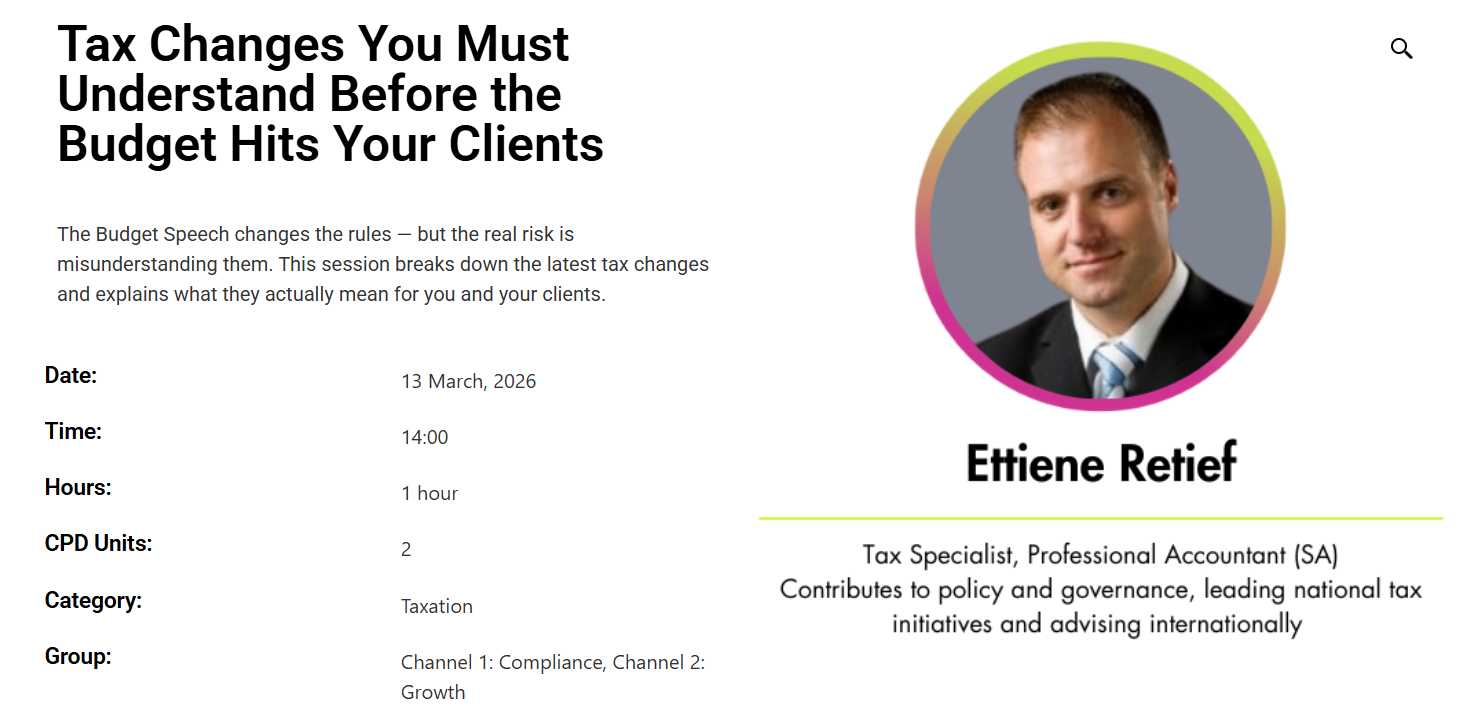
By attending this event, you will learn:
The key tax changes announced in the Budget Speech
Which changes take effect immediately and which do not
How the changes affect individuals and businesses
Practical implications for compliance and planning
Common misunderstandings that arise after the Budget
What to communicate to clients right away
How to prepare for follow-up changes and guidance.



Trending