This article will count 0.25 units (15 minutes) of unverifiable CPD. Remember to log these units under your membership profile.
Your client phones on a Tuesday. His biggest customer has just told him they are withholding 27% PAYE from next month's invoice, and he wants to know who gave them the right. The answer is the rule that has been sitting in the Fourth Schedule for years. He is a personal service provider, and nobody told him.
The structure everyone still sells
Practitioners often advice clients to register a Pty Ltd so they can invoice their ‘employers’ or ‘clients’ through the company. Pay 27% instead of 45%. Claim the car, the cellphone, the home office, the courses. It sounds clever, and it worked in the 1990s. However, after that the rules have changed. The Fourth Schedule now treats two kinds of entities as employees:
A labour broker is a natural person who, for reward, provides a client with other persons to render services or perform work, or procures such persons for the client, with those persons being remunerated by the labour broker.” SARS expressly distinguishes a labour broker from a company/CC/trust providing such services.
A personal service provider, or PSP, is a company or trust that sells the personal services of its own owner. If your client's company falls into that second box, the client paying the invoice must run it through payroll, and SARS strips out most of the company's deductions.
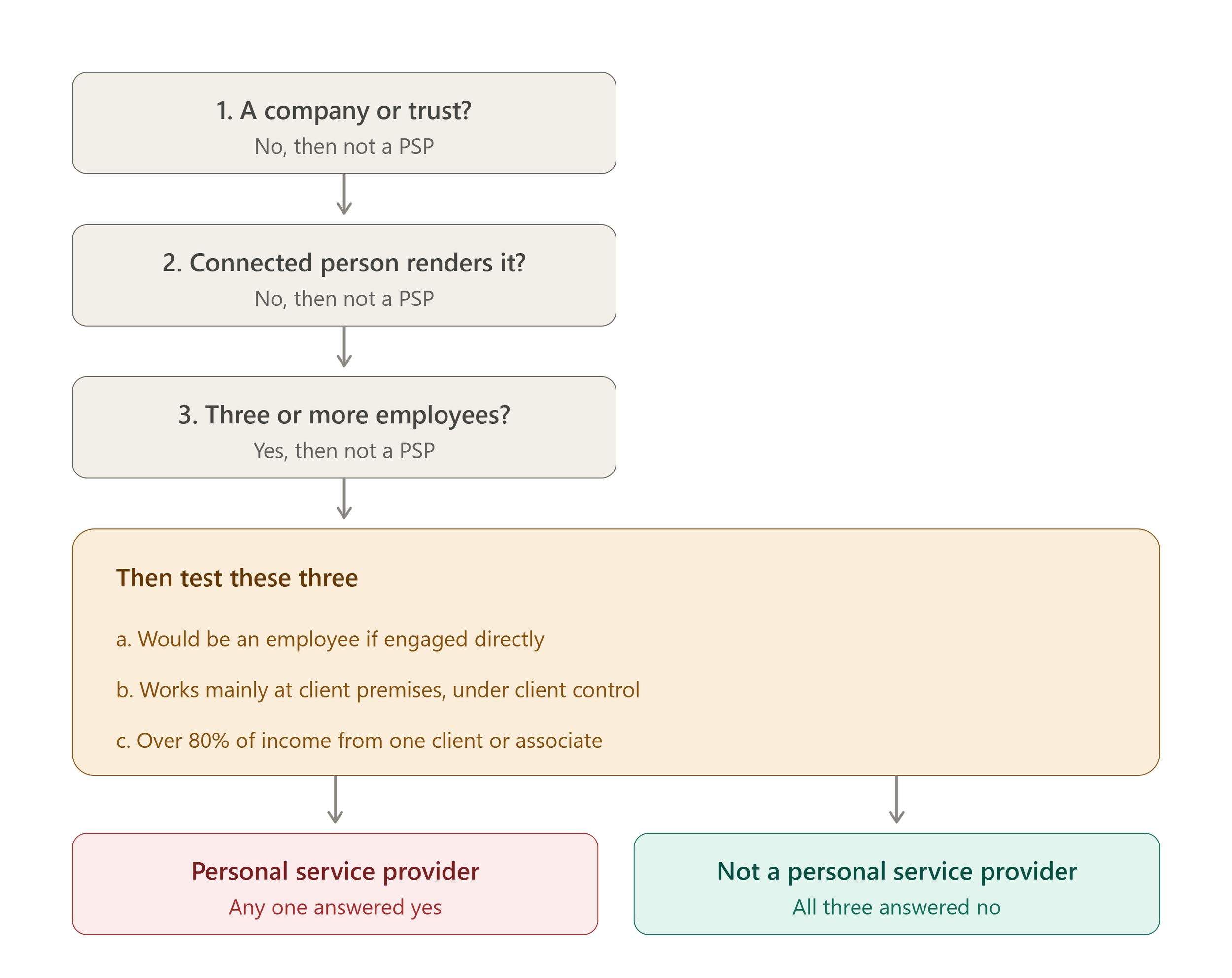
This is not a grey area. It is a definition with a decision tree, and SARS published the tree itself in Interpretation Note 35 (Issue 5).
Who is actually a personal service provider?
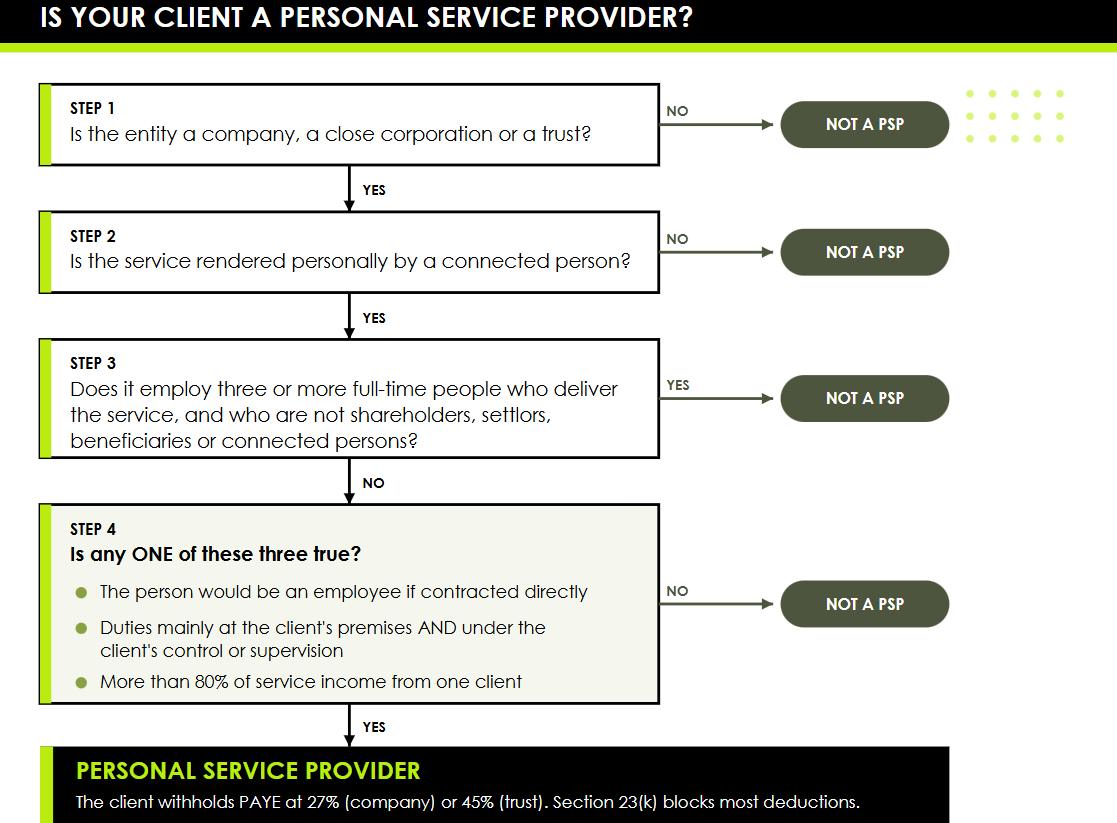
Work through four questions in order. You only reach the next one if the answer keeps you in.
Is the entity a company, a close corporation or a trust?
If your client trades in his own name, the PSP rules cannot touch him. He falls under the ordinary independent contractor tests instead, which we unpacked in our member query on independent contractors and deemed employees. SARS says this plainly at the end of Interpretation Note 35: the effect of the PSP rules can be eliminated by rendering the service directly as a natural person.
Is the service rendered personally by a connected person?
The owner, a family member, a beneficiary. If the person doing the work is connected to the entity, keep going.
Does the entity employ three or more full-time people who actually deliver the service?
This is the only real escape hatch, and it is narrower than most practitioners think. The three staff must be full-time, must be engaged throughout the year of assessment, and must not be shareholders, members, settlors, beneficiaries or connected persons in relation to any of those people. They must also be doing the service work. SARS is explicit that auxiliary staff such as cleaners do not count, because they do not enable service delivery. A receptionist is a hard sell. A spouse on the payroll counts for nothing at all.
Is any one of these three true?
The person doing the work would have been an employee of the client if he had contracted directly.
The duties are performed mainly at the client's premises and the client controls or supervises how the work is done.
More than 80% of the entity's service income comes, or is likely to come, from one client or an associated institution of that client.
One is enough, you do not need to fulfill all three. One. That 80% test is what catches ordinary, honest clients. The consultant who left the firm and kept one big customer. The IT specialist embedded in a single medical group. The engineer on a two-year project. None of them set out to avoid tax – and they are all PSPs.
The affidavit protects the client, not the company
There is one piece of relief, and it is commonly misunderstood.
Where the only reason the entity is a PSP is the 80% test, paragraph 2(1A) lets the entity give the paying client an affidavit or solemn declaration confirming that it will not derive more than 80% of its income from one client. If the client relies on it in good faith, employees' tax is not recoverable from that client.
Read that carefully, because three things follow.
The affidavit only covers the 80% test. If the person is working at the client's premises under the client's supervision, or would plainly have been an employee, the affidavit is worthless and PAYE must still be withheld.
It protects the payer, not the recipient. SARS says it directly: if it later emerges that the entity really was a PSP, the section 23(k) limitation still applies to that entity. Your client's deductions still fall away.
It must be in place at the start of the engagement and refreshed each year. An affidavit produced during an audit is not reliance in good faith.
What it costs the client who pays the invoice
Practitioners with payroll clients need to sit up here, because the liability sits on the payer's side of the transaction.
Payments to a PSP are remuneration. That makes the payer an employer with all the usual duties. Employees' tax must be withheld at 27% for a PSP company and 45% for a PSP trust, unless SARS has issued a directive for a lower rate. Skills development levy applies to the same amounts.
If the payer gets it wrong, paragraph 4 of the Fourth Schedule makes the amount a debt due to the State, and paragraph 5(1) makes the employer personally liable for what it failed to withhold. Add a 10% late payment penalty and interest. Add a possible understatement penalty. And under paragraph 16(2C), every shareholder and director who controls or is regularly involved in the company's overall financial affairs becomes personally liable for that employees' tax, penalties and interest. SARS set this out in Interpretation Note 27 years ago and it has not softened.
The payer does have a right of recovery from the recipient under paragraph 5(3). Try explaining that to a client whose contractor invoiced him eighteen months ago and has since moved on.
What it costs the company that receives
This is where the structure quietly bleeds. Section 23(k) reverses the normal rule. Instead of allowing every expense in the production of income, it disallows everything except a short list:
salaries and wages paid to employees for services rendered
retirement fund contributions for employees
legal expenses under section 11(c)
bad debts under section 11(i)
refunded remuneration and refunded restraint of trade payments
premises, finance charges, insurance, repairs, and fuel and maintenance on assets, but only where those premises or assets are used wholly and exclusively for trade.
One useful piece of good news. SARS accepts in Interpretation Note 35 that a wear and tear allowance under section 11(e) is not an "expense incurred", so it survives section 23(k).
Everything else goes. Accounting fees. Cellphone. Marketing. Training. Subsistence. Bank charges. The vehicle that is also used privately, because "wholly and exclusively" means exactly that.
Two more doors close at the same time. A PSP cannot be a small business corporation under section 12E, so the graduated SBC rates are gone, as we explained in our guide to qualifying as an SBC. A PSP also cannot register for turnover tax as a micro business. And where the PSP is a trust, the 45% flat rate lands on top of every other trust complication we set out in the biggest trust tax myth.
Case study: Ndlovu Technical Services (Pty) Ltd
Sipho is the sole shareholder and director. He resigned as an operations engineer in 2024 and now invoices his former employer, Delta Logistics (Pty) Ltd, R95 000 a month through his company. That is R1 140 000 for the year, and it is his only client.
He works at Delta's depot four days a week, uses Delta's systems, and reports to Delta's operations manager. He does have an office with his wife as a part-time bookkeeper and one receptionist on the payroll.
Is he a PSP?
Company, yes. Service rendered personally by a connected person, yes. Three or more unconnected full-time service staff, no, because his wife is a connected person and the receptionist is auxiliary. Then all three of the step four criteria fire at once: he would have been an employee, he works mainly at Delta's premises under Delta's supervision, and 100% of his service income comes from Delta.
He is a personal service provider. An affidavit would not have helped, because the premises and control test applied on its own.
What it costs Ndlovu Technical Services
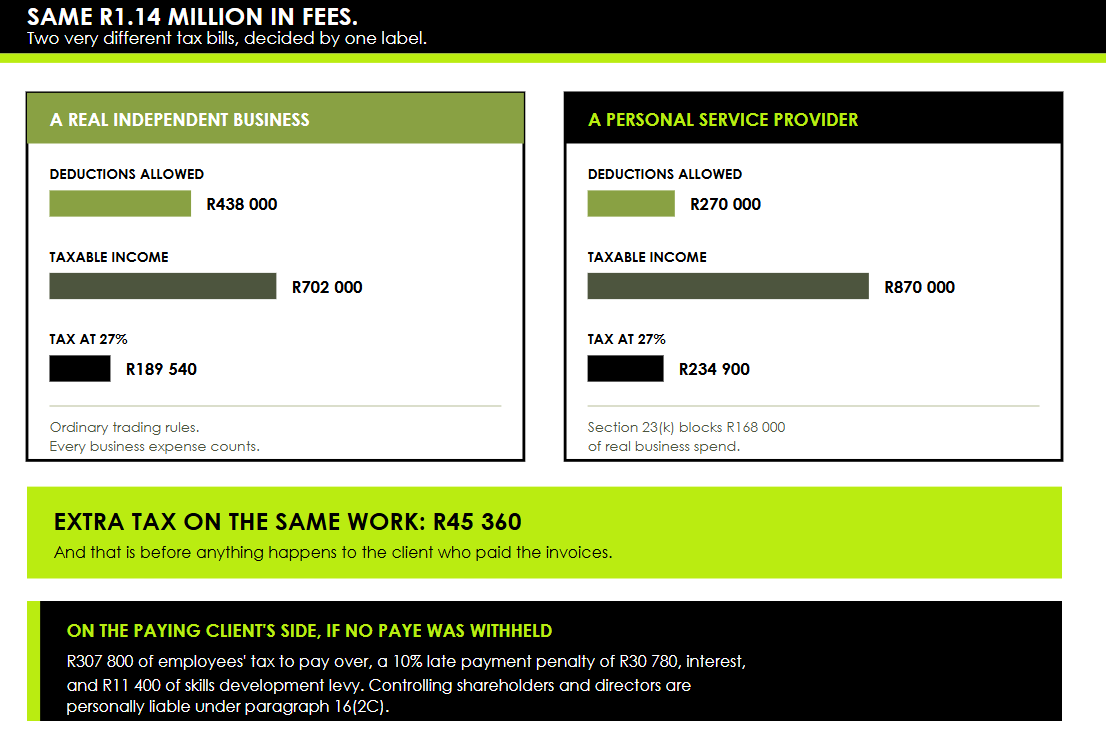
He claimed R420 000 of expenses plus R18 000 of wear and tear. Section 23(k) allows the R180 000 of staff salaries, R60 000 of office rent, R12 000 of insurance on business assets, and the R18 000 wear and tear. It disallows R30 000 of vehicle running costs, because the vehicle is also used privately, and R138 000 of accounting fees, cellphone, travel, marketing and training.
Allowed: R270 000. Taxable income: R870 000. Tax at 27%: R234 900.
Had the company been a genuine independent business, taxable income would have been R702 000 and tax R189 540. The label costs him R45 360 in extra tax on identical work.
What it costs Delta Logistics
Delta withheld nothing. It is now personally liable for R307 800 of employees' tax, a 10% late payment penalty of R30 780, interest, and R11 400 of skills development levy. Sipho's structure has become Delta's finance director's problem, and under paragraph 16(2C) it may become that finance director's personal problem.
There is one more sting. Delta must withhold 27% of every rand invoiced, but Sipho's actual liability is R234 900. That is R72 900 of his cash sitting with SARS until assessment. Paragraph 11(a) lets a PSP apply for a directive setting a lower withholding rate. Almost nobody does.
What to do this week
Three jobs, and all three are billable.
Screen your books. Pull every client that is a company or trust invoicing a single dominant customer. Sort by concentration. Anything above 80% of service income from one payer goes on a review list today, not in February.
Fix the paperwork at both ends. For clients who receive: a signed affidavit or solemn declaration to each payer at the start of every year of assessment, where the 80% test is the only exposure. For clients who pay: a standard onboarding questionnaire for every company or trust supplier of services, kept on file, plus the correct payroll setup with nature of person "H" for a personal service provider. SARS itself recommends exactly this in Interpretation Note 35.
Reprice the reality. If the client is a PSP and cannot restructure, stop pretending. Move the disallowed spend out of the company, apply for a paragraph 11(a) directive so the withholding matches the real liability, and warn him that dividends tax still waits at 20% on the way out. Then charge for the advice. This is the same recurring compliance work we mapped for gig and informal economy clients in provisional tax and the side hustle, and it prices the same way.
A misclassified contractor is not a small filing error. It is an employees' tax assessment on your client's biggest customer, and a call from that customer's lawyers to ask who advised on the structure.
Be the accountant who caught it first.
👉 Join CIBA and we'll show you how to turn contractor classification reviews into a service clients pay for, instead of a problem you fix for free.
Related guides



Trending