This article will count 0.25 units (15 minutes) of unverifiable CPD. Remember to log these units under your membership profile.
Farmers are taxed under their own set of rules. Most of the expensive mistakes happen when a farm's tax is worked out as if it were any other business, or when a growing farm drifts into activities the rules treat differently.
A farmer builds a juice plant, buys extra cattle before year-end or fixes up a house for a farm worker. Each looks like an ordinary management decision. Each can change the farmer's tax in ways that are easy to miss.
Section 26 of the Income Tax Act says that the taxable income of anyone carrying on pastoral, agricultural or other farming operations is worked out under the Act, but subject to the First Schedule. SARS's Guide on the Taxation of Farming Operations (October 2023) explains how it applies the rules. Below are eight mistakes that come up often, for practitioners and for finance teams in agricultural businesses.
1. Assuming everyone involved in the farm is a farmer
"Farming operations" is not defined, so the facts decide. SARS's guide gives the example of a company that owns a vineyard and lets another company run all the farming in return for a fixed rent based on the value of the land. The operator is farming. The landowner is not, because its income comes from owning the land. If the rent were a percentage of the vineyard's yield instead, the landowner might also be treated as farming. Many agreements mix a fixed rent with a crop share, and farmer status is not always the better result.
Some income earned on a farm is not farming income at all. SARS treats income from harvesting, transporting or packing other farmers' produce as non-farming income, as it does accommodation and catering on a game farm (Interpretation Note 69).
Practical step: Review lease and share-farming agreements and list each income stream as farming or non-farming. Where the answer is unclear, model both treatments and record why you chose one.
2. Missing the point where farming becomes manufacturing
The courts have accepted that processing can be part of farming, but SARS limits this to the farmer's own produce. SARS uses the example of a salmon farmer: smoking fish bred on the farm is farming, but smoking fish bought from neighbouring farms is a process of manufacture, and the farmer is then carrying on two separate trades.
Consider a citrus farmer who builds a juice plant with room to grow, and buys oranges from neighbours to fill the spare capacity in the early years. Even if most of the fruit comes from the farmer's own orchards, SARS's view is that the bought-in fruit takes the juice operation outside farming. A packhouse built for the farm's own fruit that later packs for neighbours raises the same question.
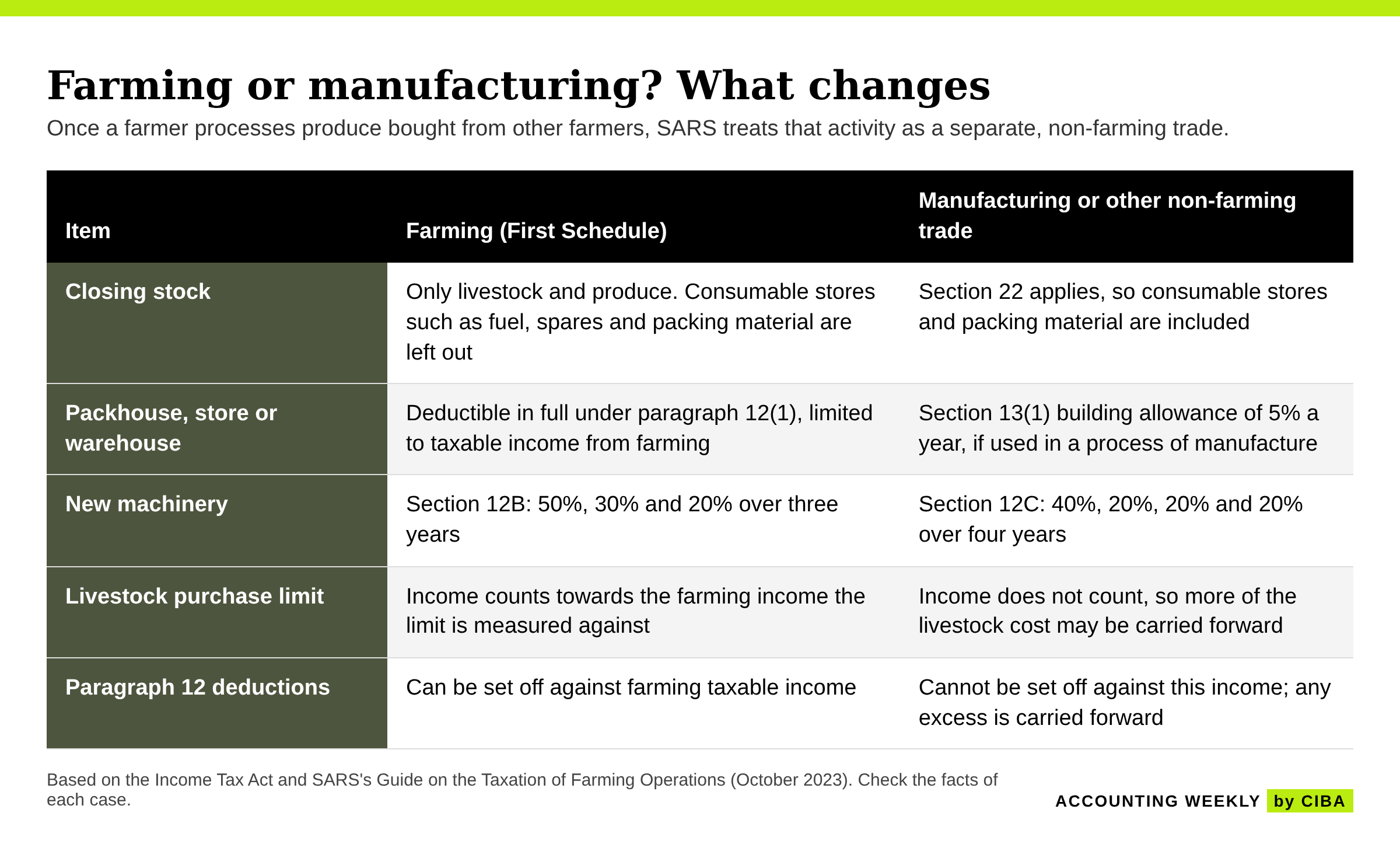
The classification changes several numbers at once, as the table shows. The building is the one that hurts most: a store used only for the farm's own produce is deductible in full under paragraph 12(1), limited to farming taxable income. Once it is used in a process of manufacture with other farmers' produce, the building only qualifies for a 5% annual allowance under section 13(1).
Practical step: Ask every farming client each year whether they process, pack or store anything for other farmers. Where they do, keep separate accounts for the farming and the manufacturing trade, and reclassify the buildings and machinery involved.
3. Valuing stock on the accounting numbers
Section 22 does not apply to a farmer's trading stock. Under the First Schedule, only livestock and produce go into opening and closing stock. Consumable stores such as fuel, spares and packing material are left out.
Livestock is valued at standard values set by regulation, and these are very low: R50 for a bull, R40 for an ox or a cow. A farmer may choose different values, but no more than 20% above or below the standard values, and the choice binds later years. A herd carried at R5 million in the financial statements might therefore have a tax value of about R100,000. The tax computation removes the accounting value and adds back the tax value each year, and the difference feeds into deferred tax.
Produce is valued at a fair and reasonable value, which SARS takes as the lower of production cost and market value. Production cost means direct costs such as labour, water, fertiliser and electricity, and excludes capital spending. Growing crops are part of the land and are not brought into account until they are harvested. Nursery stock becomes produce once it is in a saleable condition (Interpretation Note 79).
Practical step: Prepare a separate tax stock schedule each year. Do not start from the accounting stock figure, especially where biological assets are measured at fair value.
4. Getting the livestock purchase limit wrong
Paragraph 8 of the First Schedule limits the deduction for livestock purchases. The cost of livestock bought, together with the opening stock value, may not exceed the farmer's income from farming plus the closing stock value. Any excess is carried forward to the next year. Farming income here includes all farming activities, not only livestock, but it excludes income from a manufacturing trade, which is another reason the split in mistake 2 matters.
This catches farmers who expand the herd just before year-end. The limit does not apply to livestock no longer held at year-end, for example animals that died or were sold, or to the extent that the herd's market value has fallen below what was paid.
Practical step: Calculate the limit every year, even when you expect it not to bite, and keep a running schedule of the amount carried forward.
5. Misapplying the capital development deductions
Paragraph 12(1) of the First Schedule gives farmers a full deduction for many capital improvements. Where an item falls under paragraph 12, it must be claimed there and not under the wear-and-tear or other allowances.
Eradicating noxious plants and alien invasive vegetation, and preventing soil erosion, are deductible in full with no limit.
Dipping tanks, dams, irrigation schemes, boreholes, pumping plants, fences, farm buildings (other than domestic ones), roads, bridges, power lines and the planting of trees for fruit, nuts and similar crops are deductible only up to the farmer's taxable income from farming. Any excess is carried forward and cannot be set off against other income.
A farmer who installs a large irrigation system while the farm is still building up its income may therefore wait several years for the full deduction.
On sale, movable assets on which development expenditure was claimed are recouped as farming income. Immovable improvements such as dams and roads are not; they fall into capital gains tax when the farm is sold.
Practical step: Keep a capital expenditure register showing each improvement, the provision it was claimed under, the amount deducted and the balance carried forward.
6. Losing track of assessed losses and section 20A
For companies, an assessed loss brought forward can only be set off against the greater of R1 million or 80% of taxable income for the year. A farming company can therefore pay tax while still carrying a large loss, although for smaller companies the R1 million floor often means the full loss can be used.
For individuals, section 20A ring-fences losses from part-time farming, so they cannot be set off against salary or other income. The rule only applies once taxable income, before the loss is set off, reaches a set level. For years of assessment starting on or after 1 March 2026, that level has dropped from the 45% rate to the 39% rate. Under the 2026/27 tables, 39% applies to taxable income above R695,800.
Consider an accountant who farms on the side and has made farm losses in three of the last five years. The losses can now be ring-fenced at a much lower income, and can be used against practice income only if the farming has a reasonable prospect of making a taxable income within a reasonable period. The six-out-of-ten-years rule, which removes that escape for other trades, does not apply to farming. Full-time farmers fall outside the rule altogether.
Section 20A applies only to natural persons. SARS has sent letters to farming companies asking why it should not apply; challenge these.
Practical step: Test every individual farming client against section 20A each year, using the 39% threshold, and keep evidence of the farm's commercial prospects.
7. Overlooking VAT adjustments
A registered farmer can buy animal feed, animal remedies, fertiliser, pesticides, and plants and seeds for cultivation at the zero rate, provided SARS has endorsed the farmer's notice of registration and the supplier issues a valid tax invoice. Suppliers such as co-operatives should keep a copy of the endorsed notice on file. Farming enterprises with a turnover of up to R1.5 million may file six-monthly returns.
The adjustment most often missed is a change in use. A farmer buys building materials for general maintenance, puts them in the farm store and claims the VAT. Months later, some of the materials are used to repair a house provided to a farm worker. Residential accommodation is an exempt supply, so section 18(1) requires output tax on the lower of cost and market value of what was used. For capital goods used partly for taxable supplies, an adjustment is needed when the taxable use changes by more than 10 percentage points; goods that cost less than R40,000 are excluded.
A farmer who becomes a vendor may be able to claim an input adjustment on goods already held, but only to the extent that VAT was paid on them. The 2026 Budget raised the compulsory registration threshold from R1 million to R2.3 million from 1 April 2026.
Practical step: Record every issue from the farm store to staff housing or private use, and process the adjustment in the VAT period in which it happens.
8. Paying too much tax on staff housing
Free or cheap accommodation for employees is a taxable benefit, valued by a formula based on the employee's remuneration in the previous year, less an abatement. The abatement was R95,750 for 2025/26 and the 2026 Budget proposes R99,000. Where an employee's remuneration is below the abatement, there is no taxable value, which covers many farm workers. Above it, the value is 17%, 18% or 19% of the excess, depending on whether the house is furnished and whether power or fuel is supplied.
Two provisions are under-used. Paragraph 9(5) of the Seventh Schedule allows the Commissioner to set a lower value where the formula overstates what the accommodation is worth, for example an older house in a remote area. There is no dedicated application route, so document the condition of the housing well. Separately, an employer can transfer a house to an employee without a taxable benefit if the employee's remuneration and the property's market value are below set limits and the employee is not a connected person. Those limits have been R250,000 and R450,000 since 2014; the 2026 draft Rates Bill proposes raising them to R360,000 and R650,000 from 1 March 2026.
Practical step: Recalculate housing benefits each year against the current abatement, and consider a paragraph 9(5) request for housing worth less than the formula suggests.
A word on employee ownership
Selling a stake to a long-serving employee gets no tax relief. If an employee buys 25% of a R10 million company on loan, the seller pays capital gains tax without receiving cash, and the company must declare R3.125 million in dividends for the employee to repay R2.5 million after 20% dividends tax. Forfeiture conditions can bring in section 8C. Other structures reduce some costs but add their own risks, so get specialist advice before the price is agreed.
Implementation checklist
Before year-end
☐ List every income stream and mark it as farming or non-farming, with reasons.
☐ Check whether any processing uses bought-in produce, and whether any building is used for other farmers' produce.
☐ Review rental and share-farming agreements to confirm who is farming.
☐ Count livestock and produce, and record the condition of nursery stock and harvested crops.
When preparing the return
☐ Replace accounting stock values with standard values for livestock and the lower of cost and market value for produce.
☐ Leave consumable stores out of farming stock, and include them for any manufacturing trade.
☐ Calculate the livestock purchase limit and carry any excess forward.
☐ Classify each capital item under paragraph 12, section 12B or the other allowances, and apply the farming income limit.
☐ Test individual clients against section 20A, using the 39% threshold from 1 March 2026.
Ongoing
☐ Keep endorsed VAT notices of registration on file and record change-in-use adjustments for stores used on staff housing.
☐ Recalculate staff housing benefits each year and consider a paragraph 9(5) request where the formula overstates the value.
☐ Keep separate accounts for farming and any manufacturing trade.
☐ Get tax advice before agreeing any employee ownership transaction.


Trending