Rule 56 default judgment against SARS: lessons from Virgin Mobile
This article will count 0.25 units (15 minutes) of unverifiable CPD. Remember to log these units under your membership profile.
When SARS sits on an objection or misses a Tax Court deadline, Rule 56 lets the taxpayer force its hand. A 2025 Supreme Court of Appeal judgment sets out what the remedy can and cannot achieve.
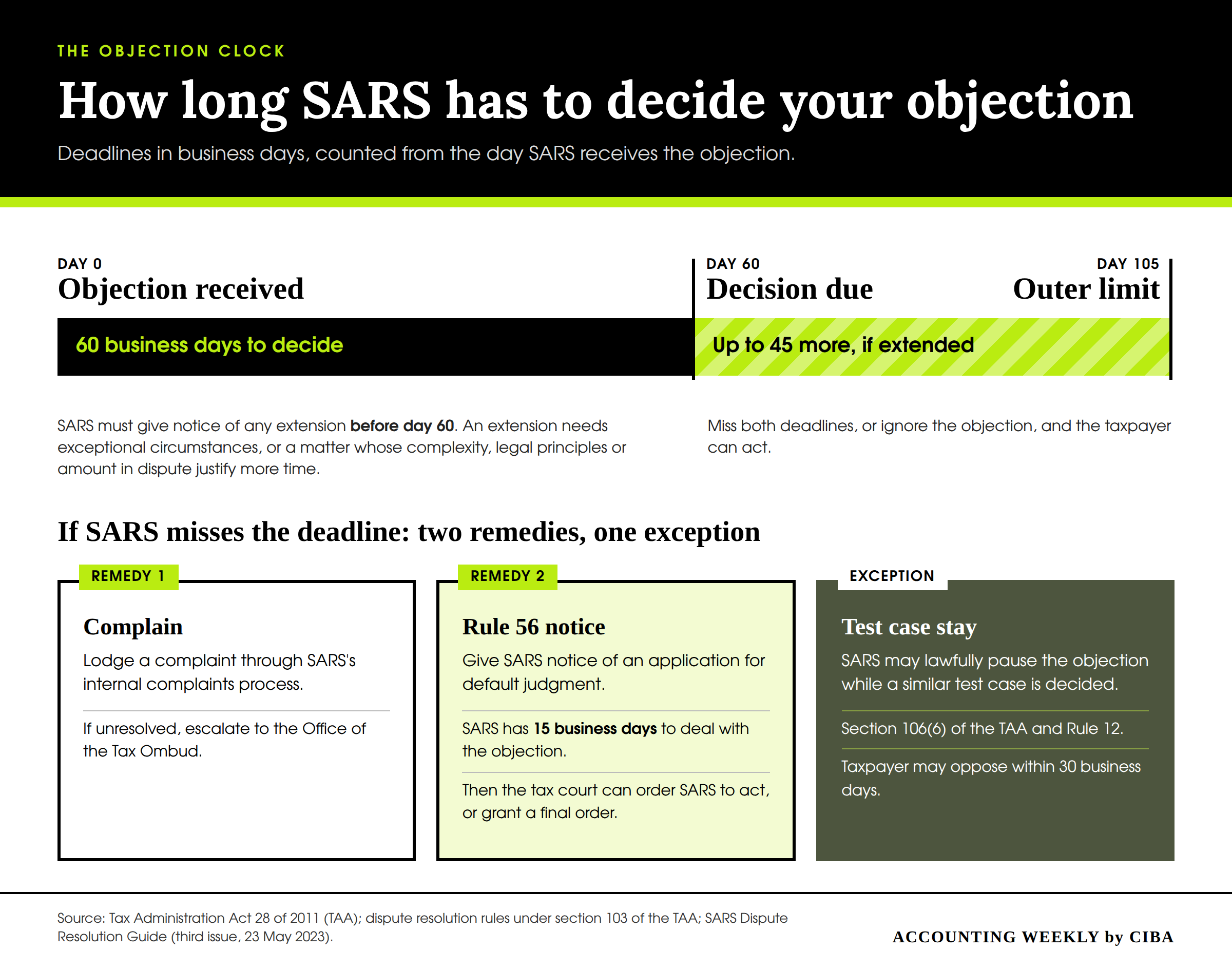
Taxpayers and tax practitioners know the situation well. An objection goes to SARS and nothing comes back. The dispute resolution rules put a limit on that silence. SARS must notify the taxpayer of its decision within 60 business days of receiving the objection.[1]
SARS may extend that period by up to 45 business days where there are exceptional circumstances, or where the complexity of the matter, the legal principles involved or the amount in dispute justify more time. It must notify the taxpayer of the extension before the first 60 business days run out.[2]
What can a taxpayer do when SARS misses these deadlines, including any valid extension, or does not deal with the objection at all? This article sets out the remedies, explains when SARS may lawfully pause a dispute, and looks at how the Supreme Court of Appeal (SCA) has now interpreted Rule 56.
Two remedies when SARS does not respond
The first remedy is a complaint. The taxpayer lodges it through SARS's internal complaints process. If that does not resolve the matter, the taxpayer can take the complaint to the Office of the Tax Ombud.
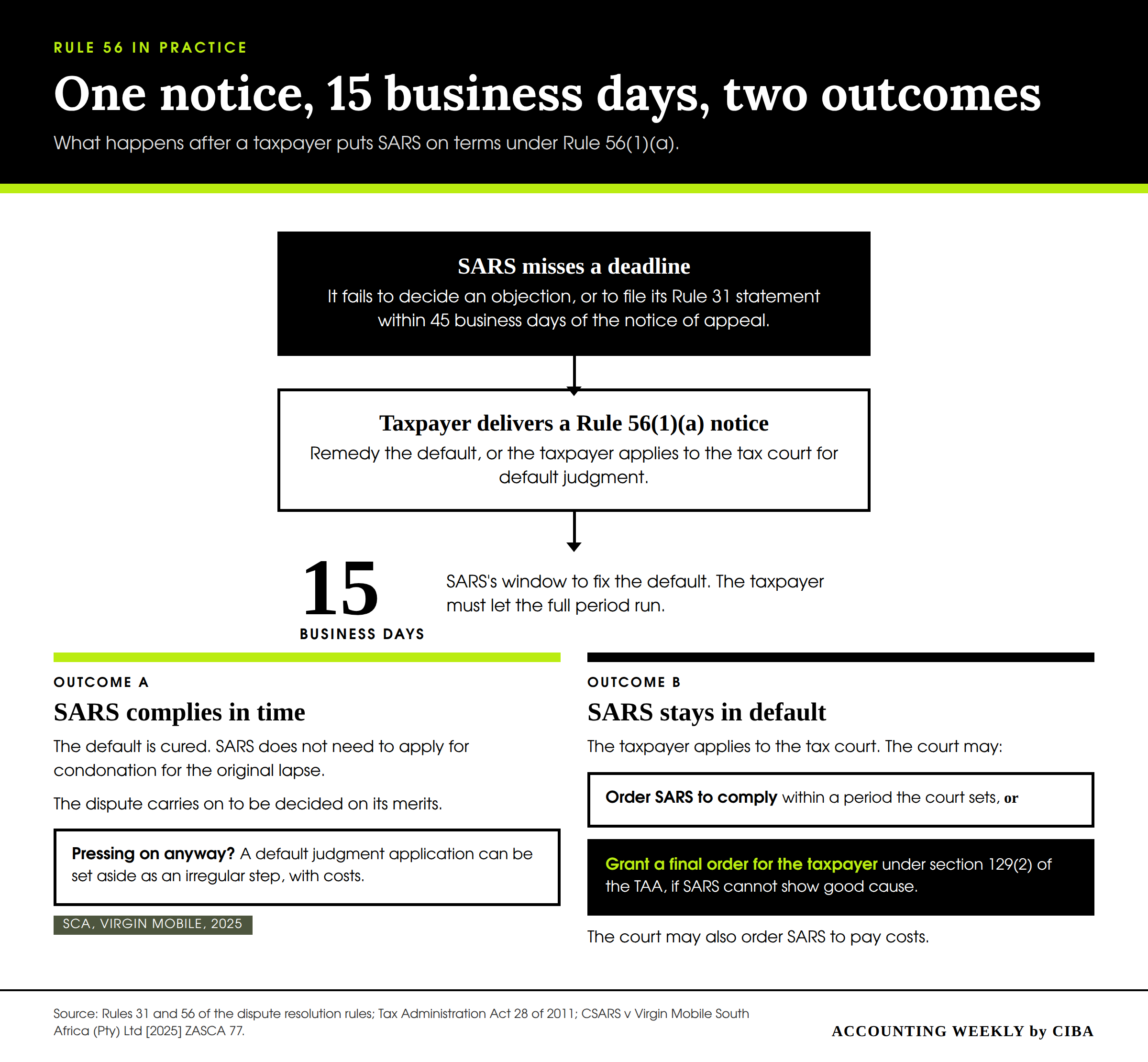
The second is an application for default judgment under Rule 56. This is a procedural application under the rules referred to in section 117(3) of the Tax Administration Act (TAA). The taxpayer starts by delivering a notice to SARS. The notice says that, if SARS does not deal with the objection within 15 business days, the taxpayer will apply to the tax court for default judgment.
If SARS does not respond and the matter goes to the tax court, the court may:
• order SARS to deal with the objection within a period the court sets; or
• if SARS cannot show good cause for its default, make a final order in the taxpayer's favour.[3]
The court may also order SARS to pay costs. A final order ends the dispute in the taxpayer's favour, so a Rule 56 notice gives SARS a strong reason to act.
When SARS may lawfully pause a dispute
Not every delay is a default. SARS may stay (pause) an objection where it has selected a similar matter as a test case.[4] Instead of litigating dozens of disputes on the same point, SARS lets one case decide the legal question for all of them. It must notify the taxpayer of the stay within 60 business days.
The taxpayer is not bound to accept the stay. It may oppose it within 30 business days of receiving the notice.[5] If the matter is not resolved, SARS must apply to the tax court for an order staying the objection or appeal until the test case is decided, and the taxpayer may oppose that application. If the stay goes ahead, the taxpayer may ask to take part in the test case.[6]
The 15-business-day window
Rule 56(1)(a) gives the defaulting party 15 business days to remedy its default once the other party has delivered a notice of intention to apply for a final order by way of default judgment. That raises a practical question. What happens if SARS remedies the default inside the window, but only after missing the original deadline by months? The SCA answered it in Commissioner for the South African Revenue Service v Virgin Mobile South Africa (Pty) Ltd.[7]
The facts of the case
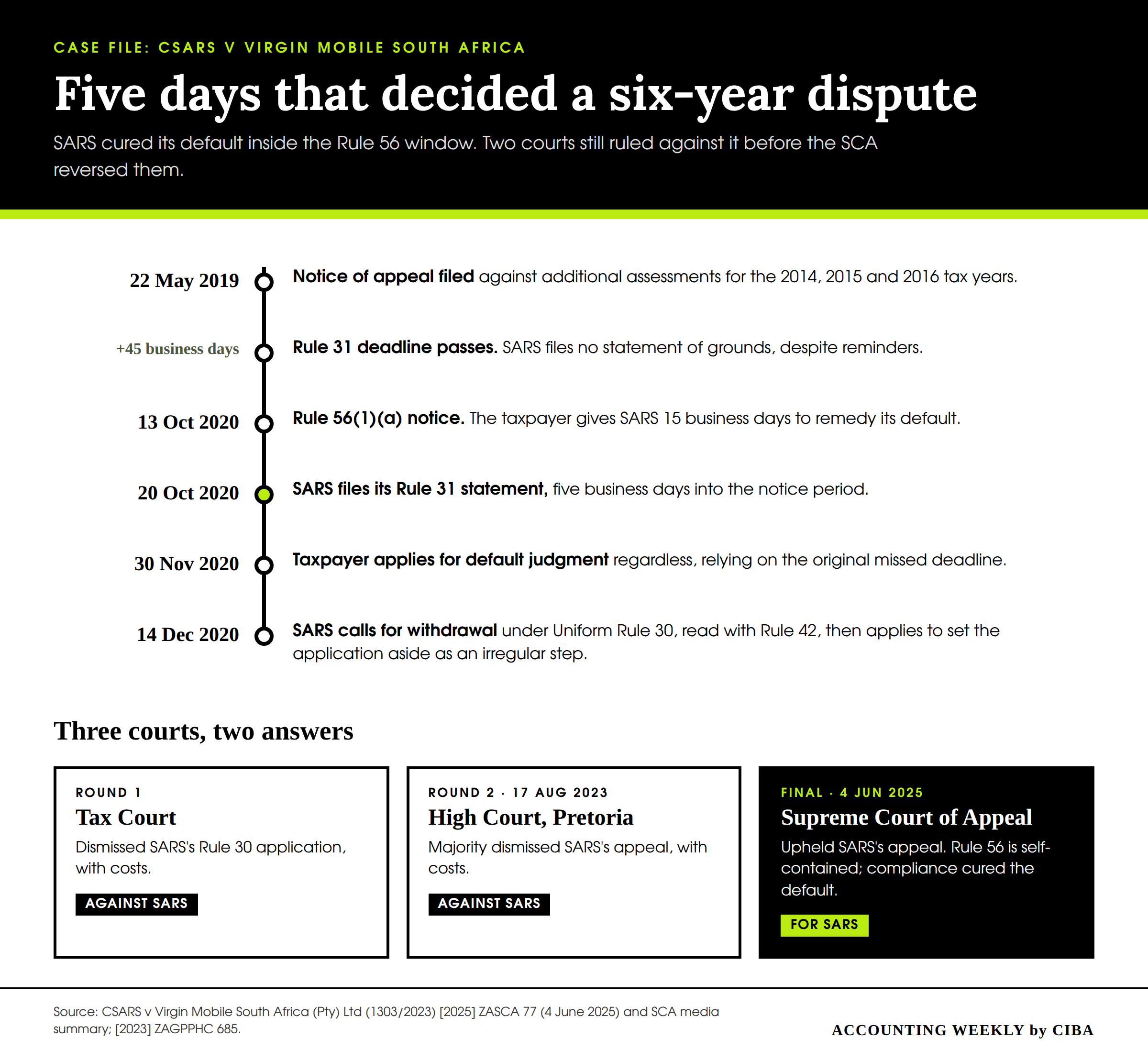
SARS raised additional assessments against the taxpayer for the 2014, 2015 and 2016 tax years. The taxpayer filed a notice of appeal on 22 May 2019. Under Rule 31, SARS then had 45 business days to file a statement of the grounds of assessment and opposing the appeal. It did not, and it stayed in default despite reminders.
On 13 October 2020 the taxpayer delivered a Rule 56(1)(a) notice, calling on SARS to remedy its default within 15 business days or face an application for default judgment. SARS filed its Rule 31 statement on 20 October 2020, five business days later. The taxpayer applied for default judgment anyway, on 30 November 2020. Its case was that a statement filed late, without condonation, did not cure the original default.
On 14 December 2020 SARS delivered a notice under Rule 30 of the Uniform Rules of Court, read with Rule 42 of the dispute resolution rules. It called on the taxpayer to withdraw the application, failing which SARS would apply to set it aside as an irregular step. SARS argued that it had complied with the notice within the 15 business days and had therefore remedied its default.
The taxpayer refused, and SARS brought the Rule 30 application. The tax court dismissed it with costs. On appeal, a majority of the High Court in Pretoria also ruled against SARS, with costs. The SCA upheld SARS's appeal with costs, including the costs of two counsel, and declared the default judgment application an irregular step.
What the SCA decided
The judgment is technical, but two findings matter to every practitioner who appears in the tax court.
1. Complying within the notice period cures the default
Rule 31 requires SARS to deliver its statement within 45 business days after delivery of the notice of appeal. Rule 4 provides for extensions of time, and Rule 52 for condonation. SARS used neither. It did not ask for an extension under Rule 4(2), and it did not apply for condonation for missing the Rule 31 deadline. The taxpayer's case rested on that gap.
The SCA disagreed. It held that Rule 56 is self-contained.[8] Its purpose is to secure compliance and move the dispute towards a final outcome. Once SARS filed its statement within the period in the notice, the default was remedied and the rule had done its job. SARS did not need to apply for condonation or an extension afterwards. The court compared the position to a notice of bar under Uniform Rule 26: a party that files the required pleading within the time in the notice lifts the bar simply by complying.
2. Rule 56 forces compliance; it does not punish
The court explained the difference between the two procedures. A condonation application is voluntary: the party in default asks the court for more time. Rule 56 is coercive: the innocent party uses it to force the defaulting party to comply, under threat of a final order. Because a final order under section 129(2) is drastic, the defaulting party must get fair notice before one is sought.
Once the defaulting party complies within the period in the notice, the rule has served its purpose. The taxpayer cannot then rely on the original lapse to pursue a final order. The court added that this does not make Rules 4 and 52 redundant. They continue to apply in their own contexts.
What this means for practitioners
The lesson lies in how Rules 31 and 56 work together. Where SARS fails to file its Rule 31 statement within 45 business days, the taxpayer may deliver a Rule 56(1)(a) notice.[9] The taxpayer must then allow SARS the full 15 business days to remedy its default before seeking a final order.
A missed Rule 31 deadline does not, on its own, entitle the taxpayer to default judgment. If SARS complies within the Rule 56(1)(a) period, an application for default judgment cannot succeed because SARS missed the original deadline. Pressing ahead risks having the application set aside as an irregular step, with costs, as happened in Virgin Mobile.
Practitioners should therefore treat Rule 56 as a way to get a stalled dispute moving. Used that way, it remains effective: if SARS ignores the notice, the tax court can order it to comply or decide the matter in the taxpayer's favour.
References
Legislation: Tax Administration Act 28 of 2011, as amended to 24 December 2024; rules promulgated under section 103 of the Tax Administration Act (dispute resolution rules).
SARS guide: SARS, Dispute Resolution Guide: Guide on the rules promulgated in terms of section 103 of the Tax Administration Act, 2011, third issue, 23 May 2023.
Case law: Commissioner for the South African Revenue Service v Virgin Mobile South Africa (Pty) Ltd (1303/2023) [2025] ZASCA 77 (4 June 2025); Commissioner for the South African Revenue Services v Virgin Mobile South Africa (Pty) Ltd (A82/22; IT25117) [2023] ZAGPPHC 685 (17 August 2023).
[1]Rule 9(1) of the dispute resolution rules.
[2]Rule 9(2) of the dispute resolution rules.
[3]Section 129(2) of the Tax Administration Act 28 of 2011, read with Rule 56(2).
[4]Section 106(6) of the Tax Administration Act 28 of 2011, and Rule 12 of the dispute resolution rules.
[5]Rule 12(3)(a) of the dispute resolution rules.
[6]Rule 12(3)(c) of the dispute resolution rules.
[7]CSARS v Virgin Mobile South Africa (Pty) Ltd (1303/2023) [2025] ZASCA 77 (4 June 2025).
[8]Paragraph 32 of the SCA judgment.
[9]Paragraph 38 of the SCA judgment.