This article will count 0.25 units (15 minutes) of unverifiable CPD. Remember to log these units under your membership profile.
South Africa’s 2026 Medium-Term Budget Policy Statement offers opportunities for economic reform and fiscal consolidation. The decisive question is whether public spending delivers measurable value, better services and sustainable growth.
The economic outlook: Finding possibilities amid uncertainty
Given the current state of international affairs or, perhaps more accurately, international disorder- it is not difficult to foresee the adverse effects on South Africa. Although foreign relations are international in nature, their consequences extend well beyond diplomacy and have a direct impact on domestic economic activity. For example, companies heavily reliant on export markets may experience a decline in gross revenue as international supply chains face significant disruption.
Global economic growth is expected to slow to 3.1%, with the war in the Middle East contributing to higher oil prices. The IMF’s October 2026 projections highlight challenging international economic conditions, which could affect South Africa’s economic growth, inflation and fiscal outlook.
The familiar adage still holds true: when the rest of the world coughs, South Africa catches the flu.
However, the strength of the MTBPS lies in its ability to draw us into the realm of the possibilitarian.
The term, popularised by the American minister and author Norman Vincent Peale, encourages us to look beyond present difficulties and recognise the possibilities that still exist. As Peale famously observed: “Become a possibilitarian. No matter how dark things seem to be or actually are, raise your sights and see possibilities, always see them, for they're always there.”
Being a possibilitarian means choosing to focus on potential, progress and hope rather than allowing limitations and obstacles to define what can be achieved.
How, then, does the MTBPS encourage us to adopt this mindset and look beyond the challenges facing South Africa towards the possibilities that lie ahead?
Economic growth
The 2026 Medium-Term Budget Policy Statement (MTBPS) sets out a strategy to accelerate economic growth, create jobs, encourage private investment and improve basic services.
Economic growth: Global growth is slowing to 3.1%, partly because the war in the Middle East has increased oil prices. South Africa's economy is forecast to grow by 1.2% in 2026, rising to 2% by 2029.
Economic reforms: Progress is being made in electricity, logistics and water, with reforms moving from planning to implementation.
Fiscal outlook: Government aims to achieve a primary budget surplus of 2.9% of GDP by 2029/30 and reduce the budget deficit to below 3% of GDP.
Public debt: Debt stabilised at 78.4% of GDP in 2025/26 and is projected to decline, although government borrowing requirements remain substantial.
Reducing the budget deficit
Government aims to reduce the budget deficit to below 3% of GDP by 2029/30 through a growing primary budget surplus.
The primary balance measures the difference between revenue and expenditure before interest payments on government debt. A growing primary surplus means government revenue increasingly exceeds non-interest expenditure, helping to contain borrowing needs.
However, debt-service costs remain a significant burden on public finances. The improvement in the primary balance is intended to strengthen fiscal sustainability and gradually reduce the deficit.
Public debt begins to decline
South Africa's gross debt stabilised at 78.4% of GDP in 2025/26, below the 78.9% projected in the 2026 Budget.
Debt is projected to decline to 76.6% of GDP by 2029/30.
Debt-service costs are expected to average 20.6% of government revenue over the medium-term expenditure framework (MTEF).
Although the debt outlook has improved, interest payments continue to absorb a substantial portion of revenue. This limits the funds available for public services and other government priorities.
Government expenditure and capital investment
Government plans to increase capital spending faster than overall expenditure during 2026/27 to 2029/30.
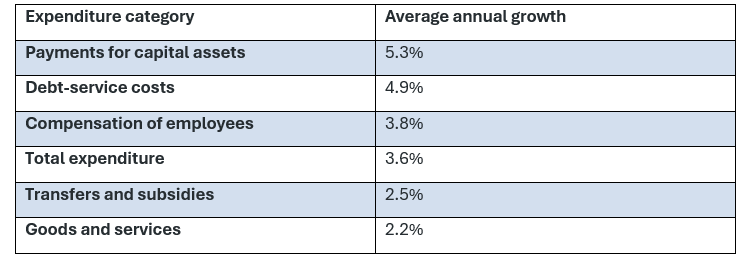
Economic development is projected to grow by 5.8% annually, while health and social development are each projected to grow by 4.2%.
The emphasis on capital spending suggests a greater focus on infrastructure investment. However, the benefits will depend on whether allocated funds translate into effective project implementation and improved services.
Fuel levies
The Minister of Finance announced temporary relief through a reduction in the fuel levy. From 4 November 2026 to 1 December 2026, the levy will be reduced by R3 per litre for diesel and R1.50 per litre for petrol.
Thereafter, the relief will continue at a reduced level until 5 January 2027, with the diesel levy reduced by R1.50 per litre and the petrol levy by R1 per litre.
The measures will provide R10 billion in relief, at a fiscal cost of R10 billion in forgone revenue. To fund this relief, the R10 billion previously transferred to the Central Energy Fund will be returned to the National Revenue Fund and allocated to the Contingency Reserve.
The fuel levy reductions are expected to support household consumption, ease inflationary pressures and provide a boost to economic activity.
The relief is structured to be fiscally neutral, ensuring that it does not compromise government spending priorities or increase public debt. The government does not expect the cost of the fuel relief to exceed the R10 billion allocated for this purpose.
Statistics South Africa (Stats SA) reported that annual Consumer Price Inflation (CPI) increased slightly to 4.5% in September 2026, from 4.4% in August. Headline inflation rose by 0.4% month-on-month, coming in below market expectations of 4.7%.
Transport costs remained a major contributor to inflationary pressures. Annual transport inflation accelerated to 10.8% in September, compared with 8.8% in August, contributing 1.5 percentage points to the overall annual CPI rate of 4.5%. This increase was largely driven by volatility in global energy markets and higher fuel prices, exacerbated by international conflicts. Annual fuel-price inflation surged to 27.9% in September, up from 20.6% in August.
Against this backdrop, the fuel levy reductions announced by National Treasury are particularly significant. The measures are intended to provide temporary relief from rising fuel costs and help moderate their impact on transport expenses. By easing these cost pressures, the relief may also help contain inflation, support household purchasing power and sustain economic activity. However, the extent of the impact will depend on how far the reductions in the fuel levy translate into lower prices for consumers and businesses.
Tax receipts
The expected revenue for the tax year ending April 2027 is R54.1 billion above the the estimate published in February 2026.
A significant portion of this improvement is attributable to higher commodity prices, particularly those benefiting the mining sector. Provisional corporate income tax collections increased by 17.4% during the first six months of the financial year compared with the corresponding period in the previous year, with mining making the largest contribution. This is not surprising given the prevailing global uncertainty and geopolitical conflicts. During periods of instability, investors often turn to commodities such as gold as a store of value, increasing demand and potentially driving prices higher. However, these revenue gains are expected to dissipate over the medium term as commodity prices and related tax receipts fluctuate.
Beyond favourable commodity prices, improved revenue administration and stronger tax compliance have also contributed to the increase in tax collections. The South African Revenue Service (SARS) plays a central role in strengthening the revenue base and supporting government’s efforts to combat the illicit economy, particularly in the alcohol and tobacco industries.
Through the modernisation of customs and excise operations, SARS is enhancing cargo scanning, expanding track-and-trace capabilities and strengthening frontline enforcement. These measures are intended to disrupt the networks that facilitate illicit trade, improve compliance and protect government revenue.
Overall, gross tax revenue is projected to increase from R2.14 trillion in 2026/27 to R2.53 trillion in 2029/30. While the stronger near-term revenue outlook provides some fiscal relief, the anticipated decline in commodity-related gains highlights the importance of sustained improvements in revenue administration and tax compliance to support government finances over the medium term.
The MTBPS would go a step further if the anticipated increase in tax revenue translated into more favourable personal income tax brackets in the coming tax years. Taxpayers will be watching with bated breath to see whether the additional revenue provides any meaningful relief from their tax burden.
Municipal funding and accountability
Government intends to link municipal funding more closely to service delivery and intervene when municipalities fail to meet their financial obligations.
Funding: An additional R21.8 billion is allocated to the equitable share for the bulk costs of free basic services. Metros receive an additional R13.4 billion from the general fuel levy.
Payment of creditors: Transfers were withheld from 69 municipalities that failed to pay creditors. By 31 July 2026, 38 municipalities had concluded repayment plans and paid R4.2 billion.
Outstanding public-sector debt: Public bodies owe municipalities R27.6 billion, and government is enforcing payment.
Conditional grants: Grant allocations will be linked to credible, funded project pipelines. Two water grants are to be merged in 2027/28.
Revenue collection: Smart meters installed in 28 municipalities have generated an additional R361 million in revenue.
Regulation: Amendments to the Municipal Finance Management Act (MFMA) aim to strengthen accountability, penalise misconduct and enable earlier intervention in financially distressed municipalities.
The central message is that municipal funding must be supported by improved financial management, revenue collection, payment discipline and measurable service delivery.
Fighting Crime and Corruption
It is noted that crime and corruption undermine governance, divert funds from service delivery and increase business costs.
Government has allocated R810 million next year to recapitalise the South African Police Service fleet and an additional R2.2 billion over the medium term to strengthen judicial independence.
The 18-month Financial Action Task Force mutual evaluation will assess compliance with international standards and the effectiveness of investigations, prosecutions and asset forfeitures. Government aims to meet FATF requirements through strengthened anti-crime and anti-corruption measures.
Government is also increasing labour inspectors and considering measures to strengthen border inspection and immigration capacity to address illegal migration.
Gender-Based Violence and Femicide (GBVF)
In response to the unacceptably high levels of gender-based violence and femicide (GBVF) in South Africa, and in line with President Ramaphosa’s announcement, additional funding is allocated to strengthen prevention, investigation, victim support and government oversight.
The allocations include:
R3.8 billion to employ more than 3,500 social workers, with a specific focus on strengthening prevention and responding to violence against women.
R186 million to strengthen forensic and investigative capacity.
An additional R157.4 million to the Department of Women, Youth and Persons with Disabilities to improve national coordination and oversight of the government’s response to GBVF.
Access to justice and support for victims will also be expanded. The number of sexual offences courts will increase from 55 to 101, while the number of Thuthuzela Care Centres, which provide support to rape victims, will increase from 72 to 80 by 2028/29.
Beyond allocations: Measuring outcomes
During both the Select Committee on Appropriations meeting and the briefing by National Treasury, a recurring concern raised by Members of Parliament (MPs) was that government reports focus primarily on the allocation of funds to specific projects, with insufficient reference to the outcomes achieved or the actual performance of the expenditure.
The distinction between outputs and outcomes is important. An output measures what has been delivered, whereas an outcome measures the resulting impact.
For example, if the Department of Health receives funding to provide vaccines against a particular epidemic, the output would be the number of patients vaccinated. The outcome, however, would be the extent to which the vaccination programme reduces the incidence of the disease and the number of related deaths.
The same principle applies to government spending aimed at addressing the high levels of gender-based violence and femicide (GBVF).
While increasing the number of sexual offences courts from 55 to 101 is commendable, performance should also be assessed by examining whether cases are finalised more quickly, whether conviction rates improve and, ultimately, whether incidents of gender-based violence decline.
Addressing GBVF requires a comprehensive, multidisciplinary approach that extends beyond the prosecution and conviction of offenders. Early intervention, prevention programmes and appropriate counselling or therapeutic support for couples experiencing relationship difficulties may also play a role in preventing violence from occurring or escalating.
The critical question is whether the additional funding produces measurable improvements in preventing violence, protecting victims and bringing offenders to justice. If increased expenditure does not achieve its intended objectives, its effectiveness and value for money must be questioned. Funding allocations alone cannot be regarded as evidence of success.
In this regard, the Minister of Finance made an insightful observation about the assessment of government expenditure. He explained that National Treasury's role is to allocate resources in response to the country's needs. However, MPs responsible for scrutinising the efficiency and effectiveness of that expenditure must direct their oversight towards the relevant government departments.
In the case of GBVF, this would include scrutinising the performance of the Department of Justice and Constitutional Development and the Department of Women, Youth and Persons with Disabilities, among other relevant departments.
Monitoring and evaluating government expenditure is an ongoing oversight responsibility of MPs. Their role extends beyond examining how much money has been allocated or spent; they must also establish whether the expenditure has delivered the intended outputs and meaningful outcomes for the public.
Conclusion: Accountability must be measured in outcomes
The MTBPS identifies a path towards stronger fiscal sustainability and more productive public investment. The opportunity lies in implementation: ensuring that allocations translate into functioning infrastructure, improved municipal services, effective institutions and measurable social outcomes. For accounting professionals, the responsibility is to strengthen the evidence, controls and performance information on which those decisions depend.
Sources and references
MTBPS : Budget Speech. Presented to National Parliament. Wednesday 21 October 2026
Presentation by National Treasury: Laying a new foundation for growth and development. Presented to Members of Parliament on Friday 23 October 2026


Trending