This article count 0.25 units (15 minutes) of unverifiable CPD. Remember to log these units under your membership profile.
A business owner sells his business for R50 million. The contract places the sale before the February tax year-end, so the seller has to recognise and pay about R18 million in provisional tax. The first payment of about R25 million only arrives in April or May. The deal is signed, the tax is payable, but the cash is not yet available.
This real case, shared at a recent CIBA webinar, illustrates the main point: when a business changes hands, tax can shape the deal, not the other way around.
Assets or shares?
There are two basic ways to buy a business.
Buying the business assets
The buyer chooses what to take, such as stock, equipment, contracts and other assets, and may be able to limit the historic liabilities and risks it assumes. The buyer generally establishes a new tax cost or base cost for the assets acquired, with deductions or capital allowances determined under the applicable tax rules.
If the sale qualifies as a going concern, VAT may be charged at 0%. If the requirements for zero-rating are not met, VAT can apply at the standard rate.
The seller bears the tax consequences of disposing of the assets. This may include recoupments on assets on which tax allowances were previously claimed, as well as capital gains tax. The sale proceeds remain in the company and may then need to be distributed to the shareholder. Depending on how that extraction is structured and who the shareholder is, dividends tax or other tax consequences may arise.
This can result in a higher overall tax cost for the owner than a share sale, because the proceeds may remain in the company and may then need to be distributed to the shareholder.
Buying the shares
The buyer acquires the company itself, rather than selected assets. Contracts, leases, employees, supplier arrangements and other obligations generally remain with the company, subject to the applicable legal and contractual requirements.
The sale of shares is generally an exempt financial service for VAT purposes. Securities transfer tax (STT) generally applies at 0.25% on the transfer of securities, for example, R100,000 on a R40 million transaction. Transfer duty can also be relevant in certain transactions involving property-holding companies.
For the seller, the tax treatment of the share disposal must be determined from the particular facts. A share sale does not automatically qualify for capital treatment simply because shares are being sold, and the seller's base cost is important in determining the taxable gain.
The buyer, meanwhile, inherits the company's historic tax exposure and other risks. These can include SARS issues, labour disputes, contractual claims and matters that have not yet become apparent.
SARS generally has prescription periods, but these do not necessarily protect a company where the relevant requirements for prescription have not been met. The presenter highlighted that undisclosed matters can result in SARS looking back beyond the normal periods, leaving the company, and therefore its new shareholders, with the consequences.
Six questions every deal must answer
What is actually being bought?
Is the buyer acquiring the whole company, or only selected assets or part of the business?
A buyer that needs a contract, license or other right that cannot readily be transferred may need to consider a share acquisition instead.
Who pays which tax?
Is the tax payable by the seller's company, the shareholder or the buyer?
The transaction may involve income tax, capital gains tax, VAT, dividends tax, securities transfer tax or other taxes, depending on how the deal is structured.
When is the tax payable?
As the R50 million example shows, the timing of the tax liability and the timing of the cash receipts must be considered together when structuring the deal.
A transaction can be concluded before year-end, creating a provisional-tax liability, while the agreed purchase price is only received later.
Can the costs be recovered or deducted?
Legal fees, financing costs and facilitation fees can be significant. Their tax treatment needs to be considered rather than assuming that every transaction-related cost is deductible.
How does the tax change the price?
If the seller needs to receive a particular amount after tax, an increase in the tax cost can change the amount that the buyer needs to fund.
The tax calculation can therefore affect the commercial negotiation, not merely the seller's tax return.
How will the deal be funded?
Will the transaction be funded with cash, borrowing, group funding or cash already held in the company?
The presenter also discussed structures such as dividend stripping and highlighted that these can have their own tax and anti-avoidance consequences.
Sellers: clean up before selling
A seller who prepares the business before sale can reduce the risks and price adjustments that may arise during due diligence.
That means clearing loan accounts, cleaning up obsolete stock, bad debts and unproductive assets, addressing tax filing, review, audit and compliance matters, fixing governance and documentation issues, and reviewing contracts.
Every unresolved issue identified by the buyer can become a negotiation point or lead to a price adjustment.
This is illustrated with a potential R100,000 tax liability that could become a R500,000 risk once penalties and other consequences are considered. A valid SARS Voluntary Disclosure Programme (VDP) application may provide relief from certain penalties, subject to the statutory requirements and the VDP agreement. The underlying tax does not simply disappear, and interest and other amounts may remain payable.
Cleaning up a known problem before the sale can therefore make the business more attractive to a purchaser and reduce the risk adjustment that might otherwise arise during due diligence.
Buyers: never skip due diligence
A share buyer must understand what it is taking on. The tax review should cover income tax, VAT, PAYE, customs and cross-border tax, as well as open SARS matters. The presenter recommended looking at at least 10 years of tax packs, rather than relying only on the tax returns, and reviewing matters such as SARS audits, reviews and their outcomes. The review should also consider:
open audits, verifications, objections and appeals;
VDP matters;
prescription and record-retention issues;
assessed losses and their limitations;
previous restructuring or rollover transactions;
withholding taxes;
permanent-establishment and treaty risks; and
foreign tax exposures.
For example, a company manufactured a patented water-valve system and undertook projects in Botswana and Mozambique. The due diligence identified potential employees' tax and immigration issues because employees had worked in those countries without properly addressing local tax obligations and, in some cases, with visitors' permits rather than the required work permits. This discovery could expose the new owners to claims from multiple tax jurisdictions.
Findings like these should feed directly into the share purchase agreement through the price, warranties, indemnities, covenants and appropriate adjustments.
Get the contract right
For a 0% VAT treatment of a going concern, all the applicable requirements must be satisfied. These include:
the seller and purchaser being registered vendors;
the enterprise, or part of it, being capable of separate operation;
the parties agreeing in writing that the enterprise is disposed of as a going concern;
the agreement recording that the enterprise will be an income-earning activity on the date of transfer;
the assets necessary to carry on the enterprise being transferred; and
the agreement recording that the consideration includes VAT at the zero rate.
If the requirements are not met, VAT may become payable at the standard rate rather than the zero rate. The contract should therefore contain an appropriate VAT gross-up or adjustment mechanism dealing with what happens if the zero-rating fails, including who bears any additional VAT and related amounts. The contract must also match what actually happens on the day of transfer. Calling a transaction a “going concern” does not make it one.
The takeaway
The most valuable work often happens in the middle, between the seller's objectives and the buyer's risk concerns.
An accountant who models two to four different permutations of the deal, showing the timing, cash flow, cash requirements and net tax effect for each, can give the seller a clearer after-tax number and the buyer a clearer view of the risks.
The objective is not simply to calculate the tax after the deal has been agreed. It is to understand how the tax, cash flow, risk and legal structure interact before the deal is finalised.
That is advice clients will pay for.
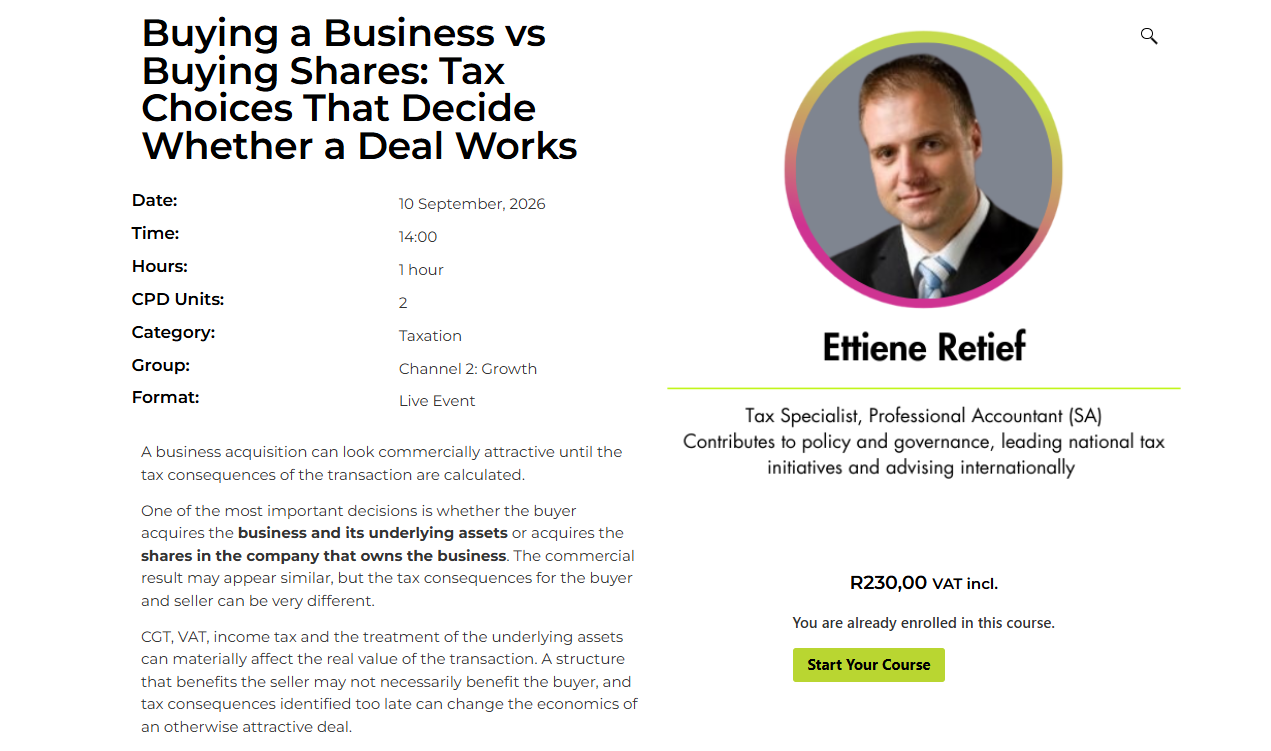
Watch CIBA’s webinar on Buying a Business vs Buying Shares: Tax Choices That Decide Whether a Deal Works and learn more on how to advice your clients.



Trending