
Note: Nothing in this article constitutes a recommendation of specific fee levels. CIBA does not prescribe or endorse any particular pricing. All figures are illustrative. Members must determine their own fees in compliance with the applicable law.
You finished the job in two hours. You billed two hours. The client paid without flinching, because what you saved them was worth ten times more. You stared at the invoice and felt it: the slow, quiet drain of charging for your time instead of your value.
If the hourly rate is your pricing strategy, you have already lost the negotiation before you opened your mouth.
The Man With the Hammer
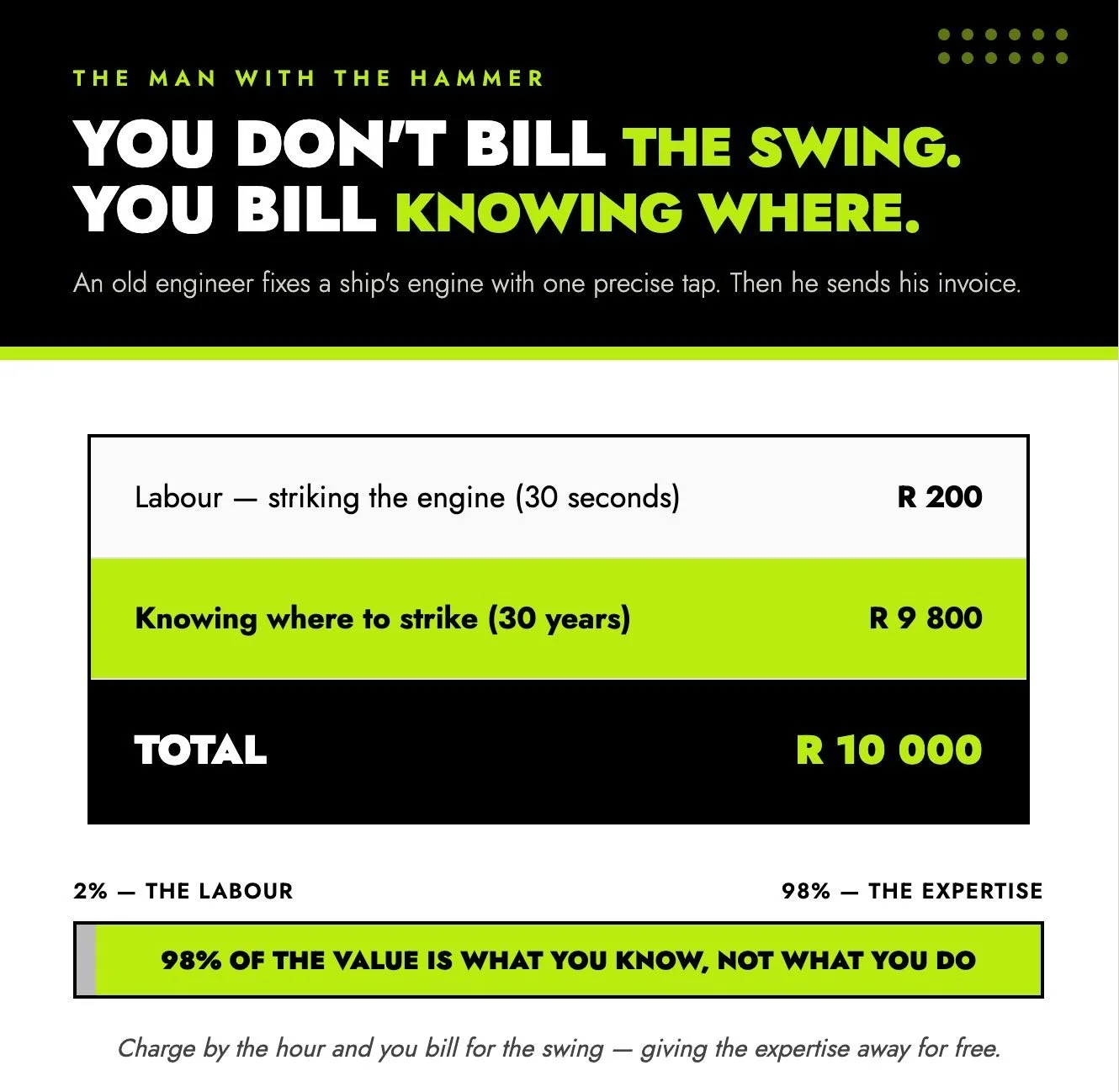
A cargo ship's engine failed. Every engineer the company called shook their head. Then an old engineer arrived, inspected the engine carefully, took a small hammer from his bag, and struck one precise point on the casing. The engine roared back to life.
His invoice arrived the next day: labour for striking the engine, R200. Knowing where to strike, R9 800. Total: R10 000.
The company objected. The engineer was unbothered. He had not billed for the thirty seconds it took to swing the hammer. He had billed for thirty years of knowing exactly where to swing it.
This is your business. Every VAT return you file, every SARS dispute you resolve, every payroll error you catch before it becomes a penalty, every tax structure you design that saves a client real money, reflects decades of accumulated knowledge, professional discipline, and competence that most of your clients could not replicate at any price. When you charge by the hour, you are billing for the swing. You are giving away the expertise for free.
The Structural Problem With Hourly Billing
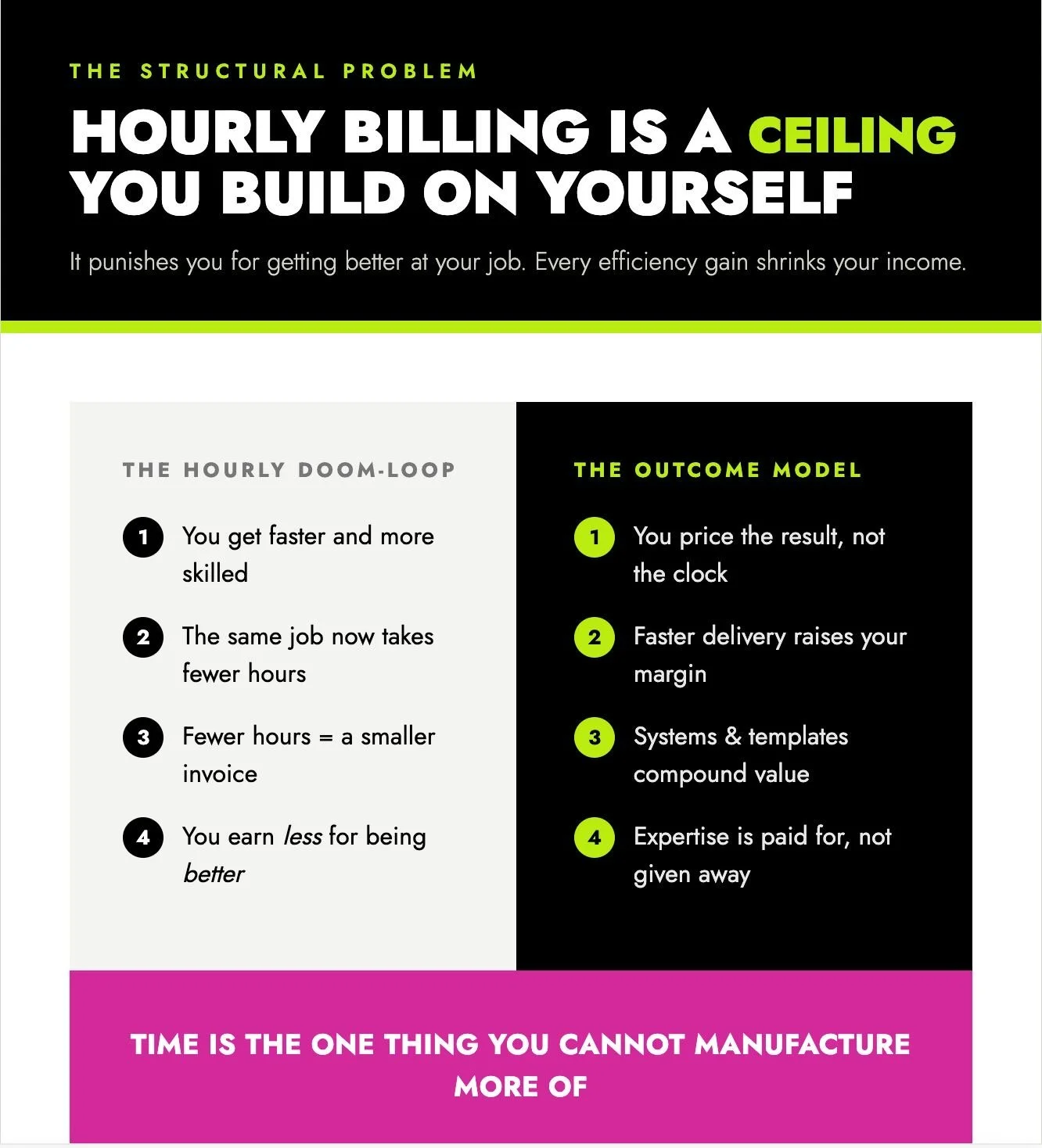
Hourly billing feels safe. It is measurable, defensible, and easy to explain. It is also a ceiling (built directly into your business model) that punishes you for getting better at your job.
Here is the logic that hourly billing forces on you: the faster you work, the less you earn. The more experienced you become, the harder you have to justify your rate to a client who remembers what you used to charge. Every efficiency gain (every system you build, every template you create, every process you refine) reduces your income rather than growing it. You are not selling expertise. You are selling time. And time is the one thing you cannot manufacture more of.
There is a place for hourly billing. CIBA's Pricing Services in Your Practice 2026 guide, available on your member profile, notes that time-based pricing works well for ad hoc consulting, once-off support, and backlog catch-ups, where scope cannot be defined in advance. For those engagements, your minimum hourly rate should be calculated properly: add your target salary, overheads, and desired profit, then divide by your annual billable hours. That floor is non-negotiable. But it is not a ceiling, and it should not be your primary pricing model.
The businesses that your SME clients run do not price this way. A retailer in Bellville does not charge customers for the hours it took to source the product. A contractor in Durban does not invoice based on how quickly they laid the tiles. They price for outcomes, and so should you.
What Clients Are Actually Buying
The insight that unlocks value pricing is this: your clients do not want your hours. They want a result. As CIBA's pricing guide puts it plainly, clients do not buy hours, they buy outcomes.
But go one level deeper. What is that outcome, really?
A retail client wants to know their margins are clean, their VAT is filed, and their year-end will not be a crisis. But what they are actually buying is the ability to sleep at night knowing someone competent is watching the numbers, that the SARS deadline will not catch them off guard, that the bank will not call because the financials are overdue, that a decision about stock or staffing will be made with accurate information rather than gut feel.
A construction subcontractor wants defensible retention claims and correct provisional tax. What they are actually buying is protection from penalties they cannot absorb and a professional in their corner if SARS comes asking.
A hospitality owner wants to know whether the business is making money or just generating turnover. What they are actually buying is time (hours not spent hunched over spreadsheets) and the confidence to make decisions rather than defer them.
None of those outcomes are measured in hours. None of that peace of mind is captured by an hourly rate. All of it can be priced as a defined scope of work with a fixed monthly fee the client can budget for and a deliverable they can point to.
You Are Selling Time, Money, Headaches and Stress Saved
Here is the framing shift that changes every fee conversation you will ever have.
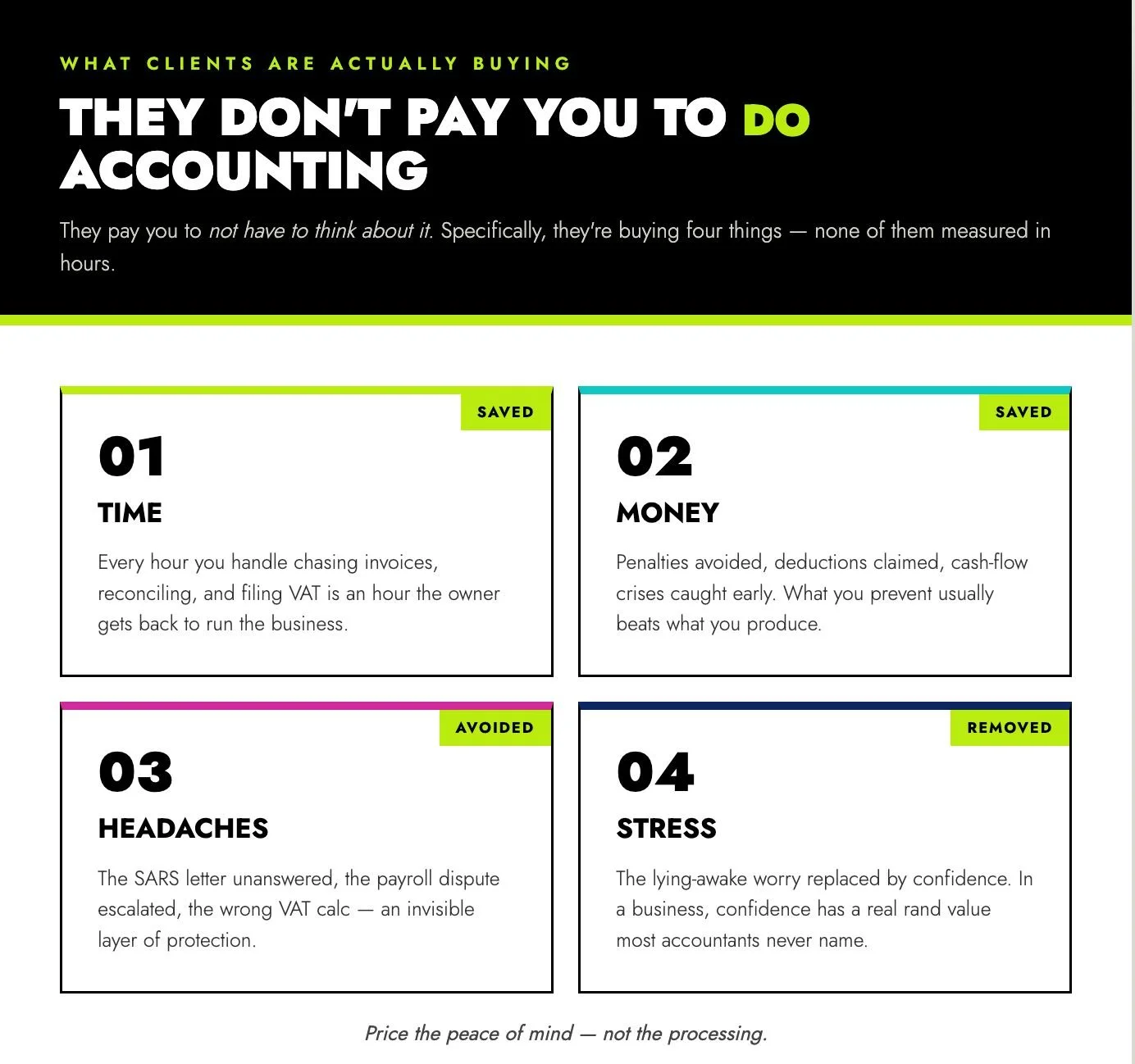
Your clients are not paying you to do accounting. They are paying you to not have to think about accounting. They are paying for four things, specifically:
Time saved. The hours they would otherwise spend chasing invoices, reconciling statements, preparing VAT schedules, and filing returns. For most SME owners, that is time they cannot bill to a customer or invest in their own growth. Every hour you handle is an hour they get back.
Money saved. The penalties avoided, the deductions claimed, the tax structuring opportunities identified, the cash flow problems caught before they become crises. The value of what you prevent is almost always greater than the value of what you produce.
Headaches avoided. The SARS correspondence that would have gone unanswered, the payroll dispute that would have escalated, the VAT calculation that would have been wrong. Your technical competence is the invisible layer of protection between your client and a category of problems they do not fully understand.
Stress removed. The entrepreneur who lies awake wondering whether the books are right, whether tax season will be manageable, whether the accountant is across things. When the relationship is working, that stress disappears. It is replaced by confidence, and confidence, in a business context, has a real rand value that most accountants never think to name.
When you frame your fee around this (when you present your retainer as the cost of all of that, rather than the cost of X hours of processing) the conversation changes entirely. The client is no longer comparing your rate to a competitor's rate. They are asking themselves whether that peace of mind, that protection, that time back, is worth the monthly fee. For an SME with a professional, competent, and timeous accountant, the answer is almost always yes.
That phrase deserves to sit in your own vocabulary: professional, competent, and timeous. It is not marketing language. It is the three-part promise that distinguishes a trusted advisor from a number-processor. You file before the deadline, not after. You flag the problem before it becomes a penalty. You give advice that is accurate, not approximate. That combination is rarer than it should be in the market, and it is worth charging for.
Be Affable, Available, and Worth Every Rand
There is an old framework that circulates among service professionals: to succeed, be affable, affordable, and available. The three A's. It has lasted because it is largely true. Clients choose accountants they like, can reach, and can afford. They stay with accountants who consistently deliver on all three.
But the third A deserves a closer look, because "affordable" does not mean cheap. It means worth what you charge.
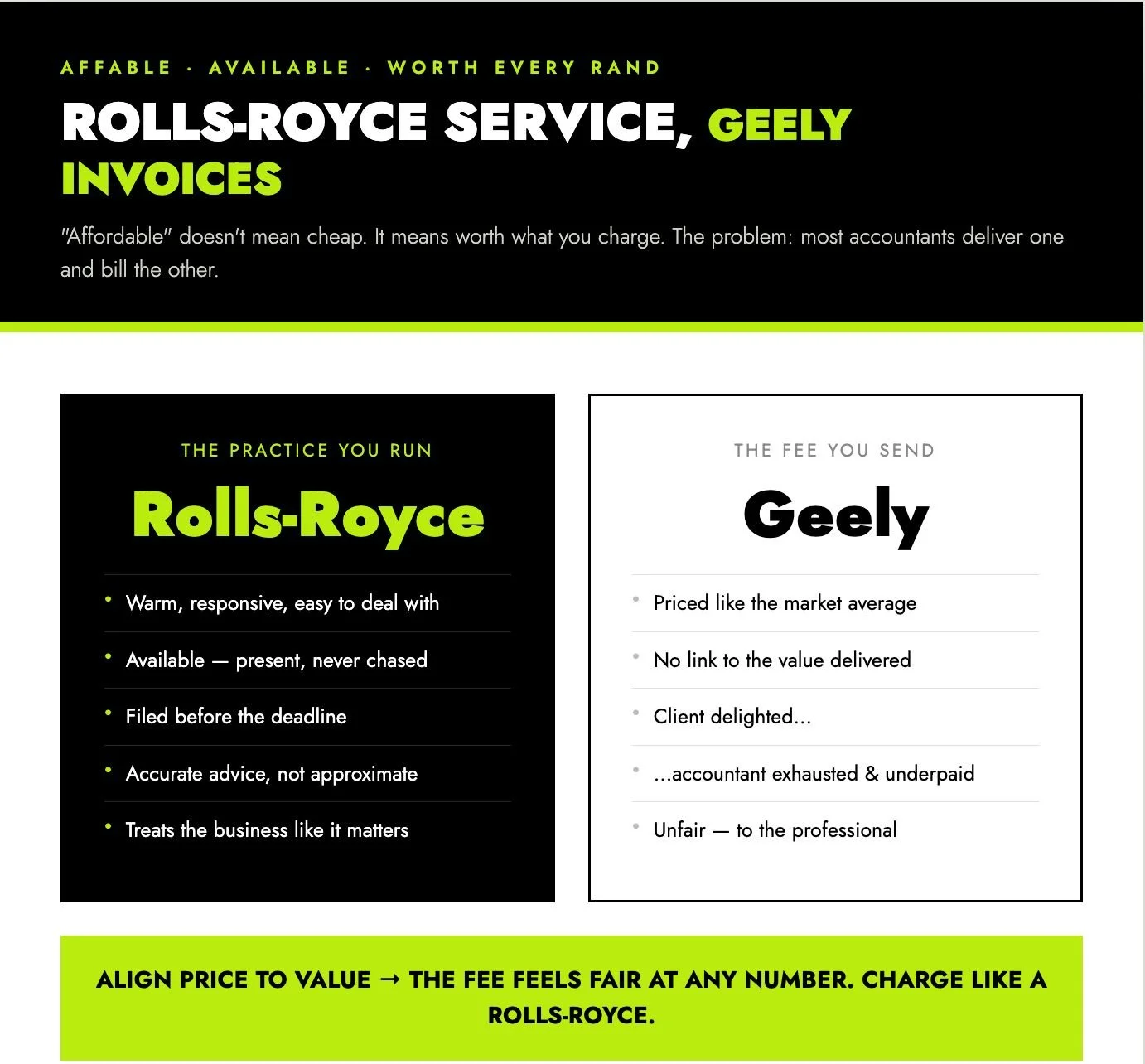
Think about it this way. A Rolls-Royce is not affordable in the sense that anyone can buy one. But the person who drives one does not feel overcharged. The engineering, the finish, the service, the experience: every element of the product justifies the price so completely that the buyer feels the transaction was fair, even at figures that would seem extraordinary in another context. Value and price are aligned. That alignment is what makes the fee acceptable, not the absolute number.
The equivalent in your practice is this: if you are genuinely affable (warm, responsive, easy to deal with), genuinely available (accessible when a client needs you, present in the relationship rather than someone they have to chase), and genuinely delivering professional, competent, and timeous service, you are a Rolls-Royce practice. You should price like one.
The problem most accountants have is that they deliver Rolls-Royce service and send Geely invoices. They are warm, available, technically excellent, always there when the client calls, and then they charge a fee that bears no relationship to any of that. The client is delighted. The accountant is exhausted and underpaid. The relationship is, in a real sense, unfair: not to the client, but to the professional who built it.
Clients who want Geely prices should expect a Geely experience. They should not expect unlimited availability, warm and thoughtful advice, technically excellent work delivered before the deadline, and a professional who treats their business as if it matters. That combination has a price. It is your job to name it, and to name it without apology.
The three A's, properly understood, are not a case for discounting. They are a case for commanding a premium. You have built something valuable. Charge for it.
The Five Models, and When to Use Each
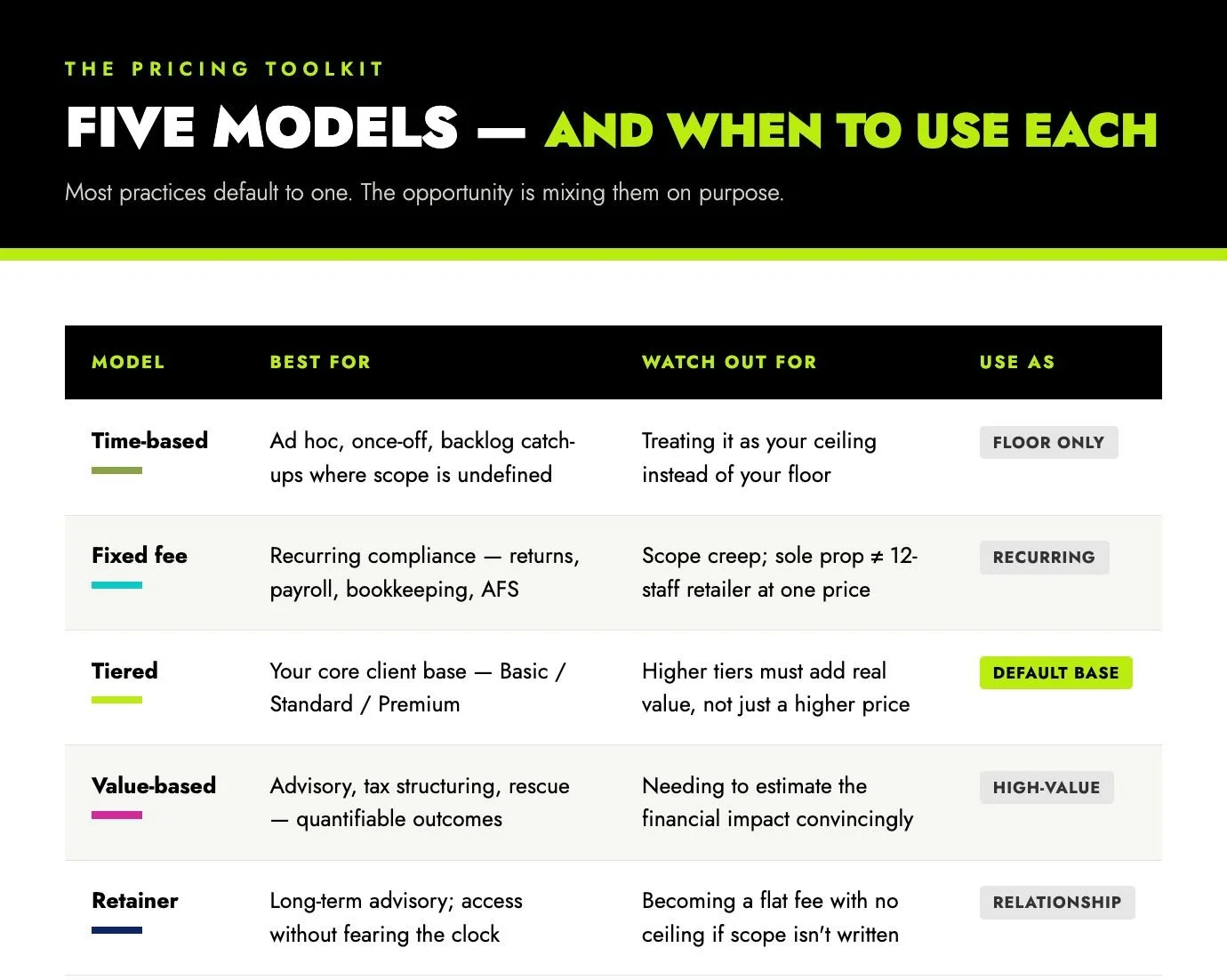
CIBA's pricing guide identifies five models that work for accounting practices. Most small practices default to one or two. The real opportunity is knowing which model fits which type of work, and mixing them intentionally.
Time-based works for ad hoc and once-off engagements where scope is genuinely undefined. Use it, but use it with a properly calculated floor rate, not a number inherited from a competitor.
Fixed fee works for recurring compliance work (tax returns, payroll, monthly bookkeeping, financial statements). The risk, as the guide flags, is scope creep: a sole proprietor with one income stream and a retail business with four product lines and twelve employees are not the same engagement at the same fee. Scope-based differentiation within fixed fees protects your margin.
Tiered pricing is where most practices should be operating for their core client base. The guide's example structure (Basic for processing and annual returns, Standard for management accounts and VAT, Premium for full reporting and a monthly strategy call) works because it gives clients a choice, anchors the mid-tier as the obvious value pick, and sets clear expectations about what is and is not included. Critically, higher tiers must include real additional value (insight, strategic input, faster turnaround) and not simply a higher price for the same deliverables.
Value-based pricing is for advisory, tax structuring, business rescue, and cash flow strategy work (engagements with a clear, quantifiable outcome). Ask outcome-based questions ("what is this decision worth to your business?"), estimate the financial impact, and price accordingly. If your intervention saves a client a material amount, your fee should reflect the result, not the hours. The man with the hammer understood this instinctively.
Retainer-based pricing is for long-term advisory relationships. The client pays a fixed monthly fee for access to your expertise, ongoing reporting, and strategic support. The retainer's appeal is psychological as much as practical: the client can ask questions without fearing the clock. CIBA's guide recommends a four-step setup (audit what you already do for the client regularly, create basic and premium options, agree scope in writing, and reassess annually).
What You Are Giving Away for Free
Before you build a new pricing structure, do one exercise: look at the last three months of client interactions and identify everything you did that was not on any invoice.
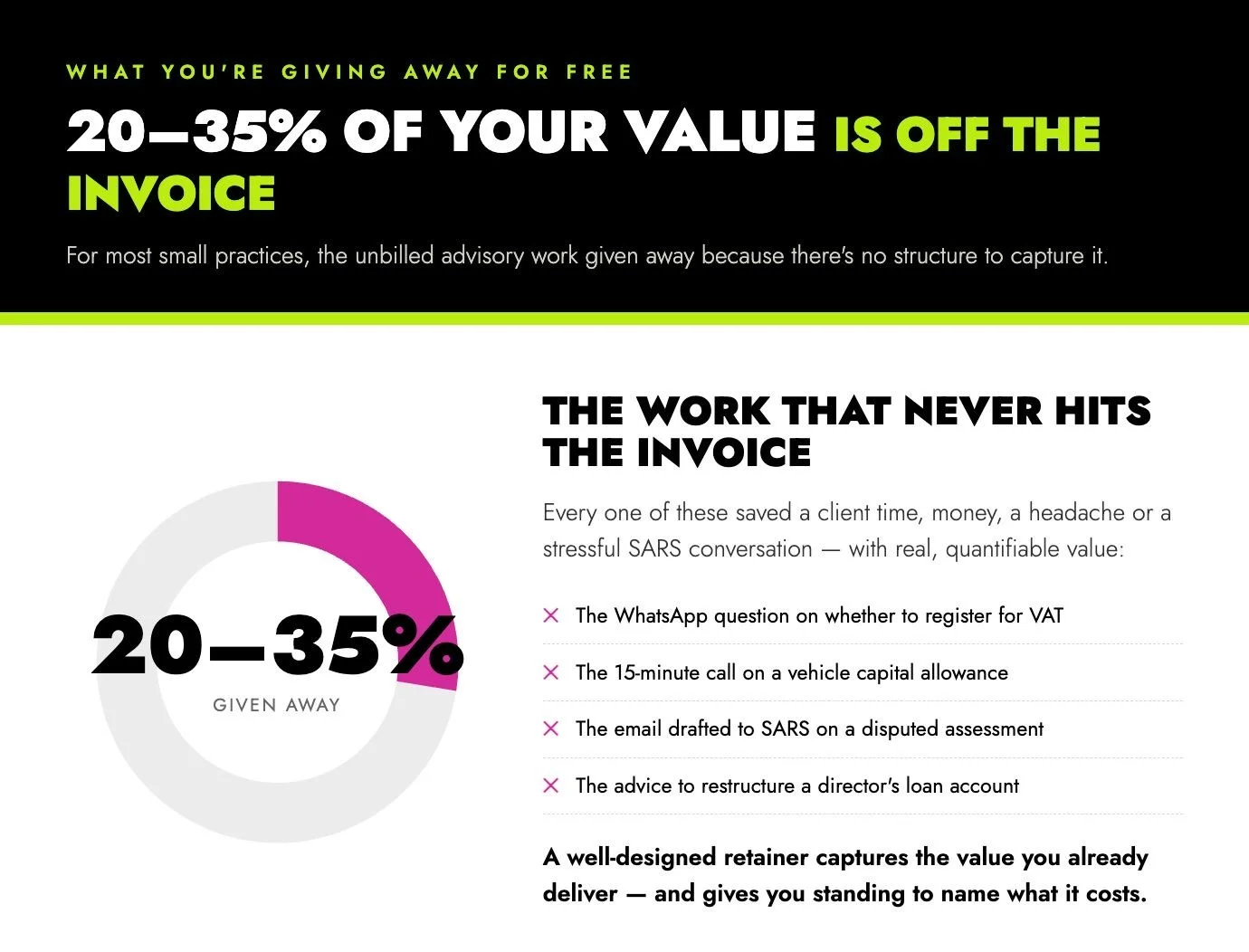
The WhatsApp question you answered about whether to register for VAT. The fifteen-minute call about whether a vehicle qualifies for a capital allowance. The email you drafted to SARS explaining a disputed assessment. The recommendation you made about restructuring a director's loan account.
Every one of those interactions saved your client time, money, a headache, or a stressful conversation with SARS. Every one of them had a real, quantifiable value. None of them appeared on an invoice. Collectively, for most small practices, that unbilled advisory work represents between 20% and 35% of the value they actually deliver to clients, given away because there was no structure to capture it.
A well-designed retainer does not just increase what you charge. It captures the value you were already delivering, puts a framework around it, and gives you the professional standing to name what your expertise costs.
The Conversation You Have Been Avoiding
Most accountants understand value pricing intellectually. They do not implement it because they are afraid of one conversation: the client who pushes back.
"I used to pay less." "I don't need all of that." "Can't you just charge me for what I actually use?"
These objections are not about price. They are about perceived value, and perceived value is your responsibility to establish, not the client's responsibility to discover. When pushback comes, the question to ask is not "can I justify this price?" but "can I show this client, in concrete terms, what they are getting, and what they would be missing without it?"
What they would be missing is someone affable, available, professional, competent, and timeous. An accountant who files before the deadline rather than the day after, who flags the problem before it becomes a penalty, who gives advice that is accurate rather than approximate, and who is genuinely present in the relationship. That is not the market standard. That is the premium. Charge accordingly.
When a client pushes back on your fee, the right response is not a discount. It is a demonstration. Show them the time they saved. Show them the penalty you prevented. Show them the hours you handled so they did not have to. The old engineer did not reduce his invoice. He explained it.
The Engagement Letter Is Where Value Pricing Lives or Dies
A value-based retainer is only as strong as the document behind it. The engagement letter must define precisely what is included in each tier, what is excluded, and how out-of-scope work is priced and authorised.
Without that definition, the retainer becomes a flat fee with no ceiling, and scope creep does the rest. CIBA's pricing guide is direct on this: communicate clearly, use written agreements, and track your time even on fixed fees to ensure the fee remains profitable. Reassess annually. Costs shift. Scope shifts. Pricing is not a one-time decision. It is a practice management discipline.
Start Here
CIBA members can access the full Pricing Services in Your Practice 2026 guide on their member profile at myciba.org. It includes the minimum hourly rate formula, the tiered package template, the value-based pricing framework, and the four-step retainer setup process, everything you need to build a pricing structure that reflects what your work is actually worth.
The designation is not the barrier. The conversation is.
👉 Join CIBA and we will show you how to position yourself as the expert clients pay more for, and keep paying.
Further Reading
- From Compliance Shop to Advisory Firm: The 12-Month Plan That Doubles Your Average Fee
- Why Advisory Services Are the Future of Accounting
- Effective Pricing Strategies for Accounting Firms in South Africa
- The Ethics Mistakes That Quietly Cost Accountants Clients, Fees, and Their Reputation