This article will count 0.25 units (15 minutes) of unverifiable CPD. Remember to log these units under your membership profile.
Most accountants believe their biggest professional risk is technical error. They worry about misinterpreting a standard, making a mistake in a tax calculation, or missing a disclosure in financial statements. Technical competence matters, but in practice it is rarely what damages an accountant’s career.
The real risk often lies somewhere else. It lies in ethical decisions.
Many accountants do not lose clients, income, or reputation because they lack knowledge. They lose it because small ethical decisions slowly weaken their professional position. These decisions often feel harmless at the time. They appear as small favours, quick adjustments, or silence when something feels uncomfortable.
Over time, those small decisions change how clients see the accountant. Once that shift happens, the accountant no longer controls the relationship.
Ethical problems rarely arrive as obvious problems
Ethical failures almost never begin with major misconduct. They begin with situations that appear manageable.
A client may ask for help with a transaction that does not quite look right. Another client may request that something be processed quickly before month end without proper documentation. A director may suggest that a number be adjusted because the bank is watching the results.
The accountant immediately recognises that the request is questionable, but it also feels easier to help than to create conflict. The client relationship is important. The fees are important. The accountant wants to be seen as helpful and supportive.
So the request becomes a small compromise.
The difficulty is that small compromises rarely stay small.
The moment an accountant loses authority
One ethical mistake can quietly change the entire client relationship.
When a client sees that an accountant is willing to bend a rule once, the professional boundary becomes unclear. The accountant is no longer seen as an independent professional applying standards and judgement. Instead, the accountant becomes someone who can be persuaded.
This changes the balance of power.
The client begins to push further. Requests become more frequent. Pressure increases. When problems eventually arise, the client often distances themselves from the decision and places the responsibility on the accountant.
At that point the accountant carries the risk while the client protects themselves.
Why ethical mistakes cost more than technical mistakes
Technical mistakes are usually fixable. An incorrect tax treatment can be corrected. A disclosure can be updated. A reconciliation error can be resolved.
Ethical mistakes are different because they damage trust.
Once trust is weakened, several things begin to happen. Clients question invoices. Fees become harder to collect. Disagreements become more frequent. The accountant spends more time managing conflict than delivering value.
Even worse, ethical issues can lead to complaints, regulatory attention, or reputational damage within professional networks.
In many cases the financial cost of these situations is far greater than the value of the client that created the problem.
Client pressure is one of the biggest ethical risks
Many ethical mistakes occur because accountants want to help clients solve problems.
Clients approach their accountants during difficult moments. Cash flow is tight. SARS queries appear. Banks request explanations. Directors are under pressure to show better results.
In these moments clients often look to the accountant for a solution.
The problem is that the solution they want may not be the solution that complies with professional standards.
The request may sound reasonable. The client might say they only need help once. They might suggest that other accountants handle things the same way.
These conversations create pressure. Accountants want to support their clients, but they also know their professional responsibilities.
This is where many ethical mistakes begin.
Conflicts of interest appear slowly
Another ethical risk appears when relationships with clients become too informal.
Many accountants work with the same clients for years. Over time the relationship becomes friendly and personal. Conversations become informal. Professional boundaries start to fade.
This can create hesitation when difficult conversations are required.
The accountant may avoid challenging a client decision because they do not want to damage the relationship. They may avoid asking difficult questions because the client is a long standing supporter of the practice.
Ironically this behaviour does not protect the relationship. It weakens it.
Clients rely on accountants for independent judgement. When accountants avoid difficult conversations, they fail to deliver the very value that clients need.
Strong ethics strengthens a practice
Accountants sometimes worry that strict ethical boundaries will drive clients away. In reality the opposite is often true.
Professionals who maintain clear ethical standards build stronger credibility. Clients understand that the accountant operates within clear rules. This creates respect for the accountant’s judgement.
When that respect exists, the entire relationship improves.
Fee discussions become easier. Professional advice carries greater weight. The accountant is seen as a trusted advisor rather than someone who simply produces compliance documents.
Over time these relationships create more stable income and stronger professional reputation.
Learning how to say no
One of the most valuable professional skills accountants can develop is the ability to say no in a calm and professional way.
Many practitioners fear that refusing a client request will damage the relationship. In practice, the way the response is communicated makes a significant difference.
A professional response does not accuse the client of wrongdoing. Instead it focuses on professional responsibilities.
For example, an accountant may say that a particular treatment cannot be applied because it would not comply with accounting standards or tax legislation. The accountant can then offer to help find a legitimate alternative.
This approach maintains the relationship while protecting professional integrity.
Clients may not always welcome the response immediately, but they often respect the professionalism behind it.
The reputation of an accountant is built in small moments
Very few accountants experience a single dramatic ethical failure. Most reputational damage develops gradually.
It begins with small decisions. A moment of silence when a question should have been asked. A small adjustment that should not have been processed. A request that should have been declined.
Each decision may appear insignificant at the time. Together they shape how clients, colleagues, and regulators view the accountant.
Professional reputation is not built through technical knowledge alone. It is built through consistent judgement, clear boundaries, and the courage to protect professional standards.
For accountants who want long careers, strong practices, and trusted client relationships, ethical clarity is not optional. It is one of the most valuable assets they have.
CPD ON Budget Tax Changes: What They Really Mean for Your Clients
The Budget Speech makes headlines.
Your clients start asking questions immediately.
What actually changed?
What applies now?
What is still only a proposal?
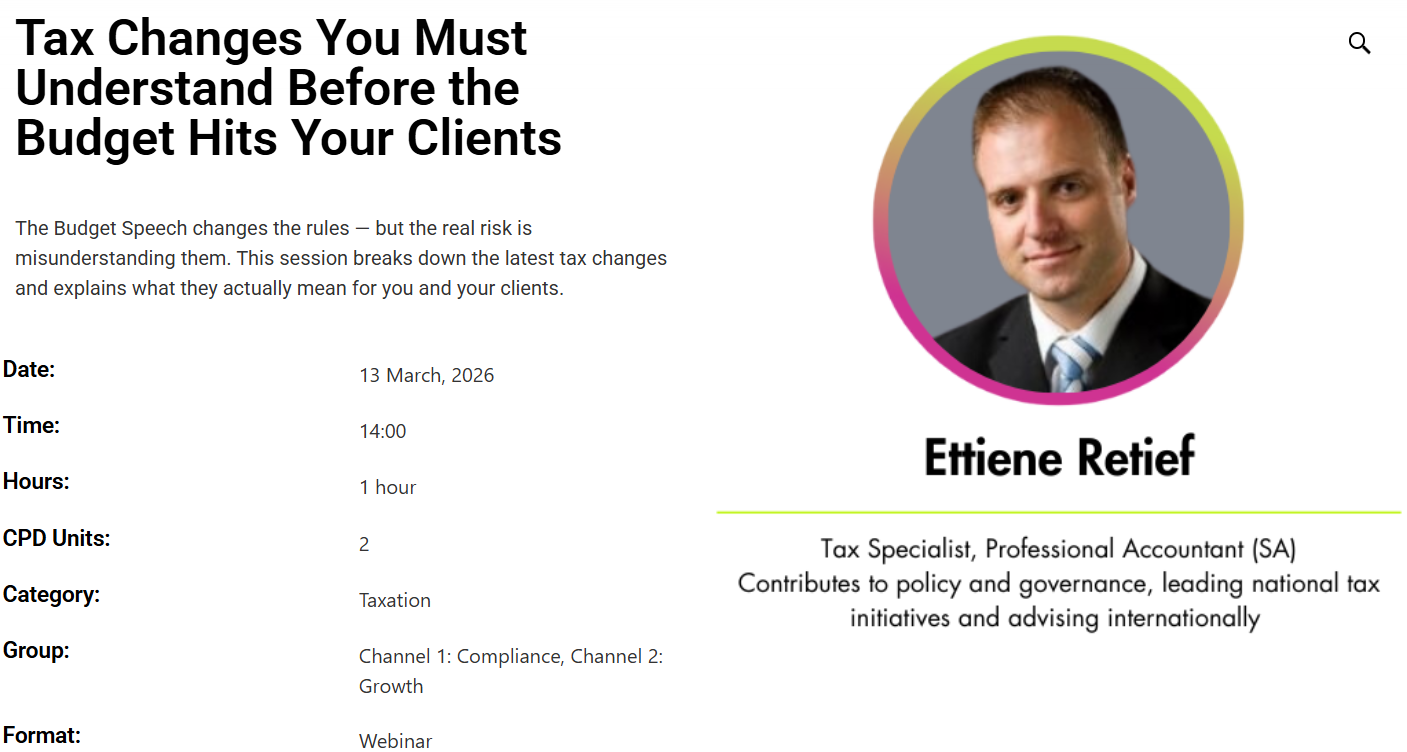
This practical CPD session cuts through the noise and explains the real tax impact of the Budget Speech. Instead of repeating the speech, we focus on what accountants and tax practitioners actually need to know to advise clients correctly.
Join tax specialist Ettiene Retief for a clear and practical breakdown that will help you respond to client questions with confidence.
📅 Event Details
🗓 Date: 13 March 2026
⏰ Time: 14:00
⏱ Duration: 1 hour
🎓 CPD Units: 2
📊 Category: Taxation
💻 Format: Webinar
Register Here
🎯 What You Will Learn
✔ Key tax changes announced in the Budget
✔ What takes effect immediately and what does not
✔ How the changes affect individuals and businesses
✔ What to communicate to clients right away
✔ Common misunderstandings after the Budget
🎤 Presenter
Ettiene Retief
A respected tax specialist who contributes to national tax initiatives and advises on tax policy and governance.
📢 Stay ahead of the Budget changes
Understand the impact. Advise your clients with confidence.


Trending