This article will count 0.25 units (15 minutes) of unverifiable CPD. Remember to log these units under your membership profile.
For many accountants working in corporate roles or professional practices, salary discussions feel uncomfortable. We are trained to be precise with numbers, cautious with risk, and respectful of hierarchy. Yet when it comes to our own remuneration, many professionals simply hope that someone will “notice their value”.
Hope is not a strategy.
The reality is that salaries in most organisations are not determined only by qualifications, loyalty, or years of service. They are influenced by perceived value, visibility, negotiation, and the ability to demonstrate impact. Professionals who understand this dynamic are far more successful in shaping their earning trajectory than those who simply wait for annual reviews.
For Chartered Business Accountants in Practice (CBAPs) and other finance professionals, the ability to influence your own salary is not about arrogance or entitlement. It is about understanding the economics of value within a business and positioning yourself accordingly.
Let’s explore some practical ways to do exactly that.
Understand How Businesses Actually Decide Salaries
Before asking for a salary increase, it is important to understand how organisations typically determine remuneration.
Most businesses consider a combination of the following factors:
• Market value – What other companies are paying for similar roles.
• Internal parity – How your salary compares with colleagues at a similar level.
• Business impact – The value your work creates for the organisation.
• Scarcity of skills – How difficult it would be to replace you.
• Future potential – Whether the organisation sees you as a future leader.
Notice what is not on this list.
Working late. Being loyal. Doing what is expected.
These things matter for professionalism, but they rarely drive salary decisions on their own.
Accountants who influence their salaries understand one key principle: salary growth follows business impact.
Stop Reporting Work. Start Demonstrating Value.
Many finance professionals describe their work in terms of tasks:
“I prepare management accounts.”
“I handle VAT and tax submissions.”
“I oversee the bookkeeping team.”
But tasks do not justify higher salaries. Outcomes do.
Instead of focusing on what you do, focus on what your work changes in the business.
For example:
• Did your improved reporting help management make faster decisions?
• Did your controls reduce fraud risk or errors?
• Did your cost analysis save the company money?
• Did you identify a financial risk before it became a problem?
When discussing your role, frame your work around results and impact.
For example:
Instead of saying:
“I manage the debtor’s function.”
Say:
“I redesigned the debtor follow-up process and reduced outstanding debt by 22%, improving cash flow.”
That is the language executives understand.
Make Your Work Visible
One of the biggest career mistakes professionals make is assuming that good work speaks for itself.
It rarely does.
Senior decision-makers are busy. If they do not clearly see the value you create, they cannot reward it.
Visibility does not mean self-promotion. It means communicating outcomes.
Practical ways to do this include:
• Sending short summary reports highlighting improvements or risks.
• Presenting insights during meetings rather than simply providing data.
• Sharing ideas that help management make better decisions.
• Offering solutions when problems arise.
A finance professional who consistently brings insight into conversations quickly becomes recognised as someone who contributes strategically.
And strategic contributors earn more.
Become Hard to Replace
Another powerful driver of salary is replaceability.
If an organisation can easily replace someone, salary growth tends to be limited. If replacing someone would create disruption, risk, or lost knowledge, the equation changes.
Accountants can strengthen their position by developing expertise that the business relies on.
Examples include:
• Deep knowledge of the organisation’s systems and processes.
• Strong relationships with clients, suppliers, or regulators.
• Expertise in specialised areas such as tax, IFRS, analytics, or systems implementation.
• The ability to translate financial information into business decisions.
Professionals who combine technical expertise with business understanding become extremely valuable to organisations.
Prepare Before Asking for a Raise
Many people make the mistake of asking for a salary increase without preparation.
A better approach is to treat the conversation like a professional proposal.
Before requesting a salary adjustment, consider preparing the following:
1. Evidence of value
Document your achievements over the past year.
Quantify them where possible.
For example:
• Cost savings achieved
• Revenue improvements supported
• Efficiency improvements introduced
• Risks identified or prevented
2. Market benchmarks
Research what professionals in similar roles are earning.
This provides an objective basis for your request.
3. Future contribution
Explain how your role will continue to add value.
Employers are more receptive when they see future impact, not only past performance.
Choose the Right Moment
Timing matters.
The best salary discussions often happen:
• During performance reviews
• After a successful project or achievement
• When responsibilities have increased
• When the business is performing well
The worst moment to ask for a raise is when the organisation is under financial pressure.
Strategic timing significantly improves the chances of a positive outcome.
Have the Conversation Professionally
When discussing salary, tone matters.
Avoid emotional arguments such as:
“I work very hard.”
“I have been here for years.”
“Everything is getting expensive.”
Instead, keep the conversation focused on value and contribution.
A professional approach might sound like this:
“Over the past year, my responsibilities have expanded and I have delivered several improvements, particularly in our reporting processes and cash-flow management. Based on the impact of this work and current market benchmarks, I would like us to review my remuneration.”
This approach keeps the discussion factual, constructive, and professional.
Sometimes the Answer Will Be No
Even strong cases do not always lead to immediate salary adjustments.
Budgets, policies, or timing may prevent a raise in the short term.
When that happens, treat the conversation as a strategic discussion, not a defeat.
Ask questions such as:
• What would justify a salary increase in the future?
• What additional responsibilities should I take on?
• What goals should I achieve before the next review?
This turns the conversation into a roadmap for future growth.
Remember: Your Career Is a Business
Chartered Business Accountants spend their careers advising businesses on strategy, profitability, and value creation.
It is worth applying the same thinking to your own career.
Your salary is not only determined by qualifications or experience. It reflects the value you create, the problems you solve, and how effectively you position yourself within an organisation.
Professionals who actively manage this process tend to see far better results than those who simply wait for recognition.
Final Thought
A salary conversation should never feel like asking for a favour.
When approached professionally, it is simply a discussion about value.
Accountants understand value better than most professionals. The key is learning how to demonstrate, communicate, and position that value effectively.
Do that consistently, and your earning trajectory will start to reflect the impact you create.
Join our CPD Here. Workplace Conflict Is Costing Your Business More Than You Think
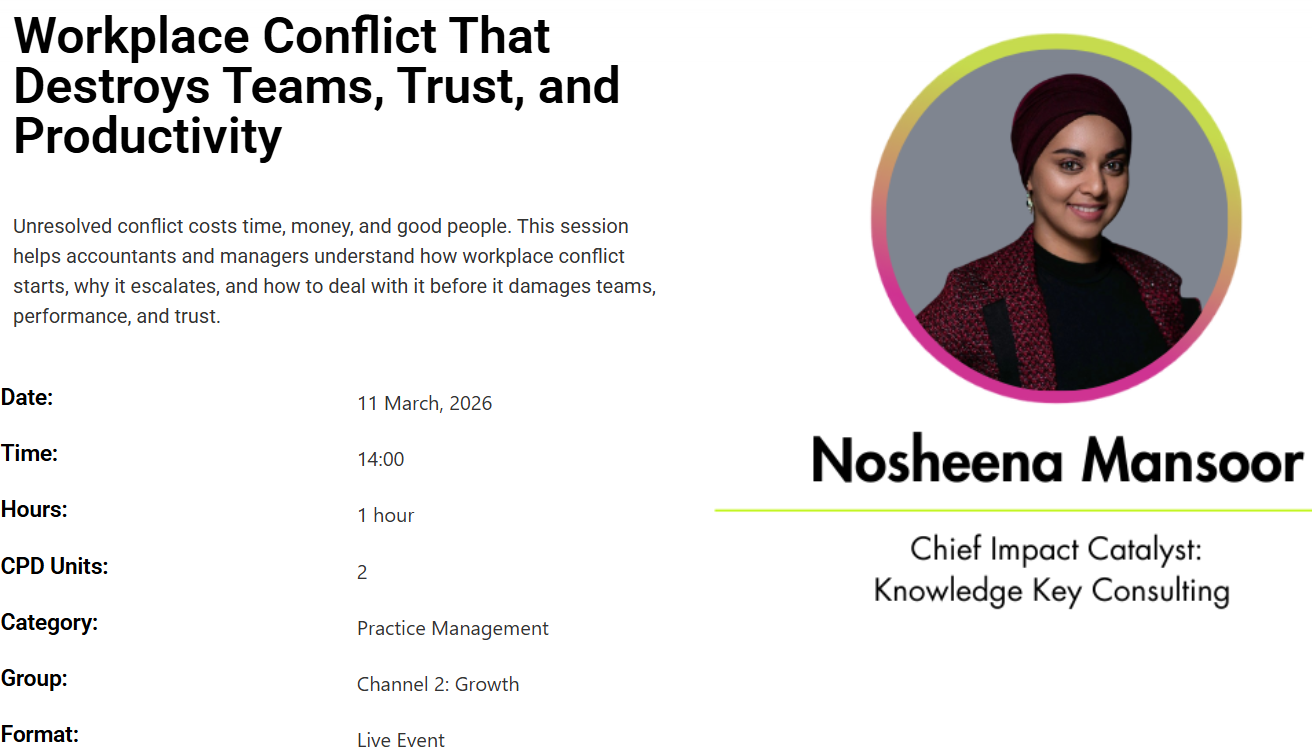
Most workplace conflict does not start with a big fight. It starts with small frustrations, poor communication, and unresolved tension that slowly grows into bigger problems.
Left unmanaged, conflict damages trust, slows down work, and pulls teams into ongoing disputes that affect productivity and morale.
This practical CPD session looks at the real causes of workplace conflict in offices, finance teams, and professional practices, and how to deal with it before it starts damaging performance.
You will learn how to recognise early warning signs, handle difficult conversations, and step in before small issues become expensive problems.
CPD Event
📅 11 March 2026
⏰ 14:00
🎓 2 CPD Units (Practice Management)
🎤 Presenter: Nosheena Mansoor
💻 Live Online Event
👉 Book your place here



Trending