Workplace Conflict: The Silent Cost Destroying Teams, Trust and Performance
This article will count 0.25 units (15 minutes) of unverifiable CPD. Remember to log these units under your membership profile.
Workplace conflict rarely starts with a confrontation.
It starts quietly.
A missed conversation. A shift in tone. A decision that doesn’t sit right. Over time, these small moments build into tension that begins to influence how people communicate, collaborate, and ultimately perform.
For accountants, financial managers, and business professionals, this is not simply a “people issue”. It is a performance issue — and if left unmanaged, it becomes a measurable cost to the organisation
Conflict Is Not the Problem , Mismanaged Conflict Is
Disagreement in a team is not only normal, it is necessary for strong decision-making. Healthy teams challenge ideas, test assumptions, and debate different approaches.
For example, a finance team may disagree on how to interpret a complex IFRS treatment or whether a provision should be recognised. These discussions, when handled professionally, improve accuracy and strengthen the final outcome.
The risk arises when that same disagreement becomes personal. Instead of debating the accounting treatment, team members begin questioning each other’s competence or intent.
Communication becomes defensive, and what was once a professional discussion turns into tension. At that point, the focus shifts away from the work, and performance starts to suffer.
Why Unresolved Conflict Becomes Expensive
Unresolved conflict does not remain isolated. It spreads, often quietly, across teams and workflows.
Consider a situation where there is tension between a financial manager and a senior accountant. Over time, the accountant stops raising concerns, avoids engagement, and shares only limited information. This leads to incomplete reporting, delayed decisions, and increased review time. The manager, in turn, begins to question the quality of work, further increasing tension.
The cost is not always visible, but it shows up in slower turnaround times, increased errors, and disengaged staff.
In a client-facing environment, this may even result in missed deadlines or reduced service quality, directly affecting the organisation’s reputation.
The Real Causes of Workplace Conflict
Workplace conflict is rarely caused by a single disagreement. More often, it stems from unclear structures and expectations.
For example, two team members may both believe they are responsible for approving a journal entry or managing a client relationship. Without clearly defined decision rights, this overlap creates frustration and tension. Similarly, when deadlines are tight and resources are limited, pressure increases, and even small miscommunications can escalate quickly.
In many cases, conflict is not about personalities, but about unclear roles, competing priorities, and lack of alignment.
Spot the Early Warning Signs
By the time conflict becomes obvious, it is usually already advanced. The real skill lies in identifying the early signs.
In practice, this might look like a team member no longer addressing concerns directly, but instead raising them with others.
Emails become more formal and less collaborative. Meetings become quieter, with less engagement and fewer contributions. There may also be subtle shifts in tone, responses become shorter, or feedback becomes more critical.
These are often dismissed as minor changes, but they are early indicators that trust is weakening and that tension is building beneath the surface.
How Leaders Accidentally Make Conflict Worse
Conflict often escalates because of how it is handled.
For instance, a manager may notice tension between two team members but choose to ignore it, hoping it will resolve itself. Instead, the situation worsens.
In another case, a leader may address the issue publicly in a meeting, unintentionally embarrassing one of the individuals involved and increasing defensiveness.
There are also situations where leaders over-accommodate one party to avoid discomfort, creating a perception of unfairness. Emotional reactions, such as frustration or impatience, can further escalate the situation.
These responses are often well-intentioned, but they reinforce the conflict rather than resolving it.
Handling Difficult Conversations Effectively
Resolving conflict requires direct and structured conversations.
For example, instead of saying, “You are always difficult to work with,”
A more effective approach would be:“I’ve noticed that during the last two reporting cycles, deadlines were missed, which delayed the final submission. Can we discuss what’s causing this and how we can address it going forward?”
This approach focuses on observable behaviour and its impact, rather than making the conversation personal. It also creates space for the other person to explain their perspective, which may reveal underlying issues such as workload pressure or unclear expectations.
The aim is to restore alignment and move forward constructively.
Address Conflict Early, or Pay Later
Timing is critical in conflict management.
For example, if a disagreement arises during a budget review and is not addressed, both parties may leave the meeting with different assumptions. Over the next few days, frustration builds, and by the time the issue is revisited, positions have hardened.
Addressing the issue early, even with a short follow-up conversation, can prevent escalation. It allows both parties to clarify their understanding and resolve the issue before it becomes more complex.
Delaying these conversations often turns a small issue into a much larger one.
Keeping Teams Productive Under Pressure
In high-pressure environments, conflict is more likely, but it does not have to disrupt performance.
A practical example would be a team working under tight deadlines during year-end reporting. Differences in opinion are inevitable, but strong teams keep discussions focused on the work. They ensure that debates are closed with clear decisions, rather than left unresolved. They also reinforce shared goals, such as meeting deadlines and maintaining reporting accuracy.
By maintaining professionalism and focusing on outcomes, teams can navigate pressure without allowing conflict to derail productivity.
Applying This in Practice
In a real work environment, managing conflict effectively is about consistent behaviour rather than one-off interventions.
For example, a finance manager can prevent many conflicts by clearly defining roles at the start of a project , who prepares, who reviews, and who signs off. This reduces ambiguity and avoids overlap. Similarly, encouraging team members to address concerns directly, rather than through others, helps maintain transparency and trust.
At an individual level, this might mean addressing a misunderstanding immediately instead of letting it build, or asking a clarifying question rather than making an assumption.
For instance, instead of assuming a colleague is being uncooperative, a simple conversation may reveal competing deadlines or external pressures.
Leaders who model calm, objective, and respectful behaviour create an environment where conflict is addressed early and constructively. Over time, this becomes part of the team culture.
Final Thought
Conflict in the workplace is inevitable.
Breakdown is not.
The difference lies in how quickly issues are identified, how professionally they are handled, and how clearly expectations are set. For accounting and finance professionals, where trust, accuracy, and sound judgement are essential, the ability to manage conflict effectively is not optional.
It is part of professional competence.
Key Takeaways
Conflict becomes harmful when it shifts from task-focused to personal
Unresolved conflict creates real, measurable business costs
Early warning signs are visible — and should not be ignored
Poor handling escalates conflict more than the issue itself
Addressing tension early protects both performance and trust
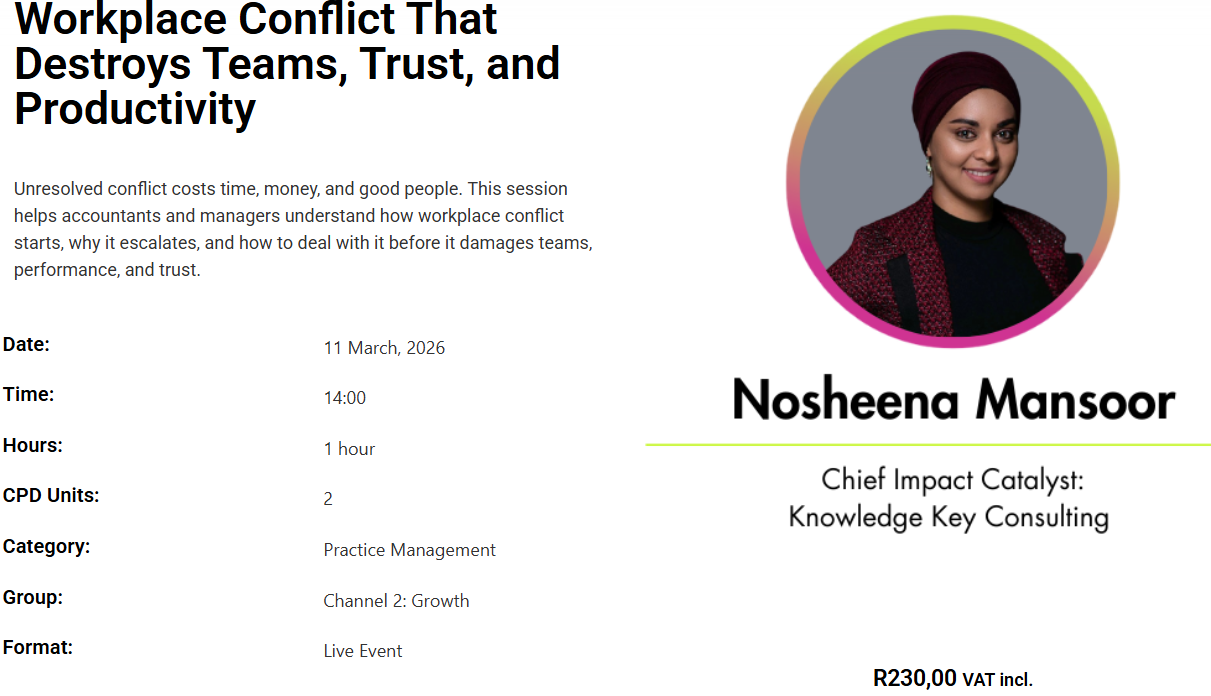
CPD ON Workplace Conflict That Destroys Teams, Trust, and Productivity
By attending this event, delegates will learn:
Delegates will learn how to recognise conflict early, deal with difficult conversations, and step in before issues escalate. This helps them protect team morale, reduce stress, and keep work moving instead of being stuck in ongoing disputes.