This article will count 0.25 units (15 minutes) of unverifiable CPD. Remember to log these units under your membership profile.
Your client phones in a panic. A subcontractor has walked off site, the retention money is disputed, and the relationship is finished. Their first move, before they call you properly, before they call an attorney? They paste the contract into ChatGPT and ask it what to do.
That instinct is the problem. It is also your opportunity.
The machine reads the words. You read the cost.
An AI can explain what a contract says. What it cannot do is tell your client what a weak dispute clause will cost their business, in their cash flow, before they sign it. It cannot weigh whether this fight is worth having. That judgement is the value, and it is the thing that keeps you in the room when a client could, technically, have asked a chatbot.
So let me put real numbers on what “going to court” actually means, because most accountants, and most of their clients, badly underestimate it.
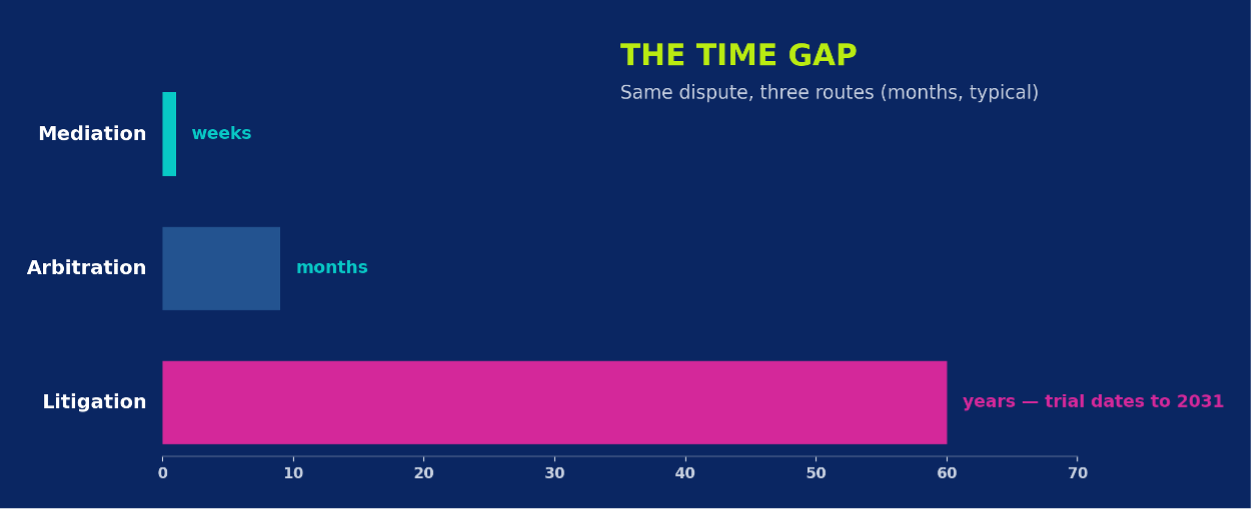
Picture a straightforward commercial dispute. High Court. Summons issued today. When do you walk into a courtroom for trial? Most people guess one to two years. The honest answer from practice is years, not months. I have run a matter that took four years to resolve, and it settled. It never reached trial. The cost of that single dispute was R1.2 million, settled, not won, and the cost lands either way. I have personally had a matter take roughly seven years to reach trial.
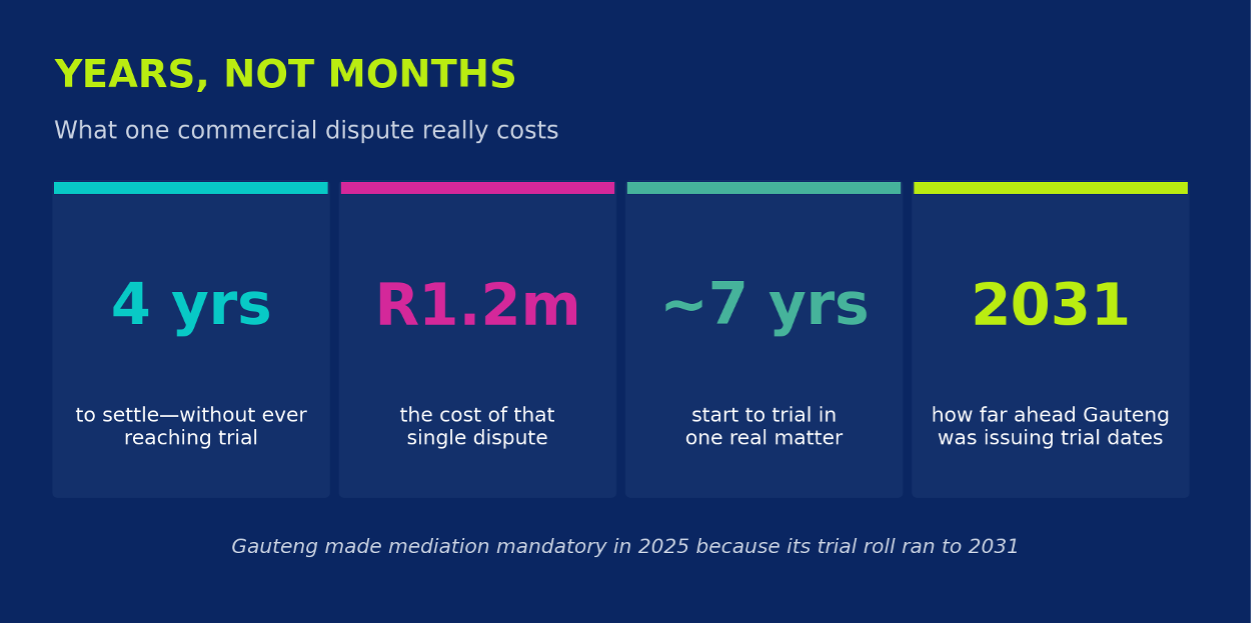
This is not bad luck. It is structural. When the Gauteng High Court brought in its new mediation rules in 2025, the official reason was that its civil trial roll had dates running as far ahead as 2031. Read that again. Courts handing out trial dates for 2031.
What ADR actually is, in one sentence
Here is the definition you can give a client on the spot: Alternative Dispute Resolution is resolving a dispute without asking a court to impose the answer. Hold onto that word, impose.
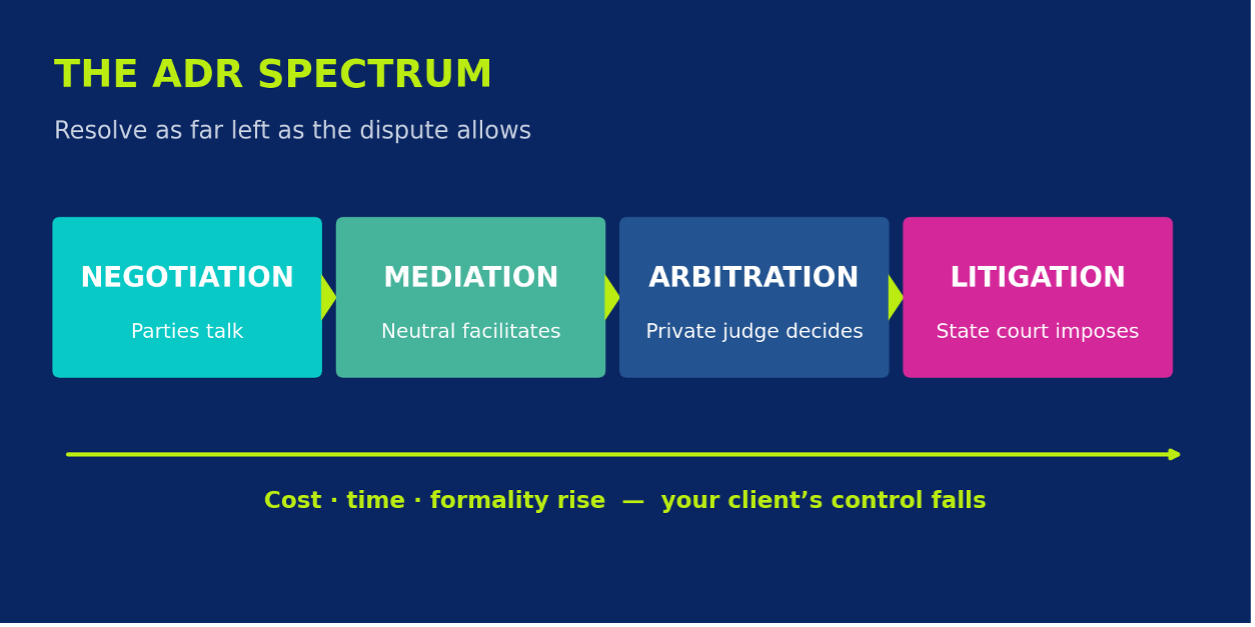
It is an umbrella term, not one process. Think of a spectrum. On the far left, negotiation, where the parties simply talk and keep full control. Move right to mediation, where a neutral party helps them get there but the parties still own the outcome. Move right again to arbitration, where a private decision-maker decides for them. On the far right, litigation, where the State’s court imposes the answer. As you move right, cost rises, time rises, formality rises, and your client’s control falls away. Advising well means resolving as far left as the dispute realistically allows.
The two your clients confuse constantly are mediation and arbitration. The cleanest way to separate them is to ask who decides. In mediation, the parties decide and a neutral party facilitates, so it only binds if they settle and sign. In arbitration, the arbitrator decides like a private judge, and the award is binding and enforceable almost like a court order. Mediation is cheap, fast and preserves the relationship. Arbitration is structured, and can rival litigation in cost if you do not manage it.
“Optional” is no longer the whole story
This is the part most people get wrong, so be precise with clients. Since 2020, Rule 41A of the Uniform Rules requires every plaintiff to serve a notice, with the summons, stating whether they agree to or oppose mediation. That applies in every High Court division.The notice is compulsory. The mediation itself stays voluntary unless both sides agree.
Gauteng is the outlier. From 22 April 2025, mediation became genuinely mandatory for all civil trial matters in that division, and it has teeth. A mediator’s report is now a pre-condition to enrolling for trial. No report, no trial date, struck off the roll. And courts have confirmed you cannot dodge it just because you have decided it would be futile. The courts mean it.
The clause is where it lives or dies
A good dispute-resolution clause works in steps, each with a hard time-trigger. Negotiation between designated representatives, with a clock, say thirty days. Then mediation, with the clause naming who appoints the mediator if the parties stall. Then arbitration, a single arbitrator under institutional rules, final and binding. And always, always, a carve-out preserving the right to run to court for urgent interim relief, because a counterparty could be stripping assets while your client waits in a sixty-day ADR queue.
When a client’s contract lands on your desk, interrogate the dispute clause on a few points.
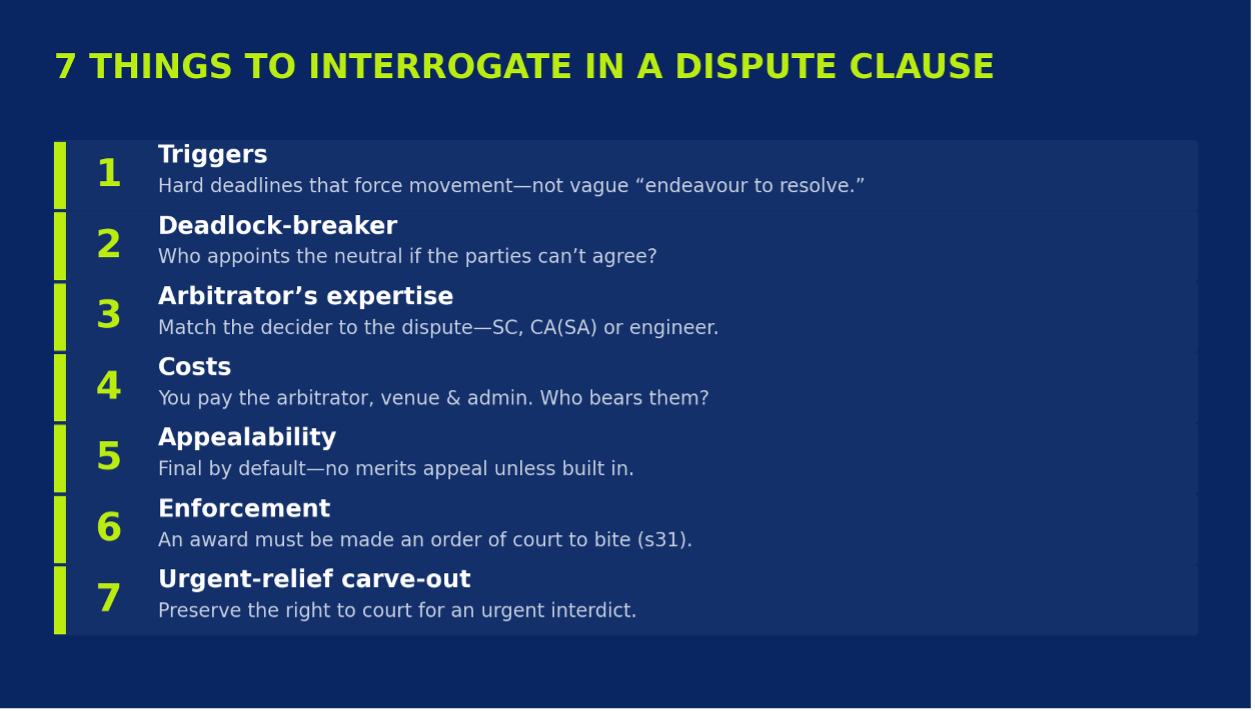
That enforcement point catches people. An arbitration award is not self-executing. Under section 31 of the Arbitration Act of 1965 you apply to have it made an order of court before you can attach assets. Under section 33, a court will only set an award aside on very limited grounds, misconduct, gross irregularity, or the arbitrator exceeding their powers, brought within six weeks. Finality cuts both ways. Fast and final is the prize, but pick the wrong person to preside over the proceedings and your client is largely stuck with a poor result.
The same failure modes repeat in the field: the toothless “resolve amicably” clause, mediating only after positions harden and costs are sunk, the wrong process for the dispute, the runaway arbitration with no cost cap, the wrong neutral, and winning an award then never making it an order of court. This is the same lesson our series has hammered through every contract type, from the way vague lease clauses fail in predictable ways, to the uncomfortable truth that your biggest contract risk is how fast you read it.
Stay in your lane, and know where it ends
Be clear about the line. An attorney gives legal advice and formal opinions, drafts and settles contracts as a legal service, and litigates. As a CBAP you do something different and just as valuable: you read and flag the dispute clause, you advise on the commercial and financial risk it carries, and when it crosses into legal territory you refer it on. You spot the risk. You do not give the legal opinion, and you never practise law.
You are not alone in that referral. Your CIBA membership already includes a free Legal Helpline, access to a qualified attorney for a quick review of contracts, debt collection, directors’ duties and personal liability. It is your first port of call, and it is also what tells you when a matter needs a paid, thorough review.
Do this, this week
Pull three of your clients’ contracts and read only the dispute-resolution clause. Just three. If one says “endeavour to resolve amicably” and nothing else, you have found a conversation worth having, and a service worth charging for. You will never turn a client away from court entirely. But you can make sure that when a dispute comes, it is a speed bump, not a seven-year sentence. The clause your client signs decides which one they get. You are the one who reads it first.
👉 Join CIBA and we’ll show you how to turn a contract review into advisory income clients will pay for, not just compliance they expect for free.
Further Reading
One Signature Can Cost You Everything — why the real contract risk is how quickly you read the document, not what it says.
Your Client Signed a Lease. Who Pays When It Burns Down? — how letting and hiring agreements fail through vague clauses and silence, and where to flag and refer.
The Claim Your PI Insurance Won’t Cover — how your engagement letter defines your scope and limits your exposure before PI cover ever kicks in.
When a Client Says “Just Register It” — Your Ethics Don’t Stop There — how a routine instruction can quietly create years of liability for the accountant who acts on it.


Choose Your Path to Exclusive Insights
Stay ahead in the world of accounting with premium content designed for professionals like you. Access expert articles, industry trends, and essential resources. Become a CIBA member and claim your CPD hours from CIBA.
CIBA Member Access
R250.00 FREE!
100% Discount when you become a CIBA Member. Join now to claim your CPD Hours. Register here: https://accounts.myciba.org/register