PCAOB 2025 Inspections: All Big Six Audit Firms Improve
This article will count 0.25 units (15 minutes) of unverifiable CPD. Remember to log these units under your membership profile.
The Public Company Accounting Oversight Board released its annual inspection reports for the six largest US audit firms on Thursday 13 August 2026, covering audits inspected during 2025. The headline is that every firm improved. The reports also arrive as the PCAOB, under new leadership, is considering changes to its inspection programme, including a greater focus on firms' systems of quality control.
The reports' headline measure is the Part I.A deficiency rate. A Part I.A deficiency is identified where the PCAOB believes that, when the firm issued its audit report, it had not obtained sufficient appropriate audit evidence to support its opinion on the issuer's financial statements and/or internal control over financial reporting. It is the most serious category in the report, and it is the number the firms are judged on publicly. However, the PCAOB cautions that inspection results are not overall ratings of a firm's audit quality.
Below is a summary of the results, the areas that improved, and the areas that still warrant attention.
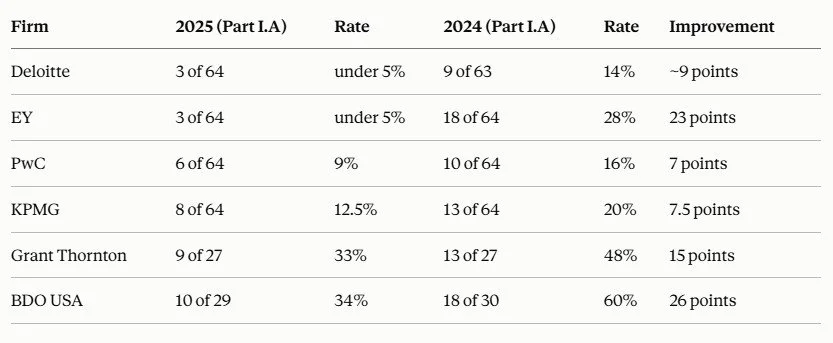
Where the successes are
EY made the biggest single jump. Its rate fell from 28% to under 5%, which the firm describes as its best inspection ever. EY has attributed the improvement to its broader audit transformation, including planned investment of $1 billion in technology and talent through fiscal 2027, greater use of AI and analytics, changes to its audit methodology and continued investment in training. Those are EY's explanations rather than findings by the PCAOB, so the causal link should be treated cautiously.
Deloitte and EY are now the cleanest of the six, both sitting around 5%.
The mid tier moved fastest in relative terms. BDO cut its rate from 60% to 34% and Grant Thornton from 48% to 33%. These are substantial reductions, although both firms continue to have materially higher deficiency rates than the Big Four firms.
The improvement is broad, not isolated. All six firms moved in the same direction, suggesting that the improvement was broad-based rather than confined to a single firm.
Where the concerns remain
Revenue remains a recurring area of concern. Revenue and related accounts featured among the areas inspected and deficiencies identified across several of the six firms. The PCAOB's data also shows that inspection teams select areas because they are generally significant to the financial statements, involve complex judgements or present other audit risks.
Other areas identified in individual reports include long-lived assets, inventory, goodwill and intangible assets, income taxes, insurance reserves and investment securities, although the areas and findings varied considerably by firm.
The gap between the Big Four and the next tier is wide. Grant Thornton and BDO still had Part I.A deficiencies in roughly one in three inspected audits, with deficiency rates roughly six to seven times those of Deloitte and EY. The result is particularly relevant as Grant Thornton integrates CBIZ's accounting practice following their combination, which is expected to significantly expand Grant Thornton's US audit business.
The percentages need context. The PCAOB selects audits using both risk-based and random methods, and the audits reviewed are not necessarily representative of a firm's entire population. The PCAOB also cautions that inspection results are not necessarily comparable across years or firms. That means a change in the number of audits with deficiencies can produce a relatively large percentage movement, particularly where the number of audits reviewed is limited.
The inspection approach may also change. Under Chairman Demetrios (Jim) Logothetis, the PCAOB is considering modernising its inspection programme, including placing greater emphasis on firms' systems of quality control. The Board has established an Inspections Modernization Council to help inform that work.
What this means in practice
The direction of travel is positive, but the results should not be read as proof that audit-quality problems have been resolved. The PCAOB itself cautions that inspection results are based on selected audits and are not overall ratings of firms. The more significant question will be whether the improvements are sustained and whether firms' systems of quality control are producing consistent results across engagements.
As the PCAOB considers changes to its inspection approach, future results may provide a different perspective on whether improvements are embedded across firms' quality management systems rather than confined to individual engagements.