This article will count 0.25 units (15 minutes) of unverifiable CPD. Remember to log these units under your membership profile.
National Treasury published a discussion paper on 20 August 2026 titled A Framework to Centralise Unclaimed Financial Assets in South Africa. It proposes a single central administrator for unclaimed assets, custody of those assets with the Corporation for Public Deposits, and a statutory cut-off date after which a claim can no longer be made. Comments close on 19 September 2026. Here is what is in it, in plain language, and why it affects your practice and not only fund administrators.
The starting point: unclaimed financial assets are growing
The Financial Sector Conduct Authority (FSCA) put unclaimed financial assets at roughly R88.56 billion in its 2022 report, across banking and non-banking sectors. Treasury says the total keeps growing.
Unclaimed financial assets include dormant bank accounts, unclaimed retirement fund benefits, unpaid dividends, and unpaid investment and insurance proceeds. Money that is due to somebody, and is not being paid, because nobody can find the person or the person never came forward.
Treasury is blunt about why the pile keeps growing. Every institution defines "unclaimed" differently. Every institution traces differently. Records are incomplete or out of date. Tracing is often outsourced to firms charging tracing fees that are not consistently regulated on governance, timelines or pricing. In short, the system is fragmented, and fragmentation is expensive.
What Treasury proposes
Two new structures, working together.
A central administrator holding one national record of unclaimed assets. It would do the tracing, run one public-facing portal where a person can search and claim, and process the claims when they come in.
The Corporation for Public Deposits (CPD), a subsidiary of the South African Reserve Bank that already manages deposits for government entities. Under the proposal, the assets themselves would sit with the CPD, invested in safe, liquid instruments, earning interest.
So the asset leaves the bank's or the fund's balance sheet, moves through the central administrator, and is deposited with the CPD. The data and the tracing stay with the administrator. The money and the investment sit with the CPD.
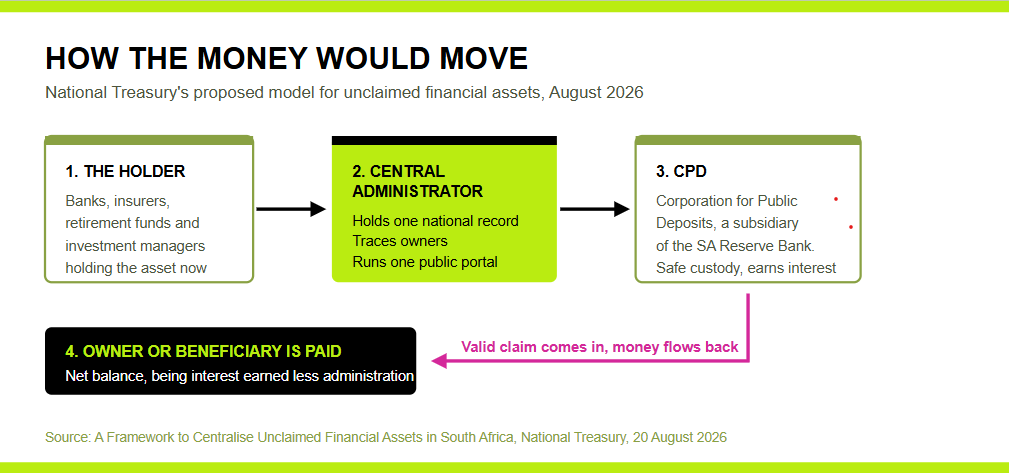
When a valid claim comes in, the claimant is paid the net balance, which Treasury defines as interest earnings less administration fees. Treasury is careful to say this is not the state taking the money. Ownership stays with the owner or beneficiary until the claim period expires.
That last phrase is the important one.
The 45-year clock
Right now, a claim on an unclaimed benefit does not expire. Treasury wants to end that, and puts two options on the table:
Option one is an age cut-off. The asset stops being claimable once the owner reaches, or would have reached, 110 years old.
Option two is a fixed period. The asset stops being claimable 45 years after it first became unclaimed. If an endowment policy matured and went unclaimed in 2015, it would fall away in 2060.
Treasury leans towards the 45-year option because it is easier to administer and does not require tracking anyone's age. Once the cut-off hits, the asset stops being claimable and is used in line with the approved CPD framework. This means that a right your client's family currently holds forever would become a right with an expiry date.
Who would run it, and when
Treasury has not decided who the central administrator should be. It sets out two routes: build a new independent agency, similar in shape to the Government Pensions Administration Agency but with its own CEO, service level standards and sanctions when it misses them, or appoint an existing administrator with the scale and systems to do the job. The FSCA would supervise either way. Self-administration by the CPD is specifically not recommended, because tracing and paying beneficiaries sits outside the CPD's mandate.
The rollout is phased. Phase one is unclaimed retirement fund benefits. Phase two extends the model to dormant bank accounts, insurance proceeds and investment products, once sector-wide definitions and the enabling legislation are in place.
There is a definitional gap Treasury openly flags. The Pension Funds Act already says a benefit is unclaimed if it is not paid within 24 months of becoming legally due and payable. Banking and investment products have no equivalent. One of the consultation questions asks whether the 24-month rule should be stretched across the whole financial sector.
Why this is a practice issue, not a fund administrator issue
Unclaimed benefits are born in payroll and HR records, and payroll records are your territory.
Think about where your clients operate. Construction, private security, farming, hospitality and logistics all run high staff turnover. A general worker joins in March, leaves in November, moves provinces, changes numbers, and the contact details on the fund's member record die with the old cellphone. Multiply that across a decade of a client's payroll and you can see how R88 billion accumulates.
Three places this can become billable work:
Deceased estates.
Old employment history is where lost benefits hide. A single search across former employers can add real money to an estate, and the executor is relying on you to think of it.
Employer data clean-ups.
If Treasury tightens FSCA reporting in phase one, funds will push harder on employers for complete member data. Your labour-intensive clients will be the ones who cannot produce it. Cleaning that up before it becomes a compliance problem is an advisory engagement, not a favour.
Client wealth reviews.
Most people have no idea they are owed anything. Asking a client to list every employer since their first job, and every policy they stopped paying, costs you twenty minutes and can change a household's year.
This is also why the wider regulatory direction matters. The FSCA has already mapped its priorities for the next three years, and reporting quality runs through most of them. Practitioners who track that early get to charge for readiness instead of scrambling for it.
Also worth watching: a separate working group chaired by the FSCA is looking at a digital retirement dashboard for South Africa, which would let members see and track their retirement savings in one place. If it lands, it attacks the problem at the source.
A policy is written by the people who show up. Very few small practitioners ever comment on a Treasury paper, which is exactly why the sector's real-world experience of lost member data rarely makes it into the final design.
👉 Join CIBA and we'll show you how to turn a Treasury discussion paper into a service your clients pay you to handle.