This article will count 0.25 units (15 minutes) of unverifiable CPD. Remember to log these units under your membership profile.
Accounting Today published its 2026 VAR 100 on 7 July, the annual ranking of the largest resellers of accounting and ERP software by revenue. Alongside the ranking, the firms on the list reported what their clients asked for over the past year. The pattern is consistent, and it maps directly onto services South African business accountants in practice are already equipped to deliver.
What the resellers reported
Five demands came up repeatedly across the firms surveyed.
Speed of answers
Clients have stopped asking whether the system can produce a report. They want visibility into cash flow, profitability and exceptions as those things happen, rather than days later once the data has been gathered and reconciled.
Sector-specific advice
Generic implementations are being turned down. Clients want a partner who understands their operating model, their regulatory pressure and how money moves in their particular industry.
Proof of payback before approval
Clients want to know what an engagement delivers, how quickly it pays back, and where they can consolidate.
Fewer overlapping tools
Several firms reported clients asking them to audit the existing software stack and remove duplication, rather than simply adding another subscription.
Ongoing guidance rather than a project
One firm described the shift from a single installation to a continuous improvement programme. Clients want a standing relationship, not a handover and an invoice.
The firms who use to be software resellers now describe themselves as strategic advisors first (and software resellers second). Others have added consulting on data governance, cloud migration and scalability.
The same demands, translated into your service list
Each demand above is an accounting problem before it is a software problem. That makes each one a chargeable service.
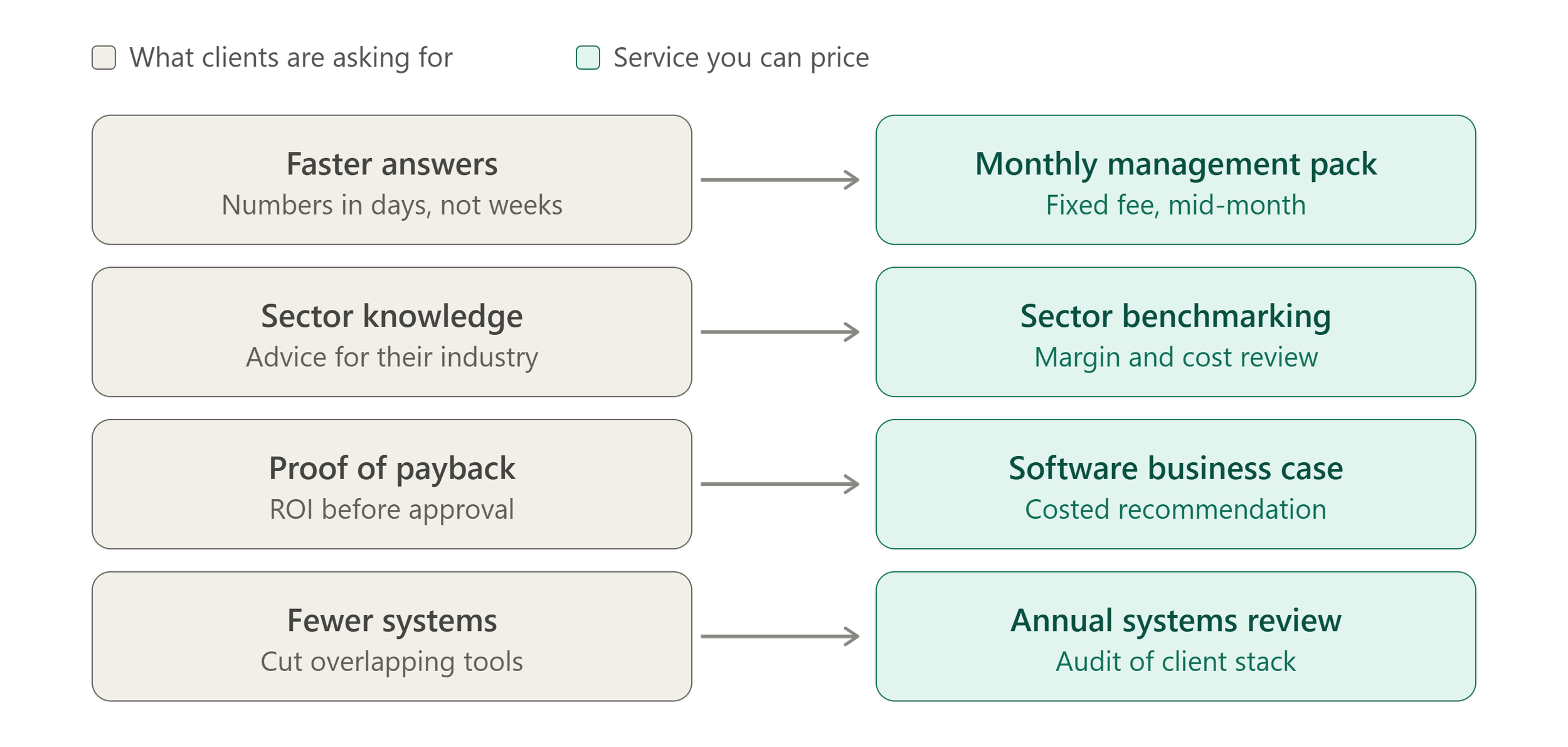
The fifth demand, ongoing guidance instead of a once-off project, is the pricing model rather than a separate service. It converts the four above from ad hoc work into a retainer.
How this looks in a construction practice
Take a mid-sized contractor. The accounting package was installed on a server in 2016. Retentions are tracked on a spreadsheet kept by the bookkeeper. Job costing is compiled once a project is finished. Quotes are priced off a materials list last updated a year ago. Nothing here looks broken. The VAT returns go in, the financial statements get signed, and the client believes the system is fine. But four things are quietly going wrong:
Margin per project is unknown until it is too late.
Costing after completion tells the client what happened. It does not tell them that job four is running 8% over on labour with a month of work still to go. Contractors usually discover a loss-making project at handover, when the only option left is to argue about variations.
Work in progress is understated.
Certified work not yet invoiced, and materials on site not yet consumed, are both assets. Sitting in a spreadsheet rather than the ledger, they understate the business. That matters at year end, and more when the client applies for finance.
Retentions carry a VAT timing question.
A retained portion of a progress payment is not treated the same way as the certified amount. If the spreadsheet and the ledger disagree, the client is either paying VAT early on money not yet received, or declaring it late. Establish which before quoting on the fix.
The bank will ask for something the client cannot produce.
Facility renewals come with a request for recent management accounts, a debtors ageing and a cash flow forecast. A contractor who needs three weeks to assemble those has already weakened their position.
The question is whether to move to a cloud package with job costing built in. This is how a reseller would raise the question, and it is a reasonable one. However, an accountant can also raise the questions the client cannot answer without you: what is the real margin on each contract, what is the unrecognised work in progress worth, is the VAT treatment on retentions correct, and what will the bank want to see in ninety days. Those four answers are the business case for changing the system. They are also billable work in their own right, and they remain billable if the client decides to keep the current package for another two years.
The structure repeats across sectors. In retail the question is gross margin by product line rather than by store, which most point of sale reports will not produce without help. In logistics it is cost per kilometre against actual fuel spend, which shifts every time the fuel price moves. Fuel price movements have already been shown to open this conversation with clients who had not thought to ask.
What to do this week
Choose three of your clients. Record what software they run, which version, and when it was last upgraded. In the next meeting, ask one question: what information would you like to see on the fifteenth of every month that you cannot see now?
The answer defines the scope. Price it as a fixed monthly amount rather than hours. The 12-month plan published in May sets out how to build the templates once and reuse them across clients.
The demand is documented. What remains is putting a name and a price on services many practices already deliver for free.