As Auditors Sharpen Their Scrutiny of Fraud, Accountants Will Feel the Impact
This article will count 0.25 units (15 minutes) of unverifiable CPD. Remember to log these units under your membership profile.
Fraud is a serious business risk and an audit expectation. With public trust in financial reporting shaken, the International Auditing and Assurance Standards Board (IAASB) revised ISA 240: The Auditor’s Responsibilities Relating to Fraud in an Audit of Financial Statements, and the IRBA has confirmed its adoption in South Africa through Communique. Effective for audits of periods beginning 15 December 2026, this update affects auditors and finance teams of entities on how they approach fraud risk.
As a business accountant, fraud prevention starts in your court. The new standard is about how you prepare, explain, and defend your numbers. Understanding and acting on these new expectations, accountants can reinforce trust, protect their organisations, and uphold the credibility of the profession. Below is a summary of what you need to know.
Fraud Prevention is Everyone’s Job
The revised ISA 240 reflects the need for stronger fraud detection and prevention in response to recent high-profile audit failures. These are the core changes accountants should understand:
🟠 1. Heightened Professional Skepticism
Auditors are required to demonstrate a “questioning mindset” at every stage of the audit. This means accountants should expect:
More probing questions
Less reliance on management explanations
A higher burden of proof, especially in high-risk areas.
Expect auditors to “stand back” and reassess whether they’ve really addressed fraud risk adequately before concluding their procedures.
🟠 2. Stronger Focus on Internal Controls
Fraud risk must now be considered across all five components of internal control (as per ISA 315), including:
Control environment
Risk assessment processes
Information systems
Control activities
Monitoring of controls.
As an accountant, be prepared to explain how your organisation’s controls actually prevent fraud, not just on paper, but in practice.
🟠 3. Inclusion of Third-Party and External Fraud
The new standard makes it clear that fraud doesn’t only come from within. It also covers:
Vendor and supplier fraud
Bribery and kickbacks
Collusion with outsiders.
Your procurement, payment, and supplier management processes must be watertight and auditable.
🟠 4. Clearer Communication Expectations
Auditors must now regularly communicate with management and those charged with governance (TCWG) regarding fraud risks and concerns.
As a finance leader, you must be ready to:
Discuss known vulnerabilities
Explain how fraud risks are managed
Report prior incidents or whistleblower complaints.
🟠 5. Tighter Documentation Requirements
Auditors will expect clear, auditable evidence to back up key judgments, especially around revenue recognition, estimates, and unusual transactions. Your documentation practices need to be clean, complete, and current.
Spotting the Fraud Red Flags
Accountants are the first line of defense when it comes to identifying fraud indicators. Here are some common “red flags” you should be alert to in financial statements:
🚩 Income Statement Red Flags:
Declining or highly volatile revenue without clear explanation
Operating expenses rising faster than income
Repeated net losses or sudden surges in profitability
Unusual one-off revenue items (e.g., asset sales masking losses)
High interest expenses indicating over-leverage.
🚩 Balance Sheet Red Flags:
High or increasing debt resulting in negative equity
Swelling receivables or inventory levels
Declining asset quality (e.g., frequent impairments)
Short-term debt spikes without liquidity backup.
🚩 Cash Flow Red Flags:
Negative cash flow from operations
High capital spends without equivalent returns
Net income and cash flow mismatches
Regular financing activity (borrowing to survive)
Large dividends despite weak cash position.
🚩 Fraud-Specific Behavioural Red Flags:
Transactions near period-end with vague explanations
Inconsistent financial records
Frequent changes in accounting estimates
High staff turnover in finance
Undisclosed related-party dealings
Pressure to meet unrealistic targets
Tips or complaints about senior management.
What You Need to Do Now
✅ Strengthen Internal Controls
Implementing and evaluating internal controls should not be left too late. Review and document your clients’ internal controls with fraud risk in mind starting now. Make sure segregation of duties, approval workflows, and reconciliations are well defined and followed.
✅ Get Involved Early
Engage with auditors from the planning phase. Help identify fraud risk areas and explain your control environment clearly.
✅ Document Everything
Create audit trails for decisions, approvals, and estimates. If you can’t explain it with documentation, it will become a risk point.
✅ Train Your Team
Make sure your finance team understands fraud indicators and knows how to flag them. Internal training can prevent costly oversights.
✅ Take Red Flags Seriously
Treat inconsistencies, overrides, and pressure points as real warning signs, not just anomalies.
Join Us for the 2026 National Budget Speech Viewing & Expert Analysis
25 February 2026 | Fire & Ice Hotel, Menlyn, Pretoria
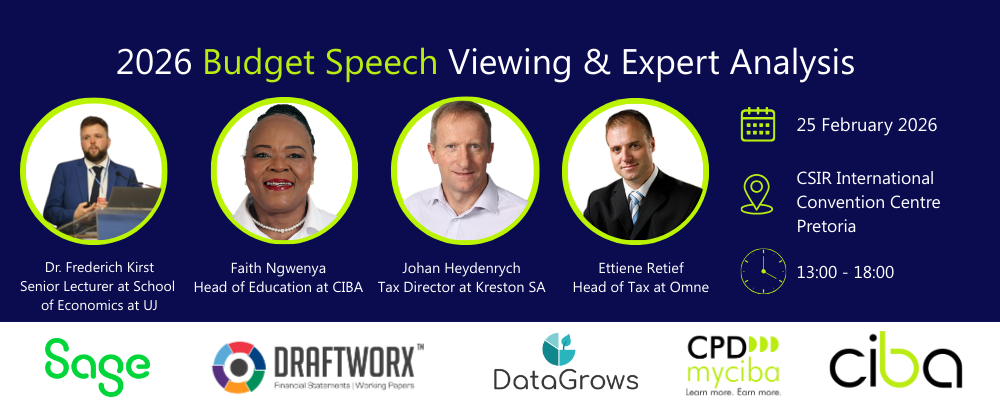
South Africa’s 2026 National Budget Speech will set the tone for the country’s economic direction, tax landscape, and fiscal priorities. With potential tax increases and key policy shifts on the horizon, finance professionals cannot afford to simply watch the speech, you need to interpret it.
That’s why CIBA is hosting a live Budget Speech Viewing & Expert Analysis Event designed to unpack the announcements as they happen. Join us in Menlyn for an afternoon of insight, analysis, and meaningful professional connection.
🎙️ Our expert panel includes:
Johan Heydenrych, Tax Director at Kreston SA
Ettiene Retief, Head of Tax at Omne
Prof. Phindile Nkosi, Director of the Public & Environmental Economics Research Centre (PEERC)
Together, they will translate policy into practical takeaways for your clients, your advisory role, and your strategic planning.
🍸 After the session, enjoy a cocktail networking event to engage with peers and discuss the road ahead for South Africa’s economy.
📅 Date: Tuesday, 25 February 2026
📍 Venue: Protea Hotel Fire & Ice! by Marriott, Menlyn, Pretoria
⏰ Time: 13:00 – 16:00 (Networking 16:00 – 17:30)
💼 CPD: 3 Units (Taxation)
💰 In-person ticket: R350
💻 Prefer online? Book the virtual option for R250.
Why attend?
✔ Understand real-time tax implications from top experts
✔ Gain clarity on anticipated tax changes
✔ Learn how fiscal decisions will affect SMEs, compliance, and advisory
✔ Strengthen your strategic insights for 2026
✔ Connect with other finance professionals and leaders
➡️ Secure your seat for the in-person event here


Choose Your Path to Exclusive Insights
Stay ahead in the world of accounting with premium content designed for professionals like you. Access expert articles, industry trends, and essential resources. Become a CIBA member and claim your CPD hours from CIBA.
CIBA Member Access
R250.00 FREE!
100% Discount when you become a CIBA Member. Join now to claim your CPD Hours. Register here: https://accounts.myciba.org/register