B-BBEE Affidavits: Why CIBA Members Must Treat Them as Agreed-Upon Procedures Engagements
This article will count 0.25 units (15 minutes) of unverifiable CPD. Remember to log these units under your membership profile.
Many small businesses in South Africa qualify to submit a B-BBEE affidavit instead of a full verification certificate. For EMEs, Black-owned QSEs, start-ups and certain co-operatives, the affidavit is the official B-BBEE level confirmation.
But when a CIBA member helps a client prepare or confirm this affidavit, it is not an audit, not a review, and not a “quick signature” favour.
It is a professional engagement that must be performed in terms of the Agreed-Upon Procedures Standard (ISRS 4400 Revised).
This protects you as the practitioner, protects the client, and ensures the document holds up under verification, tender reviews, bank applications and regulatory checks.
1. Why an AUP Engagement Is Required
A B-BBEE affidavit requires the practitioner to confirm factual information such as:
Annual turnover
Percentage of Black ownership
Whether the business qualifies as an EME, QSE, or start-up
Sector code applicability
This involves specific factual checks that must be performed and reported exactly as they were done.
ISRS 4400 (Revised) describes an AUP engagement as one where:
The practitioner performs procedures agreed with the client
The practitioner reports factual findings only
No assurance is provided
This is perfectly aligned with B-BBEE affidavits. You are not expressing an opinion on the client’s B-BBEE status; you are confirming factual information and reporting what you found.
2. What an AUP Engagement Means in Practice
When you help a client with a B-BBEE affidavit, you must:
a) Agree the procedures with the client (before starting)
ISRS 4400 requires that:
The client understands what you will check
You agree on the exact procedures to perform
You record these procedures in an engagement letter
b) Perform only the agreed procedures
You cannot add your own judgement or opinion.
You cannot confirm “reasonability”, “compliance”, or “fairness”.
You only report what you tested and what you found.
c) Report factual findings
Your AUP report must include:
Each procedure you performed
The exact findings for each procedure
Any exceptions found
d) No assurance
You must clearly state:
This is not an audit
This is not a review
You express no opinion or conclusion
This protects you from liability and misunderstanding.
3. What Procedures Should You Perform for a B-BBEE Affidavit?
Below is a practical, CIBA-friendly procedure set you can use and adapt.
a. Confirm Annual Turnover
Obtain management accounts or AFS.
Inspect revenue totals for the latest financial year.
Compare the turnover to the thresholds:
≤ R10 million → EME
R10–R50 million → QSE (note: affidavits allowed only for Black-owned QSEs)
b. Verify Black Ownership Percentage
Inspect the share register or membership register.
Inspect ID documents of shareholders or members.
Calculate the percentage legally and beneficially held.
c. Confirm Sector Code
Inspect the client’s primary business activity.
Compare to the official sector code lists (e.g., Construction, Tourism, ICT).
d. Confirm Qualifying Status
Examples:
If start-up → less than 1 year old?
If co-operative → turnover threshold met?
If QSE → is the ownership ≥51% or 100% Black-owned (required for affidavit use)?
e. Prepare the Affidavit Based on Verified Facts
You are not giving a B-BBEE opinion—only confirming the facts.
4. What Your AUP Report Must Contain
According to ISRS 4400, your report must include:
Mandatory Elements
Title: “Agreed-Upon Procedures Report on B-BBEE Affidavit Verification”
Addressee (usually the client)
Purpose of the report
Statement that the report may not be suitable for another purpose
Statement that this is not an assurance engagement
Ethical compliance statement
Independence statement (if applicable)
Description of each procedure
Findings of each procedure
Signature, date, and practitioner details
Example extract for your report
Procedure 1: We inspected the annual financial statements for the year ended 28 February 2025 and noted turnover of R6 200 000.
Finding: Turnover is below the R10 million EME threshold.
This approach ensures your report is compliant and defensible.
5. Why This Matters for CIBA Members
B-BBEE affidavits are increasingly scrutinised by:
Banks
Government procurement teams
Large corporates
Verification agencies
Incorrect affidavits can lead to:
Client penalties
Disqualification from tenders
Reputational damage
Liability for the practitioner
Using ISRS 4400 protects you because:
You followed a recognised international standard
You did not express an opinion
Your work is limited to factual findings only
Your procedures are clearly documented
This gives your client a defensible affidavit and you a compliant engagement file.
Conclusion
B-BBEE affidavits may look simple, but they require a proper professional approach. By treating the work as an Agreed-Upon Procedures engagement under ISRS 4400, CIBA members:
Protect themselves
Deliver higher-quality work
Ensure clients have valid, defensible affidavits
Build trust with regulators and stakeholders
Join Us for the 2026 National Budget Speech Viewing & Expert Analysis
25 February 2026 | Fire & Ice Hotel, Menlyn, Pretoria
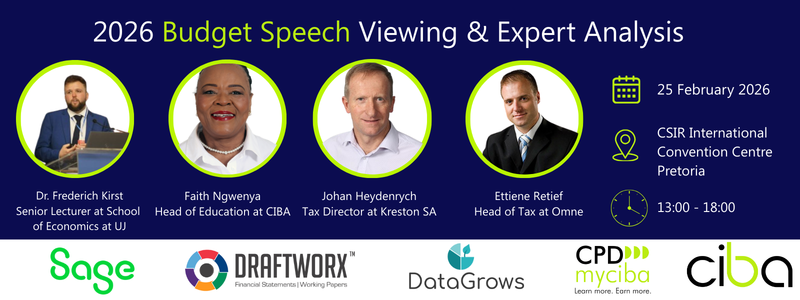
South Africa’s 2026 National Budget Speech will set the tone for the country’s economic direction, tax landscape, and fiscal priorities. With potential tax increases and key policy shifts on the horizon, finance professionals cannot afford to simply watch the speech, you need to interpret it.
That’s why CIBA is hosting a live Budget Speech Viewing & Expert Analysis Event designed to unpack the announcements as they happen. Join us in Menlyn for an afternoon of insight, analysis, and meaningful professional connection.
🎙️ Our expert panel includes:
Johan Heydenrych, Tax Director at Kreston SA
Ettiene Retief, Head of Tax at Omne
Prof. Phindile Nkosi, Director of the Public & Environmental Economics Research Centre (PEERC)
Together, they will translate policy into practical takeaways for your clients, your advisory role, and your strategic planning.
🍸 After the session, enjoy a cocktail networking event to engage with peers and discuss the road ahead for South Africa’s economy.
📅 Date: Tuesday, 25 February 2026
📍 Venue: Protea Hotel Fire & Ice! by Marriott, Menlyn, Pretoria
⏰ Time: 13:00 – 16:00 (Networking 16:00 – 17:30)
💼 CPD: 3 Units (Taxation)
💰 In-person ticket: R350
💻 Prefer online? Book the virtual option for R250.
Why attend?
✔ Understand real-time tax implications from top experts
✔ Gain clarity on anticipated tax changes
✔ Learn how fiscal decisions will affect SMEs, compliance, and advisory
✔ Strengthen your strategic insights for 2026
✔ Connect with other finance professionals and leaders
➡️ Secure your seat for the in-person event here


Choose Your Path to Exclusive Insights
Stay ahead in the world of accounting with premium content designed for professionals like you. Access expert articles, industry trends, and essential resources. Become a CIBA member and claim your CPD hours from CIBA.
CIBA Member Access
R250.00 FREE!
100% Discount when you become a CIBA Member. Join now to claim your CPD Hours. Register here: https://accounts.myciba.org/register