This article will count 0.25 units (15 minutes) of unverifiable CPD. Remember to log these units under your membership profile.
Let’s be honest.
When many accountants reach the income tax and deferred tax section of the financial statements, the reaction is often:
“But the tax is already calculated… why do we need this again?”
Income tax and deferred tax are regularly viewed as:
overly technical,
unnecessary for small entities, and
something that “only auditors care about”.
And yet, under IFRS for SMEs, income tax and deferred tax play a very specific role, not to complicate your life, but to tell a more accurate financial story.
Let’s unpack it in a way that actually makes sense.

Step 1: Income Tax, The Easy Part (Mostly)
Income tax is the part everyone is comfortable with. It answers a simple question:
How much tax does the business owe SARS for this year?
In IFRS for SMEs, current income tax is:
based on taxable profit, not accounting profit,
calculated using the tax rules, not accounting rules,
recognised as:
a tax expense in profit or loss, and
a current tax liability (or asset, if overpaid).
So far, so good.
But here’s where the confusion usually starts 👇
The Accounting vs Tax Mismatch Problem
Accounting and tax don’t always speak the same language.
Some common examples:
Depreciation vs capital allowances
Provisions allowed in accounting but not for tax
Accrued income taxed only when received
Expenses deducted for tax now, but recognised later in accounting
This means:
Accounting profit ≠ Taxable profit
And that difference doesn’t always disappear immediately
This is where deferred tax comes in.
Step 2: Deferred Tax, The “Timing Difference Translator”
Deferred tax is not about paying more tax. It’s about when tax is paid.
A simple way to think about deferred tax is this:
Deferred tax adjusts for tax consequences that belong to this year’s accounting profit, but will only be paid or recovered in a future period.
In other words:
The accounting profit includes income or expenses now
The tax effect happens later
Deferred tax bridges that timing gap
Temporary Differences (Not Permanent Confusion)
Under IFRS for SMEs, deferred tax is calculated using the temporary difference approach.
A temporary difference arises when:
The carrying amount of an asset or liability in the financial statements
differs from its tax base
If that difference will reverse in the future → deferred tax exists.
Two quick examples:
1. Wear-and-tear allowance
Accounting depreciation: straight-line over 5 years
Capital allowance: straight-line over 3 years
Result:
Lower tax now
Higher tax later
➡ Deferred tax liability
2. Provisions
Recognised for accounting
Only deductible for tax when paid
Result:
Higher tax now
Lower tax later
➡ Deferred tax asset
Deferred Tax Is Not a Cash Item
This is an important mindset shift.
Deferred tax:
does not mean tax is payable now,
does not affect the current tax payment,
is a balance sheet adjustment that aligns profit with tax effects over time.
Think of it as an accounting equaliser, not a SARS invoice.
Why IFRS for SMEs Still Cares About Deferred Tax
Even though IFRS for SMEs is simplified, it still focuses on:
faithful representation,
consistency, and
comparability.
Without deferred tax:
profit can look overstated or understated,
assets and liabilities can be misleading,
year-on-year performance becomes distorted.
Deferred tax ensures that: The tax consequences of transactions are recognised in the same period as the transactions themselves.
That’s the real purpose, not compliance for compliance’s sake.
Common Myths (Let’s Clear These Up)
“Deferred tax is only for big companies.”
Not true. If there are timing differences, deferred tax applies, regardless of size.
“We’ll never pay that tax anyway.”
If the difference reverses, the tax effect will happen, deferred tax simply shows it earlier.
“It doesn’t affect cash, so it doesn’t matter.”
It affects profit, equity, and financial position, which absolutely matters.
A Practical Tip for Accountants
Instead of starting with:
“Do we really need deferred tax?”
Start with:
Identify differences between accounting and tax values
Ask: Will this reverse in the future?
If yes → deferred tax
If no → ignore it (no deferred tax)
You’ll often find that only a few key items drive deferred tax in SMEs.
Final Thought: Deferred Tax Is a Storytelling Tool
Income tax tells you what the business owes SARS now.
Deferred tax tells you how today’s accounting decisions affect future tax.
Once you see deferred tax as a timing explanation, not a punishment, it becomes far less intimidating and far more useful.
And maybe… just maybe… not the last note you dread anymore.
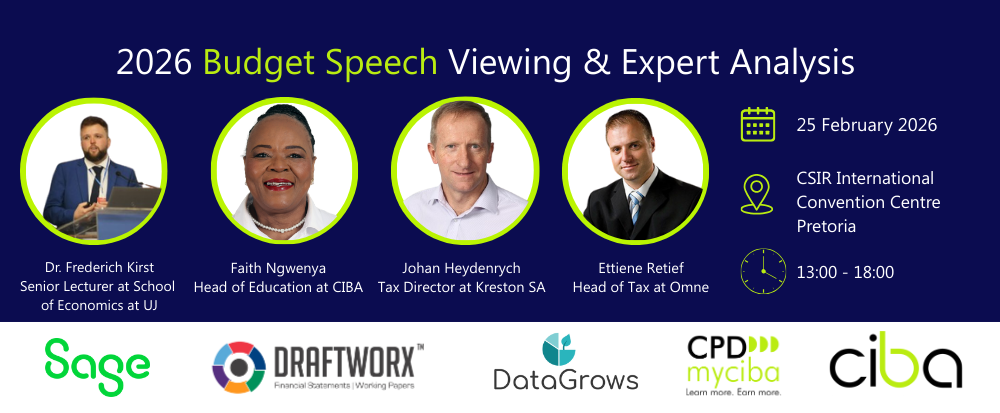
🔴 LIVE: 2026 Budget Speech Viewing & Expert Analysis
Understand the Budget as it happens. Know what to do next.
On 25 February 2026, South Africa’s National Budget Speech will set the tone for tax, compliance, and economic decision-making in the year ahead. CIBA invites you to a live Budget Speech Viewing & Expert Analysis Event, designed specifically for finance professionals who cannot afford to “wait and see” what it means.
Join us for a real-time viewing of the Budget Speech, streamed directly from Parliament, with live expert commentary translating policy announcements into clear, practical implications for your practice and your clients.
You will hear expert insights from Johan Heydenrych, Ettiene Retief, and Dr Frederich Kirst, as the Budget unfolds — not weeks later.
Whether you advise clients, manage tax risk, or lead financial decisions, this session helps you move from policy to action immediately. The event concludes with a cocktail networking session for in-person attendees.
📍 Venue: CSIR International Convention Centre, Pretoria
🕐 Time: 13:00 – 16:00 (Cocktails from 16:00)
💻 Attendance: In-person or Online
🎟️ Limited seats available
IN-PERSON: Register here
ONLINE: Register here
Don’t just hear the Budget. Understand it. Apply it.
#BudgetSpeech2026 #TaxProfessionals #FinanceLeadership #CIBA #SAEconomy

Choose Your Path to Exclusive Insights
Stay ahead in the world of accounting with premium content designed for professionals like you. Access expert articles, industry trends, and essential resources. Become a CIBA member and claim your CPD hours from CIBA.
CIBA Member Access
R250.00 FREE!
100% Discount when you become a CIBA Member. Join now to claim your CPD Hours. Register here: https://accounts.myciba.org/register
Premium
R250.00
Every month

Trending