This article will count 0.25 units (15 minutes) of unverifiable CPD. Remember to log these units under your membership profile.
“A partnership is the only business structure your clients use that no statute creates. There is no registration, no filing and no requirement that anything be put in writing. That sounds like freedom, but it also means there is no liability shield, because the shield always comes from the Act. Worse, a court can find that a partnership exists between people who never used the word and would deny it if asked.”
This article explains how partnerships arise by conduct, how personal liability escalates from joint to joint and several to sequestration of every partner’s private estate, why the income tax and VAT treatment point in opposite directions, and where the fee-earning work sits for the accountant who spots the structure first.
Two brothers run a construction outfit. One brought the bakkie and the tools. The other brought the contacts and works the sites. They split what is left at the end of each job. Nobody signed anything, because they are brothers.
You have that client. You have probably done their books for three years without once calling the arrangement what it legally is.
Four structures are created by a statute. One is not
Every other structure your clients use is built by an Act of Parliament. A company exists because someone registered it under the Companies Act 71 of 2008. A close corporation exists because of the Close Corporations Act 69 of 1984. A business trust exists because trustees were authorised by the Master under the Trust Property Control.
A partnership has no founding statute. No registration. No reserved name. No filing. No writing required.
That sounds like freedom, it is the opposite. Every one of those Acts also hands the owners a liability shield. The partnership has no Act, so it has no shield. It is not a legal person, which means there is no entity for a creditor to sue in the first place. The debt is each partner’s own debt, in full.
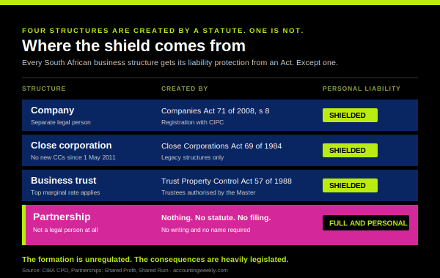
Figure 1. Where the liability shield comes from, and the one structure that has none.
Write this on the inside of the file. The formation is unregulated, the consequences are heavily legislated. Section 13 of the Insolvency Act 24 of 1936. The Income Tax Act 58 of 1962. The VAT Act. Uniform Rule 14 of the court rules. Nothing tells your client how to make a partnership. Plenty tells them what happens when it fails.
The partnership your client never agreed to
A partnership is a contract, and like almost any contract in South African law it can be concluded tacitly, by conduct. Nobody has to use the word partner. Nobody has to intend it.
Three requirements arise from case law. Each party contributes something, whether money, property, labour or skill. The business is carried on for the joint benefit of all of them. The object is profit. Meet all three and your clients are partners, whatever they call themselves and whatever they would say if you asked.
By way of example, in one matter, the parties cohabited for around twenty years. He built and ran the business. She ran the home and the children, contributing no capital and no commercial labour. The Supreme Court of Appeal held that a universal partnership existed and that she was entitled to a share of the business itself.
Those are not exotic facts. Those are the ordinary facts of half your client base. Siblings. Spouses. Two friends with one bank account and a shared spaza. A quiet uncle who put in the deposit and takes a cut of every job.
While we are clearing out the myths, the twenty-partner cap is gone. It lived in the old 1973 Companies Act and the 2008 Act simply did not re-enact it. There is no statutory ceiling now.
Every partner signs for every other partner
Mutual mandate means each partner is the agent of every other partner for the business of the firm. Anything within the ordinary scope of that business binds all of them. One brother signs a materials supply account or an equipment lease, and the other brother is bound by it. Apparent authority does the rest, because what matters is what the supplier reasonably assumed.
Your client will usually discover the contract when the creditor phones.
The escalation nobody warns them about
While the firm trades, liability is joint. The firm can be sued in its own name, partnership assets are looked to first, and the partners are in the queue together.
The day the partnership dissolves, that changes to joint and several. Each former partner is now liable for the whole debt. The creditor picks the deepest pocket and has no obligation to chase anyone else first. Retirement does not release a partner from debts incurred before they left. The moment of maximum exposure is the moment after the relationship breaks, which is also the moment nobody is co-operating.
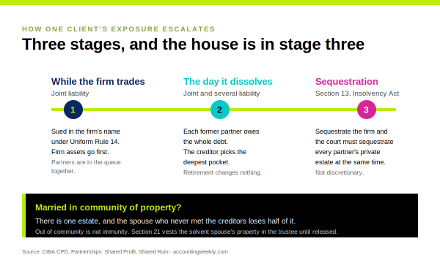
Figure 2. How exposure escalates, and where the family home enters the picture.
Then there is section 13 of the Insolvency Act. Sequestrate the partnership and the court must sequestrate the private estate of every partner at the same time. Not may. Must. The logic is structural rather than punitive, because the partnership is never itself an insolvent, so the private estates are the only place creditors actually get paid.
Three narrow categories fall outside the automatic order.
• The partner en commandite, who is liable only up to a fixed contribution and is not held out to the public as a partner.
• The special partner under the old Cape and Natal limited liability legislation.
• The non-resident partner, whose sequestration the court may postpone.
There is also an escape hatch in section 13(2) for a resident partner who undertakes in writing to pay the partnership debts and furnishes security. It requires real money on the table, immediately.
Ask every partner client one question. What is your matrimonial property regime? Married in community of property means one joint estate, and that estate is now in the concursus. A spouse who never met the firm’s creditors, never signed anything and never drew a cent loses half. Out of community is not immunity either, because section 21 vests the solvent spouse’s property in the trustee until it is released, and the spouse has to prove what is theirs.
The tax split that makes you look clever or careless
One structure, two opposite legal fictions.
For income tax the partnership does not exist. Under the Income Tax Act each partner is deemed to carry on the trade, income and deductions are apportioned to the partners, and the firm files no return and pays no tax. Partners are not employees, so there is no PAYE on drawings. Note the consequence your client will not have modelled. A partner is taxed on their share of the profit whether or not they drew a cent.
For VAT the partnership is a separate person. The firm registers as a vendor in its own name, invoices and returns are in the firm’s name, and the members are not vendors in respect of that enterprise. They stay exposed for the firm’s VAT debt.
Explain that asymmetry before the client asks why the firm has a VAT number and no income tax number. It is a two-minute explanation that buys you a great deal of authority.
What this is worth to your practice
This is not general knowledge dressed up as advice. It is a service line.
Nobody is required to keep partnership accounts. There is no prescribed framework, no audit and no filing obligation. So when trust fails there is no baseline to argue from, and whoever kept the books controls the narrative. That gap is your fee. Proper accounting records and an annual partners’ statement, priced as a standing engagement rather than a favour.
The same applies to the exit. Absent an agreement no partner can demand a buy-out at fair value, there is no valuation formula, and a disposal of a partnership interest is a disposal for capital gains tax. Death dissolves the partnership at common law, because partnership is delectus personae, a choice of person, and the heirs do not inherit the seat. Somebody still has to fund the value of the deceased partner’s share. A funded buy-and-sell agreement with an annually reviewed valuation is the answer, and pricing that valuation is your work. Our piece on what your practice is really worth applies just as neatly to your clients’ firms as it does to your own.
Know where your lane ends. Drafting the partnership agreement and litigating the split belongs to an attorney. Identifying that a partnership exists, quantifying each partner’s exposure and getting the client in front of an attorney before the relationship fails is yours. The same discipline we set out in your legal role when a client is drowning in debt applies here. Refer early, and document the referral in writing, because that record is your professional protection.
It starts earlier than most practitioners think. As we argued in when a client says just register it, the choice of structure is never only admin, and your professional obligations attach from the first conversation about it.
So What Now?
Take your three largest partnership clients, and your own firm if it is one. Ask three questions.
• Is there a written partnership agreement?
• Is there a funded buy-and-sell agreement?
• What is each partner’s matrimonial property regime?
Where the answers are no, no and I have never thought about it, you have found this week’s client conversation and this week’s referral. A written partnership agreement is the cheapest legal document your client will ever buy, and you are the person who can tell them so.
You cannot make a partnership safe. You can make certain that every partner knows exactly whose house is on the line. That is worth paying for, and it is worth charging for.
Join CIBA and we will show you how to turn a client’s invisible risk into a service they will pay you to manage.
Further reading
• What Is Your Practice Really Worth?. The free cash flow method buyers actually use, and how to apply it to a partner buy-out valuation.
• Your Client Is Drowning in Debt. What’s Your Legal Role?. Where financial work ends and regulated legal work begins, and why you document the referral.
• When a Client Says Just Register It, Your Ethics Don’t Stop There. Why structure advice carries professional obligations from the first form onwards.
• 7 Ways to Build a More Valuable Accounting Practice. Reducing owner dependency and building recurring revenue, the same logic a partnership needs for succession.
• Rescue Me, Accountant. How to Save Clients from Themselves (and Liquidation). Spotting financial distress early, which for a partnership means spotting it before section 13 does.



Trending