This article will count 0.25 units (15 minutes) of unverifiable CPD. Remember to log these units under your membership profile.
If you are a director of a company in South Africa, you may have wondered whether you need to register for UIF and Workman’s Compensation.
This can become confusing, especially in a small company where the director is also the owner, works in the business and may be the only person receiving money from the company.
The important point is that UIF and Workman’s Compensation are mainly concerned with employees. Being listed as a director does not automatically answer the question.
What matters is the director’s actual role in the business.
Are they working as an employee and receiving a salary? Are they only receiving director’s fees? Are there other employees in the company?
Once you answer these questions, the position becomes much easier to understand.
First, understand the difference between a director and an employee
A person can be a director and an employee at the same time.
For example, imagine that Sarah owns shares in a company and is also a director. She works in the business every day as the managing director and receives a monthly salary through payroll.
Sarah is not only acting as a director. She is also working for the company as an employee.
Now consider John. He is a non-executive director. He attends board meetings and receives director’s fees for performing his duties as a director. He does not work in the company every day and does not receive a normal monthly salary.
John’s situation is different.
This difference is important when looking at UIF and COIDA.
What happens with UIF?
UIF stands for the Unemployment Insurance Fund.
Employers and employees contribute to UIF so that qualifying employees may have some financial protection in certain situations, such as unemployment, maternity leave, parental leave or illness.
The normal UIF contribution is 2% of the employee’s remuneration, subject to the applicable limit. The employer deducts 1% from the employee and contributes another 1%.
But what happens when the person receiving money is a director?
The director is the only person in the company and receives a salary
Suppose a company has one director and no other employees.
The director works in the company every day and receives a monthly salary through payroll.
In this situation, the fact that the person is also the owner or director does not automatically remove the UIF obligation.
If the director is genuinely working as an employee and receiving remuneration as an employee, the company may have to register as an employer and UIF contributions may be payable.
This is an important point for small companies.
You should not assume that UIF does not apply simply because the director owns the company.
The director receives no salary
Now imagine that the company still has only one director, but the director does not receive a salary.
Perhaps the director only receives director’s fees for services performed in their capacity as a director. Or perhaps the director receives no remuneration at all.
The position can be different because there may be no employer and employee relationship for UIF purposes.
A non-executive director is a good example. A non-executive director generally performs duties as a member of the board rather than working as an ordinary employee under the control and supervision of the company.
Their director’s fees should therefore not automatically be treated in the same way as an employee’s salary.
It is important to look at the real relationship and not only the description used on the payment.
Calling a payment a “director’s fee” does not necessarily settle the issue if the person is actually working full-time as an employee.
The company has a director and other employees
This situation is easier.
If the company employs other people who fall within the UIF requirements, the company will generally need to register for UIF and make the required contributions for those employees.
You then look at the director separately.
If the director is also a salaried employee, UIF may apply to the director’s remuneration.
If the director only performs duties as a non-executive director and is not an employee, their treatment may be different.
In other words, having other employees means the company may need UIF registration, but it does not automatically mean every director must pay UIF.
What about Workman’s Compensation?
Workman’s Compensation is commonly used to refer to the system created under the Compensation for Occupational Injuries and Diseases Act, better known as COIDA.
COIDA provides protection for employees who suffer certain injuries, illnesses or diseases because of their work.
Again, the key word is employee.
Only one director and no salary
Suppose a company has one director, no employees and the director does not receive a salary as an employee.
There may be no employee for COIDA purposes.
If the director is simply acting as a director or shareholder and there is no employer and employee relationship, the company would generally not have an employee to register for Compensation Fund purposes.
Only one director who receives a salary
Change the situation slightly.
The director now works for the company and receives a salary as an employee.
This can create an employer and employee relationship.
The company may therefore need to register with the Compensation Fund and include the director as an employee for COIDA purposes.
Once again, the important question is not simply:
“Is this person a director?”
The better question is:
“Is this person also working as an employee of the company?”
The company employs other people
If the company employs one or more employees, COIDA registration will generally be required.
This can include permanent, temporary, casual and other qualifying employees.
The director’s position can then be considered separately.
A director who is also a salaried employee may fall within the company’s COIDA arrangements.
A director who is not an employee should not automatically be treated as one simply because the company is registered with the Compensation Fund.
Executive directors and non-executive directors
Understanding the difference between these two roles can make the whole issue easier.
An executive director normally works actively in the business. For example, the person may be the CEO, financial director or managing director. They may work normal hours, perform operational duties and receive a monthly salary.
An executive director can therefore also be an employee.
A non-executive director usually has a different role. They normally provide oversight, attend board meetings and participate in important company decisions. They are generally not involved in the company’s daily operations in the same way as an employee.
This is why payments to executive and non-executive directors cannot always be treated in exactly the same way.
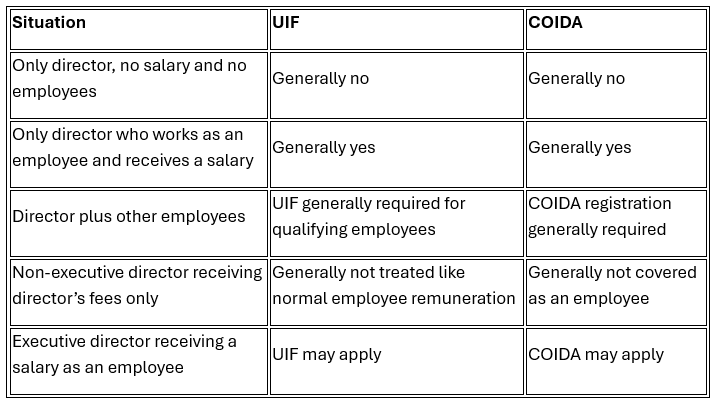
A simple way to remember it
Here is a useful starting point:
Do not look at the job title only
One of the biggest mistakes a business can make is looking only at the word “director”.
Two people can both be directors but have completely different working relationships with their companies.
One might work from Monday to Friday, receive a monthly salary and perform the same type of duties as other senior employees.
The other might attend four board meetings a year and receive director’s fees.
They should not automatically receive the same UIF and COIDA treatment.
When deciding what your company needs to do, look at the facts.
Ask whether the director works for the company as an employee, whether they receive a salary through payroll, what duties they perform and whether the company employs anyone else.
Those answers will usually point you in the right direction.
For small companies, this distinction is particularly important. Being the owner or director does not automatically exempt someone from UIF or COIDA. At the same time, being called a director does not automatically make someone an employee.
The real working relationship is what matters.




Trending