This article will count 0.25 units (15 minutes) of unverifiable CPD. Remember to log these units under your membership profile.
Mining company Assmang lost its diesel refund dispute with SARS despite using a computerised system to track fuel at its Khumani iron ore mine in the Northern Cape.
The system recorded when diesel was dispensed, how much was supplied, and which equipment received it. Yet these detailed records weren't enough to support the company's refund claims.
In August 2025, the Supreme Court of Appeal ruled against the mining company. SARS wanted Assmang to pay back the diesel refunds it had received, plus interest and penalties, totalling about R39.6m.
To help you avoid a similar situation, this guide explains what your clients need to record in their diesel logbooks, how to separate fuel that qualifies for a refund from fuel that doesn't, and what to check before submitting a claim to SARS.
What a diesel refund logbook must show
Under the Diesel Refund Scheme, businesses in industries such as farming, forestry, and mining can claim back some or all of the general fuel levy and Road Accident Fund levy included in the price of diesel used for qualifying activities.
To claim, your client must be registered for both VAT and diesel refunds.
According to SARS's diesel refund policy, your client must keep records that allow SARS to trace the diesel from the moment it's purchased to the moment it's used.
The record-keeping requirements include the following:
Diesel purchases, including the supplier's name and business address, invoice number, purchase and delivery dates, and litres purchased
The capacity of each storage tank and details of diesel added to or removed from it
The date, litres supplied, and vehicle or machine filled each time it refuels
Where and how the diesel was used, and whether the activity qualifies for a refund
Supporting information, including equipment specifications, who operated the equipment, how many hours it ran, or how far it travelled
Let's say your client runs a wheat farm in the Free State. As planting season approaches, the farmer orders 1,000 litres of diesel to fill the farm's storage tank. Throughout the week, one of the farm's tractors draws 400 litres from the tank to prepare the fields for planting.
The farm's records should allow you to match the supplier's invoice to the delivery of 1,000 litres and account for every refuel of the tractor.
The tractor's own logbook should show which fields were ploughed, who operated the tractor, how many hours were spent ploughing, and how much diesel was used.
If SARS asks your client to justify the refund, you'll have records of both the purchase and the work the diesel was used for.
Common diesel refund mistakes
Even when your client keeps detailed fuel records, it's easy to overlook certain requirements, especially when contractors are involved or equipment is used for different types of work.
Here are three mistakes to look out for when reviewing your client's records:
1. The records stop at the pump
This was one of the mistakes Assmang made. The company could show which machines received diesel, but couldn't prove what those machines were used for.
Make sure your client's logbooks record the actual work performed. SARS needs this information to determine whether the diesel qualifies for a refund.
2. The contractor pays for the diesel
If your client hires a contractor to perform qualifying work, there are two ways they can structure the agreement:
Dry rate: Your client buys and supplies the diesel, and pays the contractor for the work performed.
Wet rate: The contractor covers the cost of the diesel and charges your client for both the fuel and the work performed.
Your client can only claim a diesel refund under a dry-rate arrangement.
However, you also need to check how the contractor is paid. In Assmang's case, the company deducted fuel costs from contractor payments. The court found that the contractors were effectively paying for the diesel themselves.
Let's return to your wheat farmer. Before you took over the farm's books, a contractor invoiced the farmer R50,000 for harvesting a field. The farmer supplied R8,000 worth of diesel for the job, which the previous accountant deducted from the amount owed to the contractor.
Although the farmer originally bought the diesel, the contractor ended up covering its cost by receiving only R42,000. The farmer therefore couldn't claim a refund on that diesel.
This means that even if your client has a dry-rate agreement in place, the way you account for contractor payments could turn it into a wet-rate arrangement and disqualify your client from claiming a diesel refund.
3. Eligible and non-eligible diesel aren't separated
Your client must also record diesel used for activities that don't qualify for a refund. These litres must be excluded when calculating the claim.
For example, if your wheat farmer uses diesel from the farm's storage tank to plough fields but also sells some of that diesel to a local building contractor, both transactions must be recorded.
The farmer can claim a refund on the diesel used for ploughing, but not on the diesel sold to the contractor.
How to separate eligible and non-eligible diesel
Now, imagine your wheat farmer earns some extra income by using the farm's tractor and trailer to transport bricks for a local construction company. The farmer uses the same tractor to plough the wheat fields, so only some of the diesel it consumes qualifies for a refund.
Your client should keep a separate logbook for each vehicle or machine and record how much diesel is used for each activity. Where direct measurement isn't possible, any apportionment must be supported by reliable fuel consumption records. Hours worked and distances travelled can help substantiate these calculations.
Let's say the tractor uses 300 litres of diesel over a week. Its logbook shows that it spent 20 hours ploughing fields and five hours transporting bricks.
Assuming the tractor's records support an average fuel consumption of 12 litres per hour for both activities, you could apportion the diesel as follows:
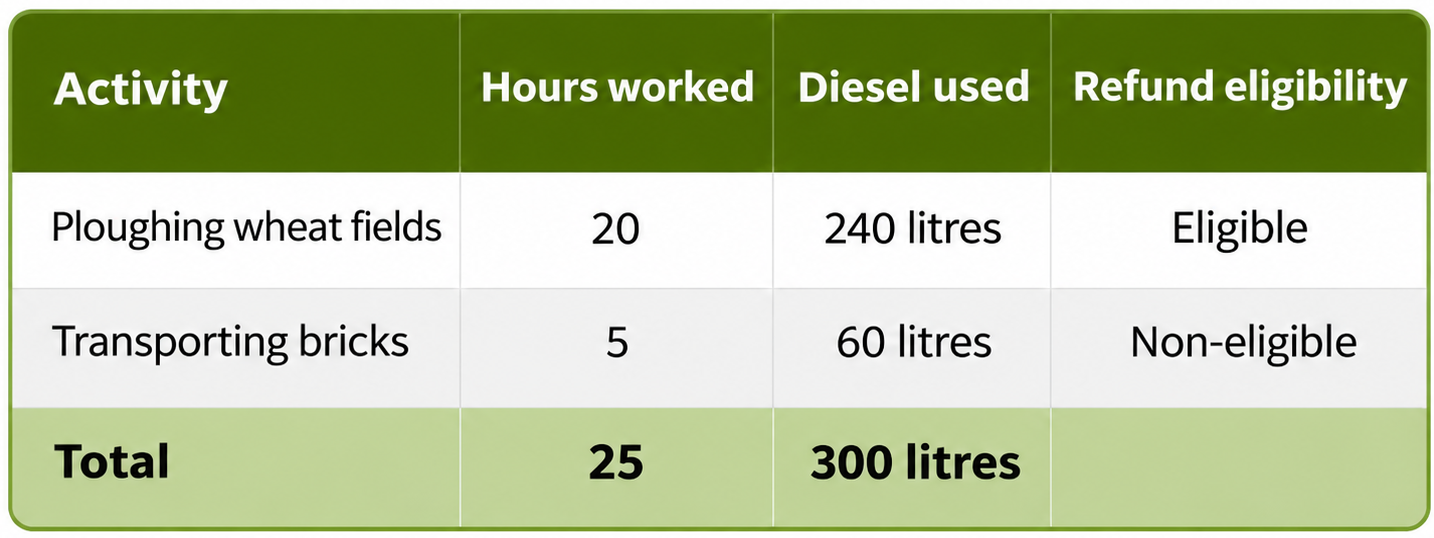
The farmer would only be able to claim a refund on 240 litres of diesel.
Make sure your client's apportionment method reflects how much fuel the equipment actually consumes during each type of work. Keep records to support the calculations and apply the method consistently across reporting periods.
Diesel refund checklist before submitting the VAT201
Once you've established how much of your client's diesel qualifies for a refund, you're ready to prepare the claim. Before submitting the VAT201, work through the following checklist:
Confirm that your client bought the diesel in its own name and used it for qualifying activities.
Reconcile supplier invoices, storage tank records, and individual logbooks. Investigate any discrepancies and account for unused diesel still in storage.
Calculate the total litres purchased and used, and identify any non-eligible litres, including diesel lost through theft, leakage, or accidents.
Check that the correct refund percentage applies. Since 1 April 2026, businesses in farming, forestry, and on-land mining can claim a refund on 100% of eligible diesel, up from 80%.
Check whether the refund rate changed during the tax period. If it did, adjust your figures using the method explained in SARS's diesel refund calculation policy (SE-DSL-02).
Submit the claim within two years of the diesel purchase date.
Retain invoices, logbooks, and supporting documents for at least five years from the date the diesel was used or disposed of, or the refund return was submitted, whichever is later.
When completing Part C of the VAT201, enter the total litres purchased and used and the non-eligible litres. SARS's system automatically calculates the refund amount.
How the new diesel refund system affects your clients
On 18 September 2026, SARS introduced a new diesel refund registration system, separate from VAT registration. Even if your clients are already registered for diesel refunds, they'll need to register again.
Before applying, make sure your client's legal-entity profile with SARS has been validated, confirmed, and merged where necessary.
You'll also need to link your client to its diesel suppliers through the new Diesel Refund Relationship Management function on eFiling. The suppliers must also be registered on the new system.
This is a good opportunity to review your client's purchase records and check that the suppliers listed on its invoices match those linked to its eFiling profile. If you haven't registered your client yet, read our article on how to register on the new system.
For now, you must still submit diesel refund claims through the VAT201. However, SARS plans to introduce a separate claims system in future.
Regardless of how claims are submitted, keeping accurate diesel logbooks remains essential. If SARS questions a refund your client received, you'll need to demonstrate exactly how the diesel was used.


Latest news