This article will count 0.25 units (15 minutes) of unverifiable CPD. Remember to log these units under your membership profile.
Imagine your client issues an invoice and SARS receives its details almost immediately, helping reduce paperwork, improve accuracy, and potentially speed up VAT refunds.
This is what SARS hopes to achieve with its proposed e-invoicing system.
In its VAT Modernisation Consultation Paper, published in August 2026, SARS proposes using this information to pre-fill VAT returns. The new system is expected to start rolling out in 2030.
But our current VAT rules were designed around fixed reporting periods, and businesses have up to five years to claim input tax. SARS hasn't proposed changing either rule, but they could come under review as e-invoicing develops.
In this article, we look at how e-invoicing could affect VAT tax periods and input tax claims, what possible changes could mean for your clients, and how you can help them prepare.
How SARS's new e-invoicing system would work
An e-invoice isn't a PDF, a scanned invoice, or an invoice sent by email. Instead, it's a tax invoice in a prescribed, machine-readable format.
This allows accounting systems to read and process it automatically, without anyone having to enter the details again.
When a supplier issues an e-invoice, its accounting software sends it to an accredited e-invoicing service provider, a business that checks and delivers electronic invoices.
For example, let's say your client owns a restaurant and buys R2,000 worth of ingredients from a food wholesaler. The wholesaler's software sends the invoice to an e-invoicing provider, such as Storecove.
This is an example of an international provider, as SARS hasn't confirmed which companies will be accredited under its proposed system.
The provider checks that the invoice meets the required rules. If the wholesaler has forgotten to include its VAT registration number, for example, the invoice could be rejected so it can be corrected.
If everything is correct, the wholesaler's e-invoicing provider forwards the invoice to the restaurant's e-invoicing provider, such as Pagero. Pagero checks the invoice again before delivering it to your client's accounting system. Like Storecove, Pagero is an existing international provider used here as an example.
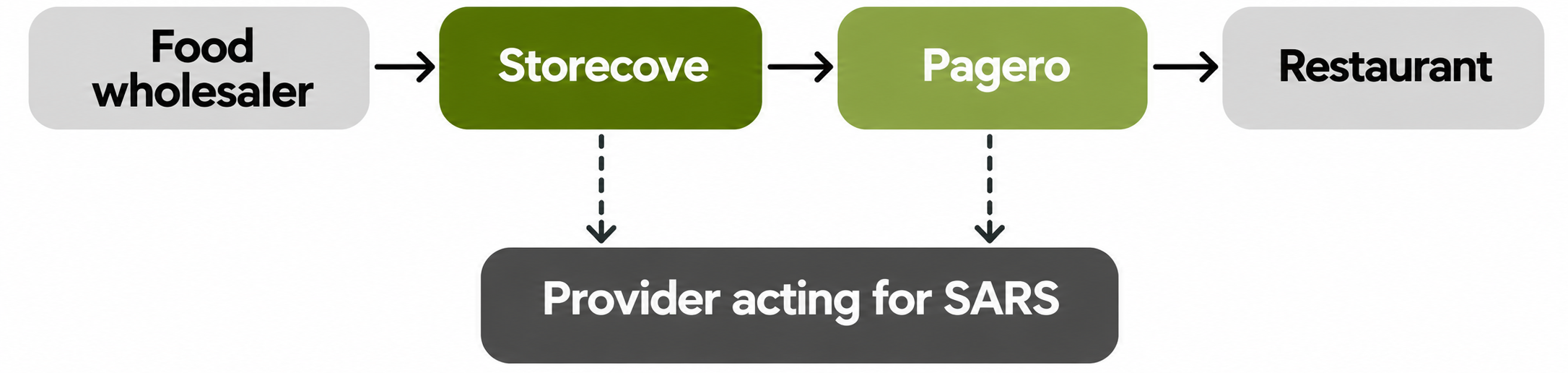
As your client's accountant, you can check that the purchase and VAT are recorded correctly, while SARS would also receive the invoice information needed to help prepare their VAT return.
Both providers, in this example Storecove and Pagero, also send the invoice details to a separate service provider acting for SARS, in near real time.
SARS would use this information to check for risks and pre-fill VAT returns. Eventually, it wants to introduce VAT auto-assessments, where SARS calculates a vendor's VAT liability using trusted transaction data, and the vendor reviews the result.
According to SARS's FAQs on VAT modernisation, taxpayers will still have the right to confirm, amend, or dispute pre-filled returns and future auto-assessments.
When businesses will need to start using e-invoicing
SARS plans to introduce e-invoicing in stages, giving businesses several years to prepare.
According to the consultation paper, SARS's preparation phase runs during 2026/27 and includes publishing draft VAT regulations. SARS then plans to develop the new system in 2027/28, when the regulations are expected to be finalised and brought into effect. Testing will follow in 2028/29, with a pilot involving volunteers in 2029/30.
The rollout is expected to begin in 2030 and take about three years. Large businesses will be first, starting voluntarily before e-invoicing becomes compulsory for them. Government entities could join at the same time or shortly afterwards, with micro, small, and medium businesses joining later.
However, SARS may change this order depending on how ready businesses are to use the system, their compliance risks, and how much VAT revenue is potentially being lost.
The public comment period closed on 16 October 2026. SARS will now review the submissions and hold discussions with industry associations, software providers, government, and taxpayers before finalising its policy.
How e-invoicing could affect VAT tax periods
SARS will need to update the law before e-invoicing can become compulsory.
According to its consultation paper, these changes will define what counts as an e-invoice, what information it must contain, and how that information must be structured.
The law will also need rules covering objections, data protection, the accreditation of service providers, and confidentiality. The detailed requirements for e-invoices will be set out in regulations.
However, SARS hasn't proposed changing VAT tax periods, payment deadlines, or the five-year window for claiming input tax.
Currently, section 27 of the VAT Act requires SARS to allocate each VAT vendor a tax period. This determines how often they must submit VAT returns.
The main categories are:
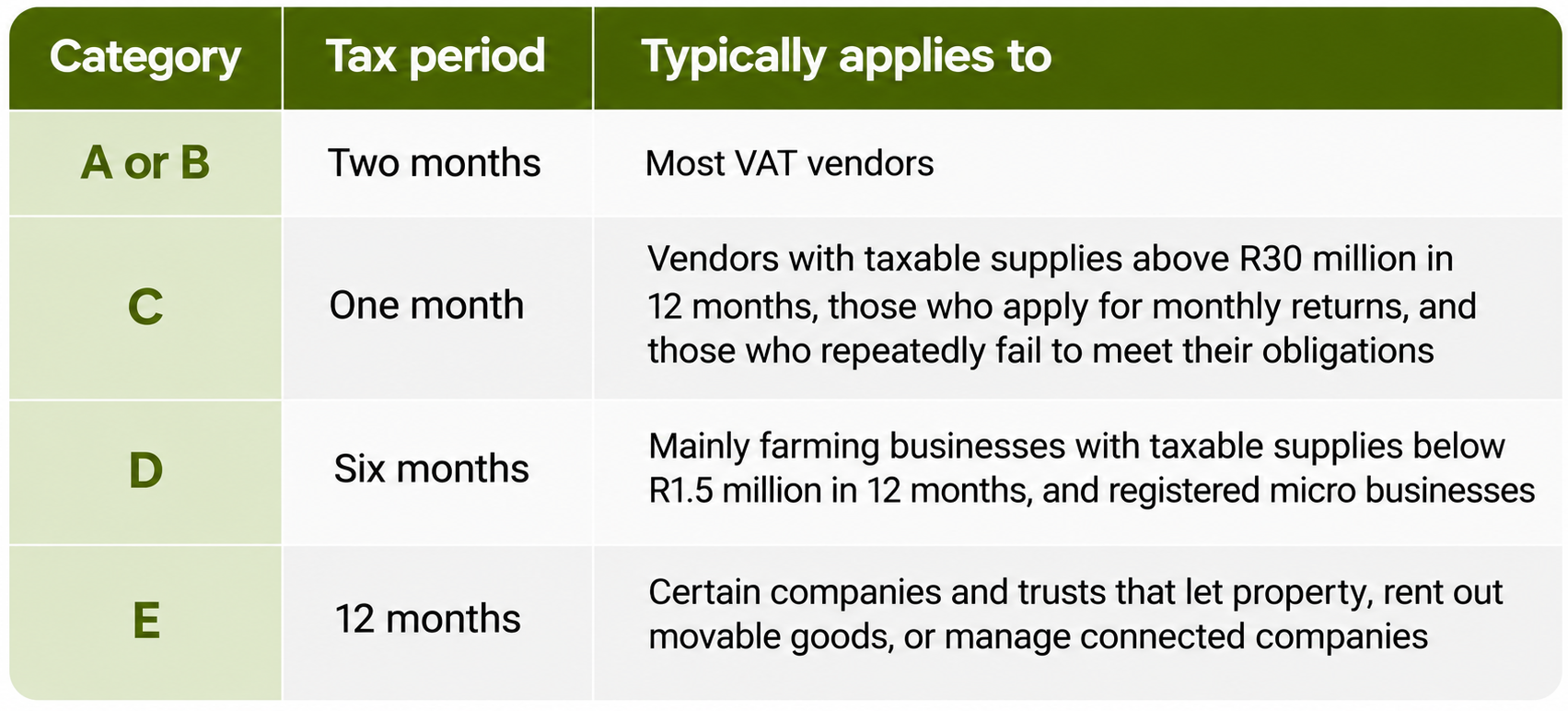
Under the proposed e-invoicing system, SARS would receive transaction information almost immediately, rather than waiting for businesses to report it after their tax periods end.
As e-invoicing becomes part of VAT administration, the existing tax-period categories may eventually become redundant. Significant changes to the VAT Act's tax-period rules can therefore be expected, although SARS hasn't yet announced what those changes will look like.
How shorter VAT periods could affect clients' cash flow
Under the current rules, VAT vendors must submit their returns and pay SARS by the 25th of the month after their tax period ends. If they file and pay through eFiling, they have until the last business day of that month.
This gives businesses some time before they have to pay over the VAT they've collected.
For example, let's say your client runs a golf club in Stellenbosch that's hosting a major corporate golf tournament.
As a Category B VAT vendor, the club submits VAT returns every two months. If it issues an invoice for the event on 1 September 2026, its tax period ends on 31 October. This means it has until 30 November to pay the VAT through eFiling, almost three months after issuing the invoice.
But if the club had to submit VAT returns every month, it would be classified as a Category C vendor, and the payment would be due on 30 October, one month earlier.
The impact could be even greater for businesses that currently submit VAT returns every six or 12 months. If SARS required more frequent payments, or even payments in near real time, businesses that rely on this money for everyday expenses could face cash-flow problems.
There could also be an upside for businesses that regularly claim VAT refunds. According to SARS's FAQs, more accurate and up-to-date VAT information could help it process lower-risk refunds faster, improving cash flow for these businesses.
Could the five-year window for claiming input tax change?
Under section 16(3) of the VAT Act, VAT vendors can claim input tax in a later tax period if they missed the original claim.
However, there's a time limit. The later tax period must end within five years after the end of the tax period in which the tax invoice should have been issued. Similar rules apply to imported goods and certain other deductions.
This gives you time to correct missed claims, whether a supplier sends an invoice late or you discover an unclaimed amount while reviewing a client's records.
But with e-invoicing, SARS would receive transaction information almost immediately. This could reduce the need for such a long period to claim missed input tax, and the current five-year window may eventually become unnecessary.
SARS hasn't proposed changing this rule yet. Its consultation paper also says transactions that don't normally require an invoice, such as deemed supplies and certain deductions, will be dealt with separately when the system is designed in more detail. This could affect how any future time limit is written.
For now, make sure your clients' invoices still meet the current requirements. Our guide to VAT invoices explains what a valid tax invoice must contain and when it must be issued.


Trending