This article will count 0.25 units (15 minutes) of unverifiable CPD. Remember to log these units under your membership profile.
A friend recently said:
“My favourite kind of debt forgiveness is when I forget I owe someone money, and they forget too.”
However, even if debt is forgiven or forgotten (e.g. by way of “prescription”) SARS seldom forgives or forgets.
Tax legislation applies whenever a taxpayer fails to pay a debt on time or fail to collect a debt on time. The following are some examples where failure to pay or receive an amount of debt in time may result in adverse tax implications:
Value-Added Tax
Failure to pay a debt on which input VAT was claimed within 12 months necessitates a “clawback” of the input VAT previously claimed. This clawback is not required if the creditor is part of a group of companies with a 100% shareholding requirement having to be met.
Failure to receive proof of payment within 90 days for goods/services within 90 days may result in the zero rating being negated and VAT at 15/115 being payable. This VAT can be reversed if proof of payment is received within 5 years.
Normal Tax and Capital Gains Tax
If IFRS 9 is not applied to Trade Debtors:
A taxpayer is entitled to a 25% doubtful debt allowance if the debt is 60 days overdue even if that debt is not objectively speaking “doubtful” and even if no accounting provision for doubtful debts is made.
A taxpayer is entitled to a 40% doubtful debt allowance if the debt is 120 days overdue even if that debt is not objectively speaking “doubtful” and even if no accounting provision for doubtful debts is made.
Whenever a debt is waived/compromised as defined, the use of the funds should be traced back to their origin:
If used to fund deductible expenditure, such expenditures may be recouped.
If used to fund a capital asset on which capital allowances were claimed, the capital allowances may be recouped.
If used to fund a capital asset previously sold, the waiver may attract Capital Gains Tax.
If used to fund a capital asset still on hand, the base cost of that asset may need to be reversed.
Section 19 of the Income Tax Act and Par 12A of the 8th Schedule contains several exemptions from the above rules. These exclusions include the following:
If the loan is not waived, but the repayment of the loan is funded by a new share subscription.
If the company is dormant and part of a group of companies.
A Word of Caution to Taxpayers
SARS issued Interpretation Note 91 (“IN 91”) that deals with Concession or Compromise of a Debt. SARS includes in the ambit of Section 19 and Par 12A not only the active waiver of a debt but also the prescription of debts and the insolvency of a taxpayer.
Taxpayers are cautioned to carefully consider Section 19 and Par 12A of the 8th Schedule whenever debts are restructured.
A company that is dormant cannot be deregistered if it has assets/liabilities. Companies that are technically insolvent can therefore not be deregistered without the loans being settled/waived. In the absence of careful tax planning, these bona fide events may trigger unplanned tax liabilities.
Part of the responsibilities of a business rescue practitioner is to restructure debts of the entity. Without careful planning, the restructure of debts may give rise to a VAT and Income Tax or Capital Gains Tax liabilities. The business rescue advisor should discuss any restructure events with SARS and consider submitting a request to waive tax debts as part of the business rescue plan.
It follows that the failure to timeously consider the tax consequences of any debt restructure process can be extremely costly to a taxpayer.
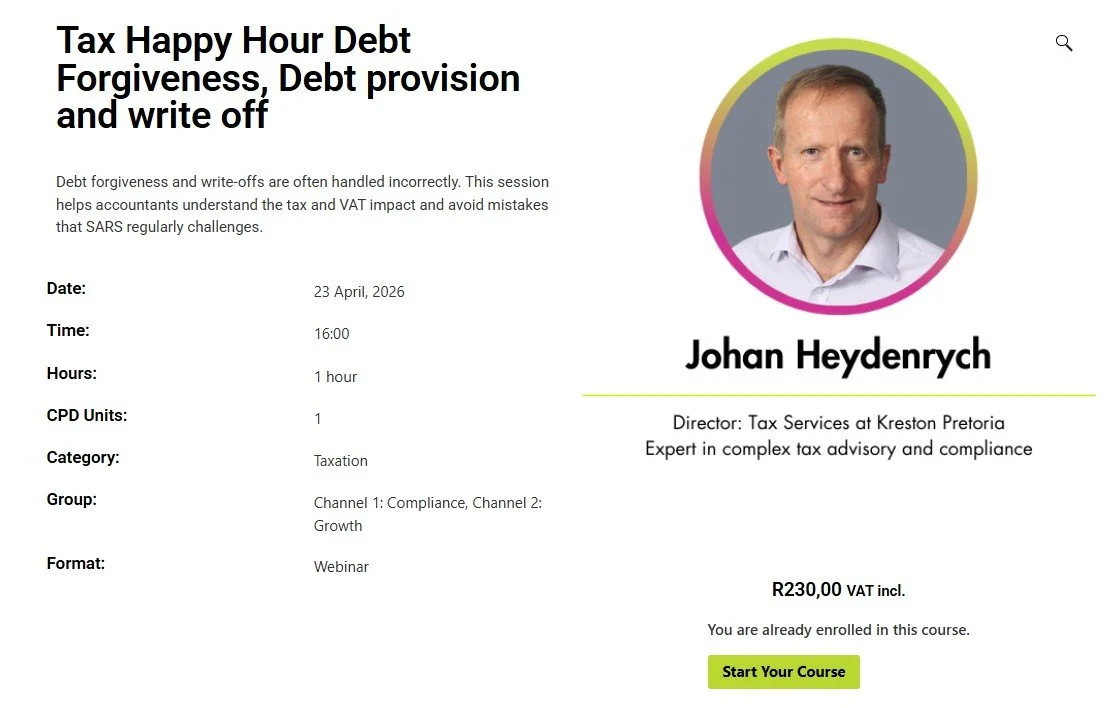
Want to learn more about debt forgiveness and its consequences? Enroll to CIBA’s Tax Happy Hour Debt Forgiveness, Debt provision and write off webinar and learn more!
What will set you apart
By attending this event, delegates will learn:
Understand the tax and VAT treatment of debt provisions, write-offs, and debt forgiveness
Identify key compliance requirements and risk areas
Recognise where accountants are most exposed to errors and potential disputes



Trending