A Taxman’s Casebook Asset for share deals – Double tax disguised as a tax dispensation
This article will count 0.25 units (15 minutes) of unverifiable CPD. Remember to log these units under your membership profile.
Jamsetji Tata (1839–1904) was a pioneering Indian industrialist and philanthropist who founded the Tata Group, shaping India's industrial revolution. Known as the "father of Indian industry," he established massive ventures such as Tata Steel and Tata Power, and established the Indian Institute of Science, setting the stage for India's modern economic development. He said that:
“With honest and straightforward business principles, close and careful attention to details, and the ability to take advantage of favourable opportunities and circumstances, there is a scope for success.”
I suggest that Mr Tata’s words in the 19th Century, advising close and careful attention to detail as a prerequisite for success, may also apply to modern tax planning.
Section 42 Asset for Share Transactions
The so-called “Corporate Rules” found in Sections 41 to 47 of the Income Tax Act are often applied to facilitate mergers, acquisitions and group rationalisations. Section 42 deals with asset for share transactions allowing assets to be transferred to a company in exchange for shares deferring the tax liability to a future disposal event, provided specific conditions are met.
This section is extremely popular since it applies to the disposal of an asset in return for shares, even if an interest of only 10% in a non-listed company is acquired. If the purchasing company is listed, no minimum percentage ownership is required by the seller.
Pitfalls You Should Be Aware Of
The following three pitfalls are highlighted when you advice your clients.
Double Taxation
Section 42 is advantageous to the seller since it delays the tax liability until disposal of the shares acquired. Section 42 is however disadvantageous to the purchaser who acquires the inherent unrealised tax liability of the seller.
This is best explained by an example:
Assume a pharmacist (Mr Pain) started a company with R1 share capital and built its value up over time to R30m. He sells the shares in the company to a listed entity, PharmChem in return for PharmChem shares worth R30million. Section 42 of the Income Tax Act applies automatically.
If Mr Pain sells the Pharmchem shares, then the base cost of the Pharmchem shares is deemed to be R1 and Mr Pain would realise a capital gain of R30million. If PharmChem sells the shares in the company acquired from Mr Pain, Pharmchem will also realise a capital gain of R30m. This leads to double taxation.
Under Section 42, the liability for CGT is not transferred from the seller to the buyer. The seller retains the liability to pay CGT, albeit on the new shares swapped for the shares sold. The buyer however acquires the inherent tax liability of the seller where the base cost is lower than the market value.
The purchasing company should obtain proof of the base costs of the seller. Failure to do so may lead to the purchasing company not being able to meet the burden of proof of the base cost of the asset acquired. It is advised that this base cost and proof of base cost be included in the purchasing agreements.
Market value requirement
Section 42 only applies where the market value of an asset exceeds its base cost. This rule must be applied on an asset-by-asset basis. It is unlikely that Section 42 can therefore apply to debtors that are transferred with provisions for doubtful debts (IFRS 9) since the market value of the debtor is lower than the base cost.
Selling a business as a going concern is problematical when applying Section 42 since a business as a whole is not recognised as a single asset for income tax purposes. The business consists of a collection of assets (and possibly liabilities) and the total purchase price must be allocated to the individual assets (and possibly liabilities) which form the subject matter of the sale. Section 42 may therefore apply to certain individual assets and not to others. Clarity should be obtained in the agreement of sale as to which assets are transferred in terms of Section 42 and which are not.
18 Month anti avoidance rule
Whenever assets acquired in terms of Section 42 are disposed of within 18 months, capital gains, recoupments or profits on disposals may not, with certain exceptions, be set off against existing assessed losses or capital losses. The ITR 14 and ITA 34C does however not cater for this anti-avoidance legislation and a taxpayer is unable to capture this limitation in a tax return.
Taxpayers are advised to carefully consider the long-term tax effect for the buyer and the seller before entering into any asset for share transaction. Since section 42 applies automatically, the parties may end with unknown double taxation, especially in private equity deals.
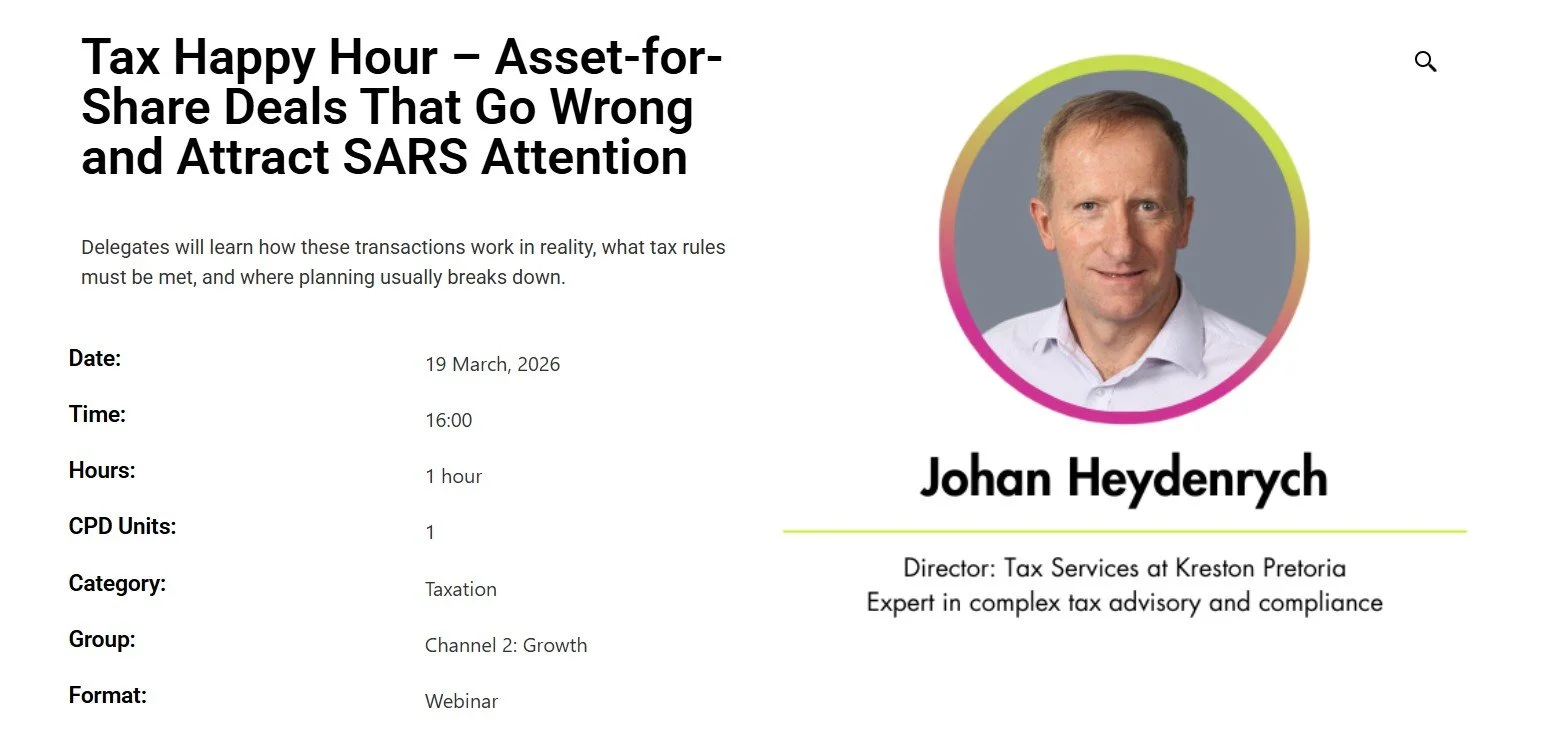
Join Johan for the CIBA’s Tax Happy Hour – Asset-for-Share Deals That Go Wrong and Attract SARS Attention
What you will learn in this event:
Understand how these transactions work in practice
Learn the key tax rules that must be complied with
Identify common areas where tax planning typically breaks down