This article will count 0.25 units (15 minutes) of unverifiable CPD. Remember to log these units under your membership profile.
Large firms appear to be securing most of the sustainability assurance work in Europe.
A study published in September 2026, which looked at 263 European companies, found that sustainability assurance was almost always bundled with the financial audit, with most of the work going to a handful of providers.
This gives firms with established audit clients an advantage and could make it difficult for smaller accounting practices to compete for sustainability assurance work.
But before a sustainability report can be independently assessed, someone needs to prepare it. And this is where smaller accounting practices have an opportunity to enter the market.
You can help your small business clients collect the information they need, calculate their carbon emissions, and prepare their sustainability reports. You can also turn this work into a recurring source of income for your practice.
In this guide, we'll look at which services you can offer, how to price your first engagement, and how to charge clients for ongoing sustainability reporting work.
Why clients may need sustainability reports
South Africa hasn't yet made international sustainability reporting standards compulsory. However, in April 2026, the Financial Sector Conduct Authority outlined plans to introduce climate-related reporting requirements for large listed companies first.
Even though your small business clients aren't legally required to prepare sustainability reports, their larger customers may need information about their suppliers to prepare their own reports.
For example, Shoprite conducts an annual sustainability survey among selected suppliers. In 2023, it found that 69% of respondents weren't monitoring their greenhouse gas emissions.
Being able to provide sustainability information could help your small business clients secure new contracts, retain existing customers, and meet the information requirements of potential investors and lenders.
In July 2026, the European Commission adopted a voluntary sustainability reporting standard to help smaller businesses respond to these requests. Although South African SMEs don't have to follow this standard, it gives you a useful starting point for preparing sustainability reports for your clients.
For example, let's say your client runs a wine farm in Stellenbosch and exports wine to a large German supermarket chain. The supermarket needs information from its suppliers to prepare its own sustainability report.
It may ask your client to provide details of how much electricity and water the farm uses, how much fuel it consumes, and how it manages its waste.
Your client may be concerned that they could lose their supply contract if they can't provide the information the supermarket needs. They might have all the relevant invoices and records but have no idea how to turn them into a sustainability report.
If you're already managing their accounts, you'll have access to some of this information and could offer sustainability reporting as an additional paid service.
Start by looking at which of your existing clients export goods, supply large retailers or listed companies, or are looking to secure new business contracts or funding. Ask whether they've received requests for sustainability information and whether they need help preparing it.
Have a look at our guide to why integrated and sustainability reporting matter for business to learn how the two types of reporting differ and why clients of all sizes can benefit from them.
What sustainability reporting involves
Many of the skills you use in your day-to-day accounting work can also be applied to sustainability reporting, from collecting and checking source documents to calculating figures and preparing reports.
For example, let's say your client owns a small bakery in Paarl that supplies bread and pastries to several supermarket branches. One of the supermarkets asks your client to provide information about its environmental impact over the past 12 months.
You could collect the bakery's electricity bills, fuel invoices, municipal water accounts, and waste collection records. You'd check that you have records for all 12 months, investigate any unusual figures, and calculate the bakery's annual consumption.
Much of this is similar to your usual accounting work. However, calculating greenhouse gas emissions is a little more complicated because you can't simply extract these figures from your client's records.
Emissions are divided into three categories, known as scopes:
Scope 1: Emissions the business produces directly, such as when the bakery burns diesel in its generator or delivery vehicles.
Scope 2: Emissions generated elsewhere to produce the electricity the business buys, such as the electricity used to run the bakery's ovens and refrigerators.
Scope 3: Other indirect emissions, such as those generated by suppliers producing and transporting flour to the bakery.
For smaller businesses, Scope 1 and Scope 2 emissions are generally easier to calculate because much of the information is already available in their accounting records.
Let's say the bakery used 2,000 litres of diesel in its generator and purchased 60,000 kilowatt-hours of electricity during the year.
You'd multiply these figures by the relevant emission factors, which tell you how much greenhouse gas is produced per litre of fuel or kilowatt-hour of electricity. If your results are in kilograms of carbon dioxide equivalent (CO₂e), divide them by 1,000 to convert them into tonnes. This common unit allows you to measure the impact of different greenhouse gases.
Returning to our bakery example, once you've completed the calculations, you can prepare a report showing the bakery's annual electricity and fuel consumption, water usage, waste volumes, and estimated greenhouse gas emissions.
Keep a record of the source documents, calculations, and emission factors you've used so you can update the report the following year.
If you'd like to learn how to calculate greenhouse gas emissions, you can find guidance on these calculations through the Greenhouse Gas Protocol, while the Department of Forestry, Fisheries and the Environment publishes South Africa's electricity emission factors.
Depending on what your client has been asked to report, you may also need to gather information about employee numbers, workplace injuries, staff turnover, and working conditions. Some of this information may already be available in the payroll records you maintain.
When to involve an assurance provider
Let's say your client owns a small furniture factory in George and supplies desks and chairs to a national retailer. The retailer has asked your client to report on the factory's electricity consumption, carbon emissions, and how much wood waste it recycles.
You agree to prepare the report for your client. As part of this service, you check the factory's records, calculate its emissions, and investigate any figures that don't make sense.
However, if the retailer also wants an independent professional to examine the report and provide a formal conclusion on the reliability of the information, your client needs an assurance engagement.
According to IRBA's guidance, there are two levels of sustainability assurance in South Africa.
Limited assurance: Involves less extensive testing and can be provided by accountants who meet the relevant professional, ethical, and quality management requirements.
Reasonable assurance: Involves more extensive testing, provides a higher level of confidence, and can only be provided by registered auditors.
Even if you're qualified to provide assurance, examining a report you've prepared yourself creates a conflict of interest.
If you're planning to offer sustainability reporting services, consider building a relationship with an independent assurance provider.
The International Federation of Accountants encourages smaller accounting practices to build referral networks so they can offer clients access to a wider range of services without having to develop all the expertise themselves.
You can charge your clients for preparing their sustainability reports and refer them to an assurance provider if they need independent verification. The assurance provider would quote and invoice the client separately.
This relationship could also bring new business to your practice if the assurance provider refers clients to you who need help preparing their sustainability information.
Read our guide to why borrowed engagement letter and report wording puts your practice at risk to learn how to make sure your documents reflect the services you're providing.
How to price your first engagement
When preparing a client's first sustainability report, much of your time will go into collecting information, checking records, and following up on missing documents.
You probably already know how difficult it can be to get financial records from some of your small business clients. Now you're asking them for information about their electricity and water consumption, fuel usage, and waste disposal, which they may never have kept track of before.
You'll also need to create spreadsheets for your calculations and set up a process for collecting information in future. This is why it's worth charging a separate setup fee for the first year.
When putting together your quote, make sure you specify the following:
Reporting period: Which months or financial year the report will cover.
Information required: Which areas you'll report on, such as electricity consumption, water usage, and carbon emissions.
Client responsibilities: Which documents your client needs to provide and by when.
Final report: Whether you'll prepare a sustainability report or complete a questionnaire for one of their customers.
Additional costs: What you'll charge extra for, such as additional questionnaires or time spent sourcing missing records.
Assurance: Make it clear that your fee covers preparing the report and excludes independent assurance.
Let's return to our furniture manufacturer in George. Their largest customer has requested sustainability information for the past 12 months.
Before quoting, you'd establish what records your client has available and estimate how long it'll take to complete the work. For example:
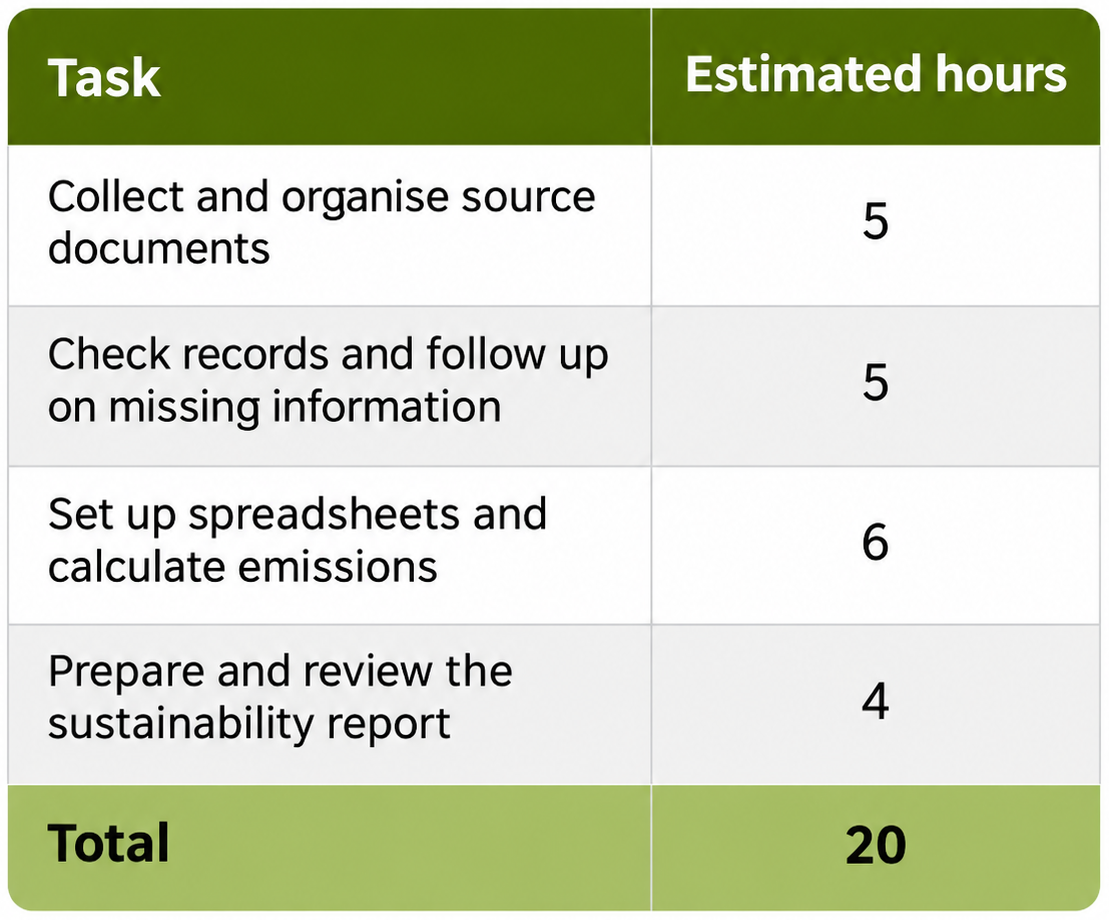
If your practice charges R900 an hour, you could quote the client a fixed setup fee of R18,000.
Your fee will depend on your practice's hourly rates, the complexity of the client's business, and how well they've maintained their records. A small business with neatly organised digital records may require considerably less work than one that still keeps its invoices in a shoebox.
You should also consider the value of the service to your client. If providing sustainability information helps them retain their largest customer, the report could be worth considerably more to them than the time it takes you to prepare it.
Read our guide to selling outcomes instead of billing hours to learn how to factor the value of your expertise into your fees.
If your client also needs independent assurance, ask your assurance provider for a separate quote so your client can budget for both services upfront.
Ideally, each practice should invoice the client directly. This helps maintain independence, makes it clear who's responsible for each service, and protects your practice from having to cover the assurance fee if your client pays late.
How to turn the work into a recurring fee
Once you've prepared a client's first sustainability report, you've already done most of the groundwork for future reports. You know which documents you need, where to get them, and how to perform the calculations.
Rather than waiting until the end of each reporting period, you can offer your small business clients a monthly or quarterly service. This spreads the workload throughout the year, helps clients identify missing information early, and gives your practice a regular source of income.
Let's return to our furniture manufacturer in George. You could offer to collect their records every quarter, update your calculations, and track changes in their electricity consumption, water usage, and carbon emissions.
Assuming this takes four hours per quarter at your hourly rate of R900, you could charge a fixed quarterly fee of R3,600, or R14,400 a year. Make sure your fee also accounts for preparing and reviewing the annual sustainability report.
As you collect more data over time, you can also start offering additional advisory services. For example, if the factory's electricity consumption increases significantly despite producing the same number of desks and chairs, you could help your client investigate the cause and identify ways to reduce their electricity costs.
What starts as one request from one of your client's customers could therefore become a regular reporting and advisory service for your small practice.


Latest news