This article will count 0.25 units (15 minutes) of unverifiable CPD. Remember to log these units under your membership profile.
The owner's diary sets the ceiling on growth
Most small accounting practices are built around one person. The owner signs off the returns, takes the client calls that matter, sets the fees, chases the debtors and still finds time to sort out the printer.
That model works while the practice is small, and it starts to fail once every new client adds hours to a diary that is already full. From that point the owner's time is the limit on what the practice can earn, and the only way to raise the limit is for the owner to change the job they do.
The Owner to CEO Map is a practical way to begin that change. It asks a practice owner to make three commitments: one job they will stop doing, one decision they will hand to someone else, and one management role their practice does not yet have. Each commitment is small enough to act on this year, and together they move the owner's time away from producing the work and towards building the business.
The pressure on the owner's time is growing
The squeeze is being felt across the profession. Intuit's 2026 Accountant Tech Survey of 725 US accounting and bookkeeping professionals found that 90% see fatigue and burnout as a significant issue, and the most common cause, named by 37%, was the volume of work and billable pressure. In the UK, the Advancetrack 2026 Accounting Talent Index reported that most firms are now turning away new business because they do not have the people to deliver it properly.
At home, SARS is changing what clients pay a practice for. For the 2026 filing season SARS widened auto-assessment, which used to cover mainly taxpayers with simple affairs, to include certain provisional taxpayers. As more routine capture and filing is done by the system, more of a practitioner's value sits in reviewing, advising and planning with the client.
That shift favours practices whose owners have time to think. An owner who spends every working hour inside client files has nothing left over to price advisory work, train staff or plan the next stage of the practice.
An owner and a CEO spend the same hours in different places
A practice owner and a practice CEO can be the same person working the same hours. What changes is where those hours go, and what the practice can do without the owner in the room.
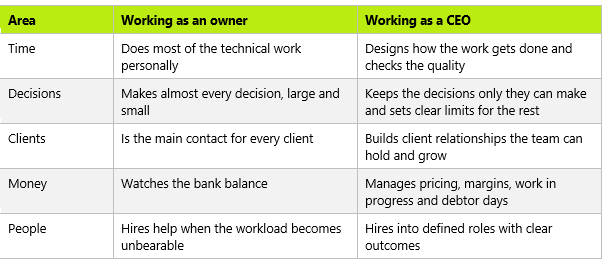
Very few owners make this shift in one step. The map breaks it into three commitments that can be written down, given a date and checked.
Move one: one job I will stop
The first move frees time, because no owner can take on CEO work until something comes off the diary. Most owners underestimate how much of their week goes on work that someone else could do, so the place to start is a simple time log kept for two weeks, in blocks of 30 minutes.
Go through the log and put three questions to each recurring task:
1. Does this task need my professional judgement, or only care and accuracy?
2. Would a client pay more, or trust the practice more, because I did it myself?
3. Could a staff member, a contractor or a system do it to the right standard if they had a clear procedure?
A task that scores no, no and yes is the one to stop. Typical candidates include capturing bank statements, chasing clients for documents, preparing routine invoices, running payroll, submitting routine eFiling returns and managing IT problems.
In practice, stopping a job means it is delegated to a team member, outsourced, automated through the practice software, or dropped because it adds nothing. Before it is handed over, write a one-page procedure or record a short screen video of how it is done, so that the person taking it on is not left to guess.
As an illustration, an owner who spends four hours every Friday capturing bank statements gives up about 184 hours a year over 46 working weeks. At an illustrative charge-out rate of R850 an hour, that is time worth more than R156,000 a year. The owner should book the recovered hours into the diary for CEO work, such as pricing reviews or client planning meetings, before the time quietly fills up again.
The commitment should be written as a dated sentence, for example: "From 1 February 2027, I will no longer capture bank statements. Our bookkeeper will capture them using the practice procedure, and I will review the monthly summary."
Move two: one decision I will delegate
The second move hands over authority, which is harder than handing over a task. When an owner delegates a task, the team still comes back to ask what to do. When an owner delegates a decision, the team member is allowed to make the call without asking, within limits the owner has set.
Until this happens, the owner stays the bottleneck for every question in the practice. Work waits on their desk, staff stop thinking for themselves, and clients learn that nothing moves until the owner replies.
Good decisions to delegate first are frequent, fairly low in risk and easy to reverse. Examples include:
1. the order in which client work is scheduled each week, within agreed deadlines
2. small fee write-offs or discounts up to a set amount per client
3. accepting a routine engagement that falls within a standard scope and fee
4. responding to routine SARS correspondence such as requests for supporting documents
5. approving staff leave against an agreed cover plan
6. software or supplies spending below a set monthly limit
Each delegated decision needs a written rule that answers four questions: who decides, within what limits, what they report back and when they must escalate. For example: "Our senior bookkeeper approves fee write-offs of up to R2,000 per client per year, lists them in the monthly management report, and refers anything larger or any complaint to me."
Two cautions apply. Responsibility for professional sign-off, such as the content of a tax return or an engagement report, stays with the registered practitioner, so delegate the decisions around the work and keep review of the work itself where the rules require it. Second, once the owner has delegated a decision, they should not overrule it unless it falls outside the limits, because a decision that is regularly overturned has not really been delegated.
Move three: one management role my practice is missing
The third move builds structure. In many small practices every management job, from scheduling and billing to hiring and marketing, still sits with the owner because nobody else has been given it. Naming one missing role, and giving it to someone, creates the first layer of management between the owner and the client work.
The missing role is usually visible in the problems that keep coming back. The table below links common symptoms to the role that tends to fix them.
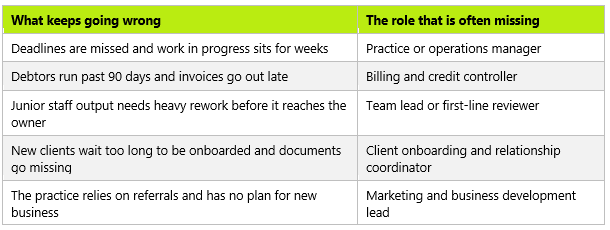
The role does not have to be a new hire. It can be an existing staff member who is given the title, protected time and the authority to act, a part-time appointment, or an outsourced service. What matters is that it is written down as a one-page description covering its purpose, the outcomes it owns, the decisions it may make and how its success will be measured, such as debtor days, deadlines met or turnaround time.
The three moves work best when they connect. The person in the new role is often the right person to take on the job the owner has stopped and the decision the owner has delegated, which gives the role real substance from its first day. Allow three to six months before judging it, because new managers need time to build confidence and staff need time to stop going around them to the owner.
Drawing your own map takes one page
The whole map fits on a single page, and writing it down is what turns good intentions into commitments. Owners can copy the table below and complete one row for each move.
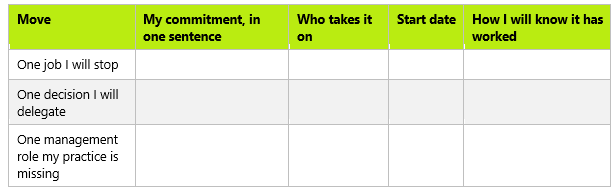
A few habits make the map stick. Share it with the team, so that staff know what is changing and who now holds each responsibility. Put a review date in the diary 90 days after the start date and check each row against its measure. When a move has bedded down, choose the next job, decision and role, because the map is meant to be redrawn as the practice grows.
PMC 2026 starts from the owner's three moves
The Owner to CEO Map opens the programme for CIBA's Practice Management Conference 2026, themed "The R10 Million Practice". The conference opens on 24 November 2026 with a Golf and Padel Day for networking, followed by the main programme on 25 & 26 November at Serengeti Estates, Kempton Park. The map sets the starting point for the conference: a practice can only grow beyond its owner once the owner has made room to lead it.
Practitioners who attend are encouraged to arrive with their map completed, or at least with the first row filled in, so that each session can be applied to a real decision in their own practice. Programme details are available on the CIBA website
Do not miss out on the PMC 2026. Click here to book your seat



Trending