Stop Applying Big-Firm Ethics to Your Small Practice
This article will count 0.25 units (15 minutes) of unverifiable CPD. Remember to log these units under your membership profile.
Thandi runs her practice from a converted garage in Benoni. One part-time bookkeeper, nineteen clients, most of them small construction firms. Last month she spent a Saturday reading the independence rules on network firms before working out that she does not have a network, has never had one, and never will.
Nobody had told her that most of the rulebook was never aimed at her.
Two codes, five principles
There are two documents in play, and practitioners mix them up constantly.
The IESBA International Code of Ethics for Professional Accountants is the global standard. It sets five fundamental principles: integrity, objectivity, professional competence and due care, confidentiality, and professional behaviour.
The CIBA Code of Conduct is the one your membership hangs on. It carries the same five principles, applies the same conceptual framework of identifying, evaluating and addressing threats, and is built on the IESBA framework, adapted for South African statute and the market CIBA members actually work in. Paragraph 26.1 says the two must be read together.
Neither code lowers the bar for a smaller practice. IESBA put it neatly in its new staff publication, Proportionality of the IESBA Code: ethics are not proportionate, but the Code is. Same standard. A shorter path to it. We covered this document in our previous article a few weeks ago in Applying the IESBA Code: Proportionality Guidance for Small and Medium Practices.
This is the part the guide leaves you to do yourself: working out what it means for your practice on a Tuesday afternoon.
Step one: find out which parts are actually yours
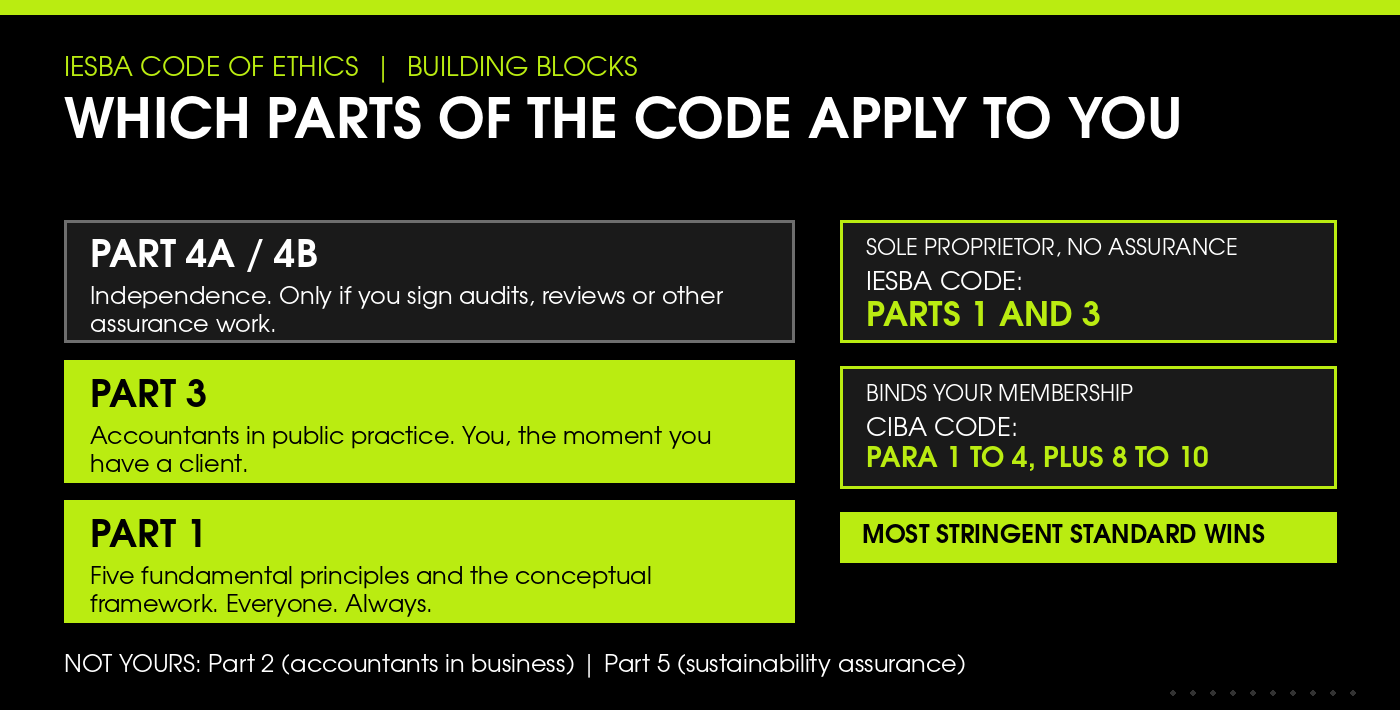
The IESBA Code is built in blocks.
Part 1 is the base and carries the five principles and the conceptual framework. Everyone stands on it.
Part 2 is for accountants working inside a business.
Part 3 is for accountants in public practice, which means you, the moment you have a client.
Parts 4A and 4B carry the independence standards, and they only reach you when you perform an audit, a review, or another assurance engagement.
Part 5 is sustainability assurance.
So a practitioner doing bookkeeping, monthly accounts, VAT, payroll and annual compilations works with Part 1 and Part 3. Parts 4A and 4B sit closed on the shelf. The moment you sign an independent review for a client's bank, that changes, and Part 4A comes in properly. The CIBA Code is organised the same way. Paragraphs 1 to 4 carry the principles and the conceptual framework for every member. Paragraphs 5 to 7 apply to members in commerce. Paragraphs 8 to 10 apply to Chartered Business Accountants in Practice. A CBAP with clients is working with paragraphs 1 to 4 and 8 to 10, and can leave the commerce sections alone.
Step two: put down the sections that do not apply
Inside Part 3, sections switch on when the facts switch them on.
➤If none of your clients pay you for tax planning, Section 380 is not your problem.
➤If you never use an external expert on an engagement, Section 390 does not apply.
➤If you have not appointed an engagement quality reviewer because the quality management standards do not require one for your work, Section 325 stays shut.
➤No conflict of interest on the file means Section 310 stays shut too.
Neither code is a checklist you run from front to back once a year. Both are sets of provisions triggered by circumstances, and where the circumstance is absent, so is the requirement.
The rule that decides ties
One provision to memorise. CIBA Code paragraph 26.2: where the CIBA Code, the IESBA Code, South African law and CIBA's own rules differ, you comply with the most stringent applicable standard.
That means proportionality never runs downhill to the softest option. If the IESBA Code is silent and CIBA is explicit, CIBA governs. If South African law is stricter than both, the law governs. Working out that Part 4A does not apply to your practice is useful. It is not a licence to assume nothing else does.
Step three: be honest about where small means riskier
Proportionate is not the same as easier. IESBA is direct about this: in a smaller practice, applying the conceptual framework leans more on close knowledge of the client and less on formal structures and procedures. That cuts both ways.
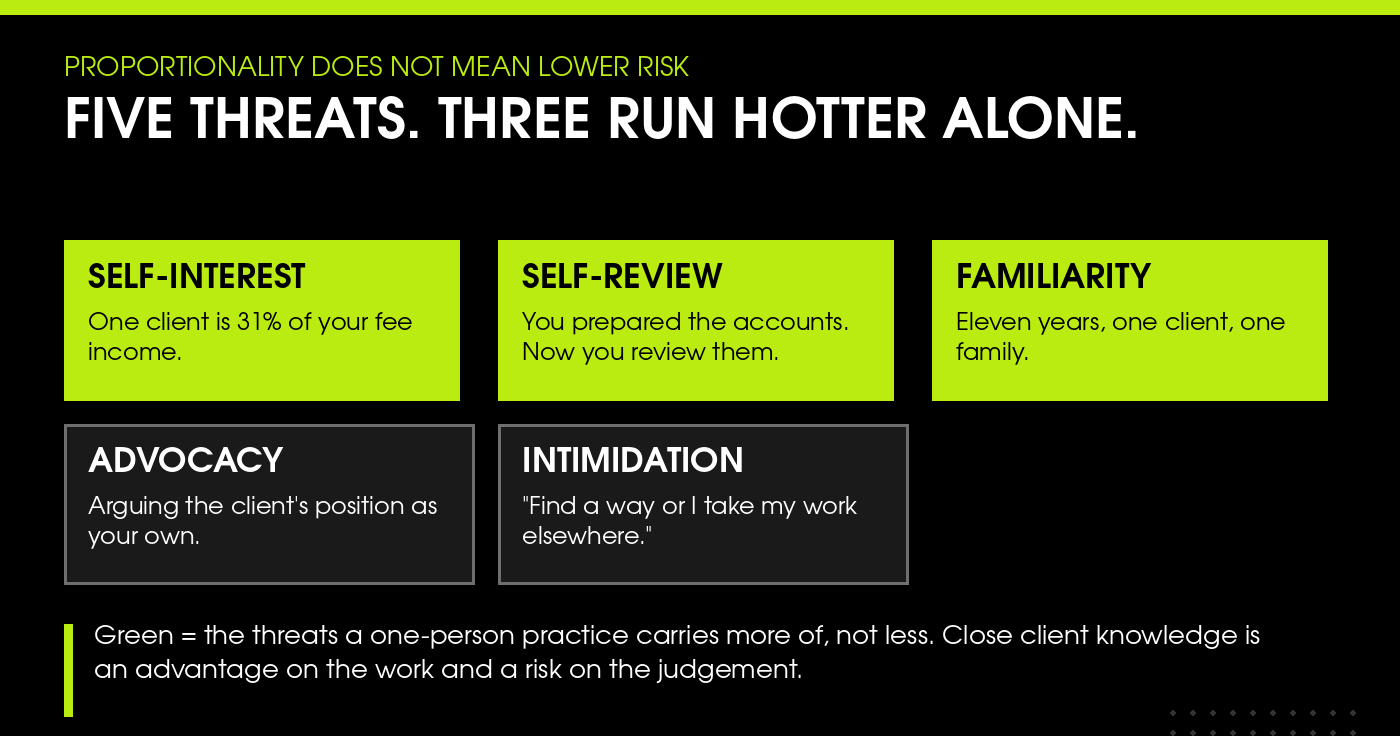
Three threats run hotter when you are the whole firm.
Self-interest. Thandi's biggest client is 31% of her annual fee income. That number sits behind every judgement she makes on that file, whether she admits it or not. The CIBA Code names a related one in paragraph 8.3.1.2: quoting a fee so low that you cannot deliver the work to standard at that price.
Familiarity. Eleven years of doing the same client's books. His wife cuts her daughter's hair. She will not push back on a R180,000 "consulting fee" as hard as a stranger would, and she knows it.
Self-review. She prepared the accounts. The bank now wants an independent review of those accounts. In a large firm a different team does the review. In her practice, there is no different team.
Step four: safeguards that work at your size
Neither code prescribes the safeguard. Both ask whether it is effective. Formality counts for nothing if the threat is still sitting there.
Four things that work in a one-person practice:
Buy in a reviewer. A contracted independent practitioner for one engagement costs less than losing the client, and far less than a disciplinary complaint. The CIBA Code lists independent review of work performed as a safeguard in its own right.
Use the reasonable and informed third party test as your ethics committee. Write the question in the file. "Would another CBAP reading this say I stayed objective?" If the answer takes you more than a minute, you have your answer.
Treat fee concentration as a business problem too. Two new construction clients cuts the self-interest threat and raises your income in the same move. Ethics and growth pointing the same direction is rarer than it should be.
Walk away when the threat cannot be brought down. Declining is a safeguard. CIBA Code paragraph 21.10 makes withdrawal compulsory where conduct becomes unlawful or unethical, and paragraph 22.7 requires it where a client refuses to correct a material error.
Where the problem is suspected unlawful conduct rather than a threat to objectivity, you are in different territory. Both codes scale the response by your role and the seriousness of the matter, and CIBA Code paragraph 7.19 says plainly that nothing requires you to act as an investigator or a prosecutor. Accounting Weekly worked through what that looks like for independent practitioners in Choosing Freedom Over Fear.
What Business Accountants should not scale at all
Here is where the "small practice, less admin" instinct gets members into trouble. Several CIBA obligations apply in full to a sole proprietor with one client:
Engagement letters. Section 17. In writing, before any work starts, covering duties, services rendered, terms, duration, how the client can terminate, and fees. Amendments recorded in writing too. There is no informal-arrangement exception for a small client, a family client, or a client you have had for eleven years.
Competence. Section 16. You may not take on work you are not qualified to do, and you may not present yourself as having expertise you do not have. Get assistance or decline. Who Can Sign What? Understanding Your Professional Boundaries as a CIBA Member sets out where each designation's authority ends.
CPD. Section 14, in line with the CIBA CPD Policy. Mandatory, not aspirational.
Taking over a client. Section 20. You must contact the outgoing accountant before accepting the engagement and ask whether there are professional reasons not to. On the other side of that call, an outgoing accountant may not withhold statutory filings or eFiling profile access, whatever the fee dispute.
Correcting errors. Sections 18 and 22. Prompt disclosure and correction is treated as evidence of compliance. Concealment is a serious breach. That is a rule that works in your favour if you use it early.
Step five: document less than you fear, more than nothing
The IESBA Code encourages documentation and requires it in only a handful of situations. Chiefly: where addressing a conflict of interest means disclosing confidential information and you need the client's consent; where you are responding to non-compliance on an audit of financial statements; and where independence matters arise on an audit or review. For most sole proprietors, none of those come up in a given year.
CIBA adds to that list, and its additions are the ones that bite in a small practice. The engagement letter under Section 17. Written disclosure and recorded consent where a conflict of interest is in play. For licensed tax practitioners, secure records of client communications and working papers under Section 11 and the Tax Administration Act.
Beyond those, keep a one-page note per client, refreshed annually. Client, services, which parts of both codes apply, threats identified, what you did about them, the third party test, engagement letter date, signature. Ten minutes a client.
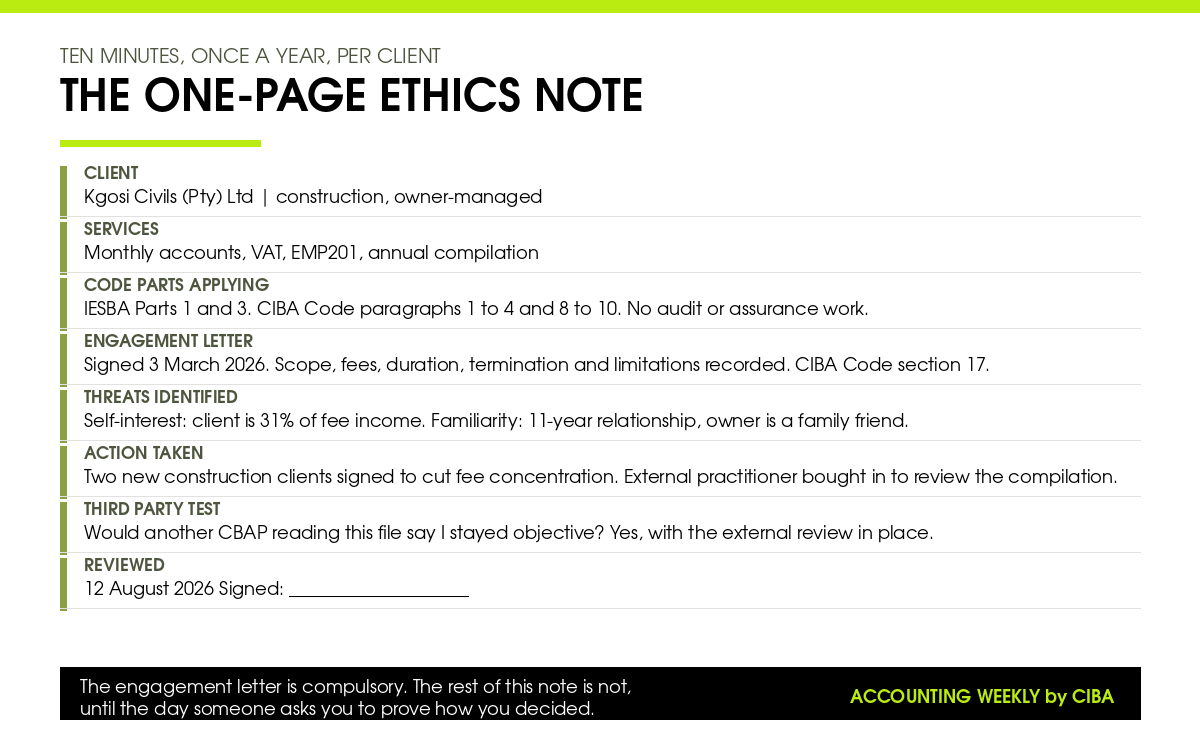
That note matters because of how you will be judged. The CIBA Code says it must be interpreted reasonably and proportionately, with regard to the nature and scope of the services, your role and responsibilities, and the information reasonably available to you at the time. It does not require perfection and does not impose strict liability for outcomes beyond your reasonable control. Disciplinary action, paragraph 24.3, is not there to punish good-faith errors.
Read that carefully. Your defence is not a perfect outcome. It is evidence that you identified the risk, thought about it, and acted in good faith with what you knew. That evidence either exists on the file or it does not.
And when you are genuinely unsure, the Code tells you to consult the CIBA Ethics Committee before you act. Sole practitioners have no partner down the corridor. That is what the committee is for.
Do this in the next week
List your service lines. Map each to the parts of the IESBA Code and the paragraphs of the CIBA Code that apply to it.
Pull your client files and check every one has a signed engagement letter that matches the work you are actually doing. Fix the gaps first.
Run your fee concentration. Any client over 25% of income is a named threat, not a nice problem.
Take your three riskiest files and write the one-page note.
Find one independent practitioner you can call for a second pair of eyes, before the engagement where you need one.
If you want a monthly version of this, the self-check in Ethics Under Pressure: A Routine That Protects Your Designation takes about five minutes and uses the same five threats.
Thandi's Saturday reading the network firm rules is time she will not get back. The rest, she now knows by heart. That is what proportionality buys you.