Why Creatives Stay Busy but Broke
This article will count 0.25 units (15 minutes) of unverifiable CPD. Remember to log these units under your membership profile.
There is a pattern that repeats itself across the creative industry. The designer with a full pipeline. The photographer booked every weekend. The DJ moving from one event to the next. The content creator constantly producing. On the surface, it looks like success.
But when you look at the numbers, the reality is different.
Many creative professionals are fully booked and still financially unstable. There is no consistent cash flow, no meaningful savings, and no real growth. The problem is not a lack of talent. In most cases, the work is excellent. The issue sits in the structure behind the work.
For Chartered Business Accountants in Practice (CBAPs), this is a space where real value can be created. These clients do not need more work. They need better business foundations.
Busy is Not the Same as Profitable
One of the first corrections to make is the difference between revenue and profit. A creative earning R30,000 a month may appear successful, but once time, tools, software, equipment, and admin are considered, very little may be left.
Many creatives are unknowingly operating at extremely low effective hourly rates. A photographer charging R1,500 per shoot but spending eight hours per project is effectively earning less than R200 per hour before overheads. That is not sustainable.
The issue is not effort. It is visibility. Most creatives do not calculate their actual costs. Pricing is based on instinct, comparison, or fear of losing work.
This is where the CBAP steps in. When you bring structure to costing, you move the conversation from guesswork to informed decision-making.
The Busy Trap
Creative professionals often fall into a cycle of saying yes to everything. Every project is accepted. Every opportunity is chased. The focus is on volume, not value.
The result is predictable. Long hours, low-value work, and burnout.
Underlying this behaviour is emotional pricing. Many creatives believe they are fortunate to have clients. They worry about losing work. They compare themselves to lower-priced competitors. As a result, they consistently undercharge.
This is not just a pricing issue. It is a business discipline issue.
Pricing must be based on what the business requires to operate sustainably, not on what feels comfortable.
Why Pricing Fails
Most creatives rely on hourly rates. This creates a hard limit on income and encourages inefficiency. The more efficient the creative becomes, the less they earn under an hourly model.
A more effective approach starts with cost-based pricing. Every project must cover time, expenses, overheads, and include a profit margin. If a project costs R3,000 to deliver, charging R3,000 is not sufficient. It ignores risk and opportunity cost.
From there, value must be considered. The same output can carry very different value depending on the client. A logo for a small personal project is not the same as a logo for a growing commercial brand. Pricing must reflect the impact on the client’s business.
Standardised packages also improve consistency. Instead of quoting from scratch each time, defined offerings create clarity, reduce negotiation, and improve conversion.
There are also non-negotiables. A deposit is one of them. Requiring at least 50 percent upfront protects cash flow and ensures commitment.
Discounting should be avoided. It reduces perceived value and trains clients to negotiate downwards. If adjustments are needed, add value rather than reduce price.
Contracts Protect Income
Without a contract, there is no control over scope, payment, or expectations.
Many creatives operate informally. Agreements are vague, and expectations are not documented. This creates exposure, particularly in the form of scope creep.
Scope creep occurs when clients request additional work outside the original agreement. Individually, these requests appear small. Collectively, they eliminate profitability.
A structured agreement addresses this directly. It defines what is included and what is not. It sets limits on revisions. It outlines timelines and payment terms.
For example, specifying that a project includes three revisions and that additional revisions are billed separately creates a clear boundary. It removes ambiguity.
Payment terms are equally important. Work should not be delivered in full before payment is received. Late payment clauses, including interest and the right to pause work, strengthen control.
Ownership of work must also be addressed. Transfer of rights should only occur once full payment has been made.
Client Quality Matters
Not all clients contribute equally to a business. Some pay on time, respect boundaries, and value the work. Others delay payment, request excessive changes, and create unnecessary pressure.
Accepting all clients without assessment leads to inefficiency and reduced profitability.
Client qualification is a simple but effective control. Before accepting work, key factors should be understood. Budget, timeline, and decision-making authority all influence the success of the engagement.
There are also clear warning signs. Immediate requests for discounts, vague briefs, and resistance to payment terms are indicators of potential problems.
Setting boundaries is not optional. It is necessary. This includes limiting after-hours communication, charging for additional work, and refusing unpaid revisions.
Moving from Freelancer to Business
The core shift required is moving from a freelance mindset to a business mindset.
A freelancer focuses on securing the next project. A business focuses on sustainability.
This requires systems. Structured pricing. Standard agreements. Defined processes. Clear communication. These elements reduce variability and create control.
Recurring revenue is also important. Retainers and monthly packages provide stability and reduce reliance on constant new client acquisition.
The Role of the CBAP
Creative professionals often lack the financial structure required to operate effectively. This creates a clear advisory opportunity.
CBAPs can assist by building costing models, improving pricing structures, implementing basic controls, and introducing simple systems that support consistency.
The objective is not to overcomplicate the business. It is to provide practical structure that enables better decision-making.
Final Perspective
Creative professionals do not need more work. They need better control over the work they already have.
Profitability is driven by pricing, protected by contracts, and influenced by client quality. Without structure, even high levels of activity will not translate into financial stability.
The role of the advisor is to introduce that structure. When that happens, the business changes. Not through more effort, but through better decisions.
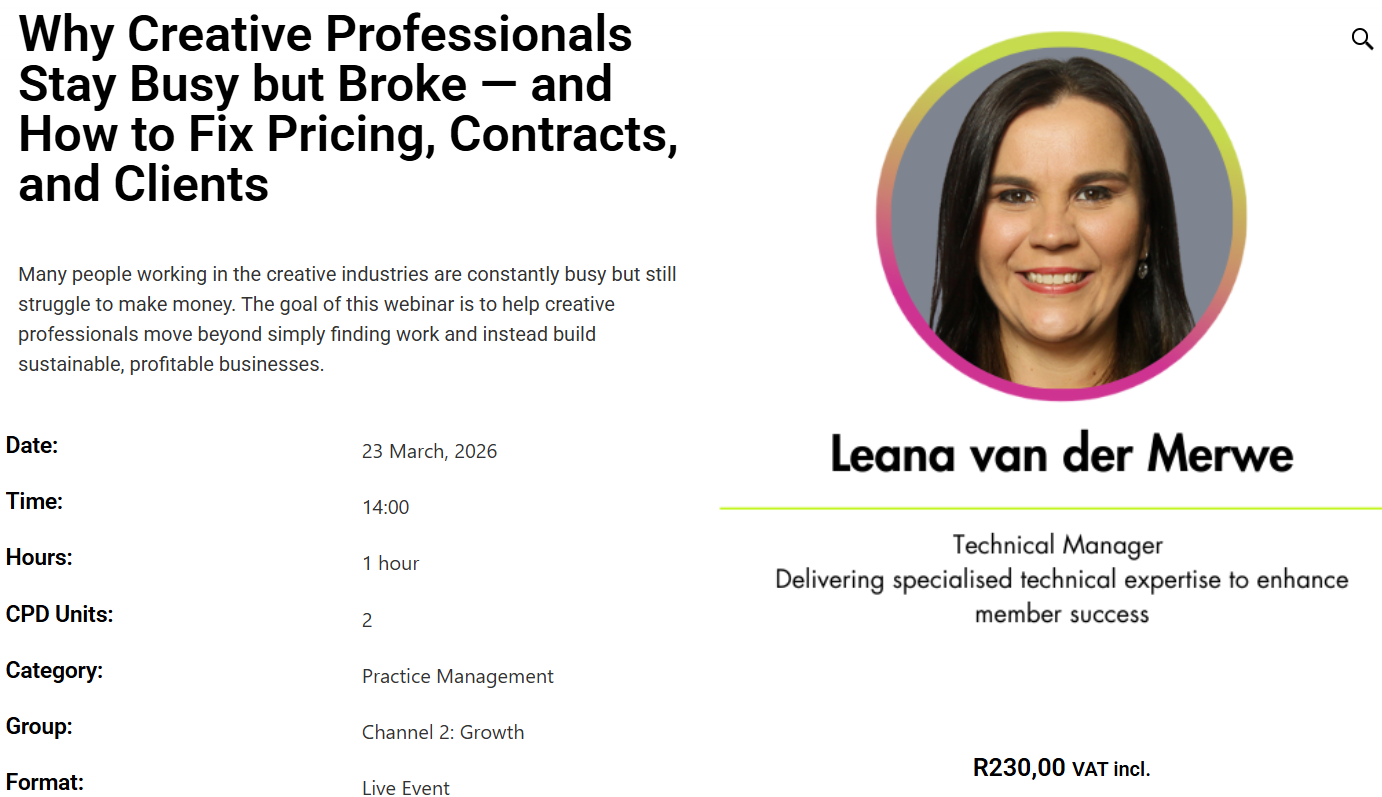
CPD for Creative Professionals: Stop Being Busy… Start Being Profitable - 23 March 2026 Register Here
Too many creatives are fully booked… and still broke.
Designers. Photographers. DJs. Content creators. Artists.
The work is there. The talent is there. The effort is there.
But the income doesn’t follow.
This is not a creativity problem.
It is a business problem.
In this CPD session, we unpack why creative professionals stay stuck in cycles of underpricing, unclear agreements, and difficult clients — and more importantly, how to fix it.
We focus on practical, real-world solutions:
• Pricing based on value, not guesswork
• Simple contracts that actually protect your income
• Managing scope creep before it destroys your margins
• Setting boundaries without losing clients
• Choosing clients who build your business, not drain it
This session is also highly relevant for accountants and advisors working with creative clients who need better structure, pricing, and profitability.
📅 23 March 2026
⏰ 14:00
⏱ 1 Hour | 2 CPD Units
💻 Live Online | Recorded
💰 R230 (VAT incl.) | Free for CIBA Channel 2
If you work with creatives — or you are one — this session will change how you see your business.
👉 Join us here and move from busy… to profitable.