Understanding Your Client’s Business: Why This Skill Changes Everything
This article will count 0.25 units (15 minutes) of unverifiable CPD. Remember to log these units under your membership profile.
Most business accountants are very good at compliance. They prepare financial statements, calculate tax, reconcile accounts, and submit returns accurately and on time. The work is technically sound, and the files look professional. From the outside, it appears that the job has been done properly.
But compliance alone does not keep businesses alive.
Every year, businesses fail while their financial statements still look acceptable. This happens because financial statements record outcomes, not causes. They show what happened after decisions were made, but they do not explain why those decisions were taken, whether they were forced, or whether the business can survive the pressure it is under.
Understanding your client’s business is the skill that moves you from being a compliance provider to being a trusted advisor. It is also the skill that protects your professional judgement and makes your work more valuable in the real economy.
When “Just Do the Statements” Should Worry You
There is one sentence that should always make a professional uncomfortable: “Everything is fine. Just do the statements.”
Many struggling businesses still report profits because owners inject cash, delay costs, or stretch suppliers. Turnover may grow simply because credit terms have become too loose. Ratios may look healthy because the underlying data is unreliable. On paper, everything appears normal.
Financial statements can normalise unhealthy behaviour. They smooth out stress and hide panic. They make short-term survival decisions look like long-term strategy. If you only look at the numbers, you may completely miss the real risks building inside the business.
What It Really Means to Understand a Business
You understand a business when you can explain, in simple words, what it sells, who it sells to, and why customers are willing to pay. You should know what actually triggers revenue in real life, not just what the accounting system records. You should understand which costs truly drive the business and where cash gets stuck.
If you cannot explain the business to a new employee in a short conversation, then your understanding is still too shallow to support strong professional judgement.
Businesses Are Systems, Not Isolated Problems
Clients usually come to you with the final symptom, most often cash flow. But cash flow problems almost never start in the bank account. They usually start much earlier, with one decision that sets off a chain reaction.
A delayed hiring decision overloads staff. Overloaded staff make mistakes. Mistakes cause rework and delays. Delays create customer disputes. Disputes delay invoicing. Invoices that are not sent cannot be collected. By the time the bank balance shows stress, the damage has already been done.
The bank account shows the result, not the decision that caused it.
Your role is not to fix the last problem in the chain. Your role is to find the first domino and stop it from falling again.
Follow How Money Really Enters the Business
To advise properly, you must understand how money actually enters the business and what must happen before it does. The business model determines revenue timing, cash flow patterns, pricing power, and risk exposure.
Saying “we are a service business” means very little without context. Monthly retainers behave very differently from once-off jobs, long-term projects, or commission-based income. If you do not understand the model, your analysis will always be generic.
Every business has a revenue engine. Leads come from somewhere, are converted through some process, delivered in a certain way, invoiced at a specific point, and collected with varying discipline. Walking a client through this process often reveals weaknesses without confrontation.
Why Revenue and Margins Often Lie
One of the most common problems in small businesses is recognising revenue when invoices are sent rather than when work is truly earned. Month-end invoice spikes, billing work that is not yet complete, and heavy credit notes in the following month are warning signs of pressure.
Margins fail for similar reasons. Most margin problems are not accounting errors. They are behavioural decisions. Discounting to secure deals, staff overriding pricing, and the absence of approval controls quietly destroy profitability. Turnover grows, profit shrinks, and management feels confused.
Without understanding behaviour, numbers alone will never tell the full story.
Costs Tell Stories If You Ask the Right Questions
Expenses are not just figures in a ledger. They are the result of operational choices. Overtime usually reflects poor planning. Repairs and maintenance often point to ageing assets and delayed replacement decisions. Wastage, fuel costs, and returns all have practical causes.
Asking what made a cost increase is far more useful than simply noting that it did.
Cash Flow Problems Are Usually Process Problems
Cash flow stress almost always comes from weak collections, poor inventory control, or supplier pressure. In many businesses, invoicing is delayed because everyone is “too busy”, and collections are avoided because owners dislike conflict.
These are not accounting issues. They are ownership and process issues. Assigning responsibility, enforcing discipline, and reviewing cash regularly often solve problems that additional finance never will.
Operations Reveal What the Ledger Hides
Errors, rework, late deliveries, and overrides all create financial consequences. When you ask clients to describe a normal order and then ask what usually goes wrong, the real drivers of risk become visible.
Mapping one full cycle from order to cash exposes control gaps that materially affect the business and your risk assessment.
People, Customers, and Suppliers Can Break a Business
Many SMEs rely on one person for invoicing, payments, systems, or institutional memory. This creates fraud risk, error risk, and burnout risk. Simple controls such as owner oversight, dual payment approvals, and basic documentation dramatically reduce exposure.
Client concentration and supplier dependency are equally dangerous. One large customer or one critical supplier can destabilise a business overnight. Understanding these dependencies allows you to advise before a crisis forces desperate decisions.
Why This Matters for Independent Reviews and Advisory Work
In Independent Reviews, analytical procedures and enquiries only work when they are grounded in business reality. The same ratio can mean very different things in different businesses. Professional judgement requires context, not blind comparison.
This is the difference between reporting and advising. Reporting tells clients what happened. Advising explains why it happened and what it is costing them.
The Real Value You Bring
When you understand your client’s business, your advice becomes specific, practical, and implementable. Clients trust professionals who understand pressure, not those who repeat generic recommendations.
Clients do not pay more for compliance. They pay more for clarity, confidence, and guidance when decisions feel heavy.
Every failing business has a moment where someone could have asked better questions earlier. Your job is to be that person. You are not advising financial statements. You are advising people running a business under pressure — and that is where real professional value lives.
Join Us for the 2026 National Budget Speech Viewing & Expert Analysis
25 February 2026 | CSIR international Convention Centre, Pretoria
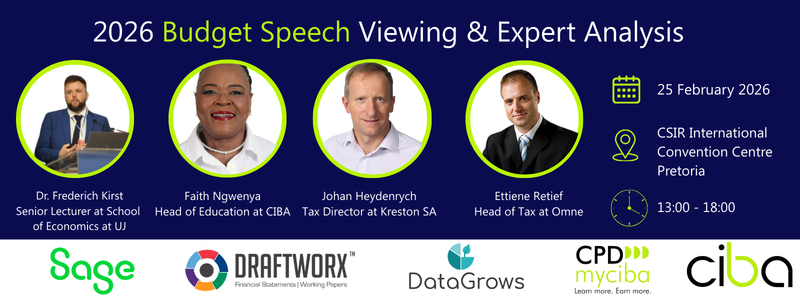
South Africa’s 2026 National Budget Speech will set the tone for the country’s economic direction, tax landscape, and fiscal priorities. With potential tax increases and key policy shifts on the horizon, finance professionals cannot afford to simply watch the speech, you need to interpret it.
That’s why CIBA is hosting a live Budget Speech Viewing & Expert Analysis Event designed to unpack the announcements as they happen. Join us in Menlyn for an afternoon of insight, analysis, and meaningful professional connection.
🎙️ Our expert panel includes:
Johan Heydenrych, Tax Director at Kreston SA
Ettiene Retief, Head of Tax at Omne
Prof. Phindile Nkosi, Director of the Public & Environmental Economics Research Centre (PEERC)
Together, they will translate policy into practical takeaways for your clients, your advisory role, and your strategic planning.
🍸 After the session, enjoy a cocktail networking event to engage with peers and discuss the road ahead for South Africa’s economy.
📅 Date: Tuesday, 25 February 2026
📍 Venue: CSIR international Convention Centre, Pretoria
⏰ Time: 13:00 – 16:00 (Networking 16:00 – 17:30)
💼 CPD: 3 Units (Taxation)
💰 In-person ticket: R350
💻 Prefer online? Book the virtual option for R250.
Why attend?
✔ Understand real-time tax implications from top experts
✔ Gain clarity on anticipated tax changes
✔ Learn how fiscal decisions will affect SMEs, compliance, and advisory
✔ Strengthen your strategic insights for 2026
✔ Connect with other finance professionals and leaders
➡️ Secure your seat for the in-person event here