This article will count 0.25 units (15 minutes) of unverifiable CPD. Remember to log these units under your membership profile.
Let us start with an uncomfortable truth.
Most business failures are not caused by bad products, bad people, or even bad accounting. They are caused by one simple thing. The business runs out of cash.
Not profit.
Not turnover.
Cash.
This is why cash flow analysis matters. And this is why avoiding it does real harm to clients.
For CBAP members, cash flow analysis is not an advanced extra or something you only do for big businesses. It is one of the most practical, protective, and valuable services an accountant can offer. It is also one of the clearest ways to move from compliance work into real advisory work.
Profit Makes Sense on Paper. Cash Keeps the Business Alive.
Many clients believe profit equals success. They assume that if the income statement shows a profit, everything must be fine.
As accountants, we know this is not true.
Profit includes non cash items. It includes income that has not yet been paid. It ignores timing differences. It can look healthy while the bank account is empty.
Cash flow analysis cuts through this confusion. It focuses on when money actually comes in and when it actually goes out. It shows whether the business can pay its bills, pay its people, and meet its obligations.
This is why cash flow problems often shock business owners. Nobody explained the difference properly. Nobody showed them the full picture early enough.
That gap is where CBAP members should step in.
Why Cash Flow Problems Build Quietly
Cash flow problems rarely arrive with a warning sign. They creep in slowly.
Customers start paying a little later.
Stock levels grow without planning.
Expenses increase month by month.
Tax liabilities build up in the background.
None of these things seem serious on their own. Together, they become dangerous.
Most business owners only look at their bank balance. That tells them what already happened. It does not tell them what is coming.
Cash flow analysis changes this. It gives forward visibility. It allows business owners to see pressure building while there is still time to act.
This is not theory. This is daily reality for small and medium businesses. Helping clients see this earlier is one of the most valuable things an accountant can do.
Cash Flow Analysis Is About Decisions, Not Reports
Clients do not care about cash flow statements for their own sake. They care about decisions.
Can I afford to hire someone next month?
Can I survive a quiet season?
Can I take on a big new client without borrowing?
Can I pay SARS on time without stress?
These questions come up every day. Without cash flow analysis, clients guess. Guessing feels cheaper in the moment, but it is far more expensive later.
When CBAP members use cash flow analysis properly, they help clients replace guessing with planning. That is the difference between reacting to problems and staying in control.
Why Clients Value Cash Flow Advice More Than They Admit
Most clients will not ask for cash flow analysis. That does not mean they do not need it.
Clients want fewer surprises. They want stability. They want to feel like someone competent understands their business properly.
Cash flow analysis gives them that confidence. It helps them understand why they feel under pressure even when sales are good. It shows them where changes are needed and which decisions are safe.
Once clients experience this, their relationship with you changes. You are no longer just the person who submits returns. You become the person they talk to before making decisions.
That is where trust is built. And trust is what allows professionals to charge properly for their work.
Why Cash Flow Analysis Matters for You as a CBAP Member
From a professional point of view, cash flow analysis is a turning point.
Compliance work is necessary, but it is crowded and price driven. There will always be someone willing to do it cheaper. Advisory work is different. It is based on insight, judgement, and understanding. That is much harder to replace.
Cash flow analysis allows CBAP members to offer services that are ongoing and relevant. Monthly cash flow reviews, planning discussions, funding support, and risk conversations all flow naturally from this skill.
It also reduces professional risk. When you understand a client’s cash position properly, you can spot warning signs early and document your advice clearly. That protects both the client and you.
Cash Flow Analysis Supports Stronger Businesses and a Stronger Economy
When businesses manage cash properly, they survive longer. They employ people. They pay suppliers. They meet tax obligations. They grow more sustainably.
When businesses collapse suddenly, the damage spreads. Jobs are lost. Suppliers are not paid. Confidence drops.
This is why CIBA sees accountants as economic enablers, not just compliance officers.
Helping businesses manage cash is not just good practice. It supports economic stability at a local and national level.
Cash flow analysis is one of the clearest ways accountants contribute to real economic outcomes.
The Bottom Line: This Is Where Accountants Earn Their Title
Software can record transactions. Anyone can produce reports after the fact.
What businesses need are professionals who can see what is coming and speak honestly about it.
Cash flow analysis is where that happens.
If your clients only hear from you once the year end is done, you are too late to add real value. If they rely on you to understand what lies ahead, you become essential.
For CBAP members, cash flow analysis is not about being more technical. It is about being more useful.
And usefulness is what defines a real professional.
Join Us for the 2026 National Budget Speech Viewing & Expert Analysis
25 February 2026 | Fire & Ice Hotel, Menlyn, Pretoria
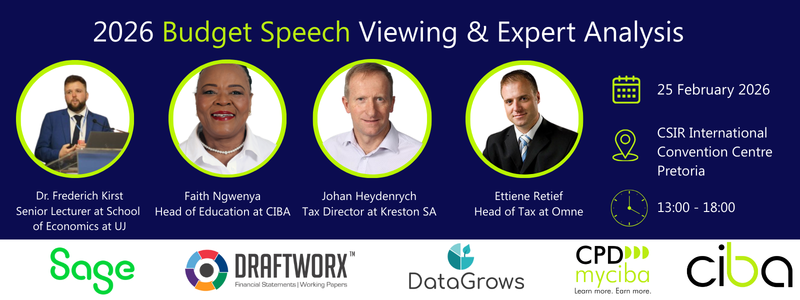
South Africa’s 2026 National Budget Speech will set the tone for the country’s economic direction, tax landscape, and fiscal priorities. With potential tax increases and key policy shifts on the horizon, finance professionals cannot afford to simply watch the speech, you need to interpret it.
That’s why CIBA is hosting a live Budget Speech Viewing & Expert Analysis Event designed to unpack the announcements as they happen. Join us in Menlyn for an afternoon of insight, analysis, and meaningful professional connection.
🎙️ Our expert panel includes:
Johan Heydenrych, Tax Director at Kreston SA
Ettiene Retief, Head of Tax at Omne
Prof. Phindile Nkosi, Director of the Public & Environmental Economics Research Centre (PEERC)
Together, they will translate policy into practical takeaways for your clients, your advisory role, and your strategic planning.
🍸 After the session, enjoy a cocktail networking event to engage with peers and discuss the road ahead for South Africa’s economy.
📅 Date: Tuesday, 25 February 2026
📍 Venue: Protea Hotel Fire & Ice! by Marriott, Menlyn, Pretoria
⏰ Time: 13:00 – 16:00 (Networking 16:00 – 17:30)
💼 CPD: 3 Units (Taxation)
💰 In-person ticket: R350
💻 Prefer online? Book the virtual option for R250.
Why attend?
✔ Understand real-time tax implications from top experts
✔ Gain clarity on anticipated tax changes
✔ Learn how fiscal decisions will affect SMEs, compliance, and advisory
✔ Strengthen your strategic insights for 2026
✔ Connect with other finance professionals and leaders
➡️ Secure your seat for the in-person event here



Trending