This article will count 0.25 units (15 minutes) of unverifiable CPD. Remember to log these units under your membership profile.
If you have ever tried explaining provisional tax to a freelance designer who has just been paid in dollars, upgraded their laptop, and already spent the balance on rent, coffee, and “creative inspiration”, you already know the uncomfortable truth. Creative businesses do not fit neatly into traditional accounting boxes.
And yet, we keep trying to force them in.
Creative businesses are built on ideas, reputation, originality, and intellectual output rather than physical goods or predictable production cycles. Their value lies in deadlines, revisions, approvals, algorithms, and client feedback, not in stock counts or fixed production schedules. Traditional accounting, however, assumes stability. Regular income, predictable expenses, and orderly reporting periods. When these two worlds collide, compliance does not fail because creatives are careless. It fails because the system was never designed for how they actually work
This is not about lowering standards. It is about applying the law and professional judgement correctly.
The Myth of the “Disorganised Creative”
Creatives are often labelled as disorganised or non-compliant, but in most cases the real issue is structural misalignment rather than intentional avoidance. Creative clients think in projects, deadlines, and deliverables. Financial years, accruals, and VAT cycles are not intuitive to how they earn income.
When accounting systems ignore this reality, creatives fall behind unintentionally. VAT becomes a surprise. Provisional tax feels punitive. Penalties appear unexpectedly. Stress builds, and avoidance behaviour often follows. What looks like irresponsibility is usually confusion, and confusion is a system design problem rather than a character flaw.
One Client, Many Income Streams
The creative sector is anything but uniform. Designers, illustrators, animators, photographers, videographers, musicians, performers, influencers, and digital creators all earn income differently. Many creatives juggle multiple income streams at once. Project-based work, retainers with unclear scope, royalties earned long after the work is completed, sponsorships, and platform income paid in foreign currency with minimal documentation.
Each stream carries different VAT implications, timing challenges, and record-keeping risks. Treating all creative income as a single, predictable revenue line is one of the fastest ways to create compliance problems. Understanding how the income is earned is just as important as recording that it was earned.
Cash in the Bank Is Not Profit
One of the most common and most damaging misunderstandings in creative businesses is the belief that cash received equals profit earned. It does not.
VAT collected is not income. Provisional tax is not optional. Cash spent does not cancel future tax liabilities. Many creatives spend money that belongs to SARS without realising it, not because they are reckless, but because no one has explained the distinction clearly enough. Tax is delayed, abstract, and invisible until it suddenly is not.
Simple structures often work better than sophisticated systems. Separating business and personal finances creates an immediate boundary and improves record-keeping almost overnight. A basic cash structure that deliberately allocates funds for tax removes emotion from financial decisions. When tax becomes predictable, fear starts to disappear.
VAT: Where Assumptions Become Expensive
VAT remains one of the highest-risk areas for creative clients, particularly where foreign clients and digital platforms are involved. The most dangerous assumption is that a foreign client automatically means zero-rated VAT. SARS does not look at passports or bank accounts. SARS looks at substance.
Where is the service performed. Where is the benefit enjoyed. Is the service connected to South Africa. If the use or enjoyment of the service is local, VAT is usually standard-rated, even if the client is overseas. Zero-rating is conditional, technical, and entirely dependent on facts and documentation. Without proper contracts and proof, SARS may retrospectively apply fifteen percent VAT, together with penalties and interest.
The Home Office Trap
Home office deductions are a favourite claim among creatives and a favourite audit trigger for SARS. Exclusive use really means exclusive. A dining table, a couch, or a shared living space does not qualify, no matter how often business work is done there.
Apportionment must be based on actual floor area, not estimates or round numbers. These claims require careful documentation and conservative judgement. When handled poorly, they undermine credibility and increase audit risk, often for relatively small tax benefits.
From Compliance to Advisory
Compliance tells creatives what already happened. Advisory helps them decide what happens next.
Project-based accounting reveals which work is profitable and which simply keeps them busy. Tax planning turns fear into predictability. Cash flow reviews reduce burnout and financial anxiety. When creatives understand why tax behaves the way it does, cooperation improves and trust grows. The accountant stops being the person who delivers bad news and becomes a partner in sustainability.
Ethics Matter
Creatives often approach financial matters with anxiety and uncertainty, particularly when SARS is involved. That makes them vulnerable to aggressive tax positions, shortcuts, and promises of easy savings. Those promises rarely end well.
Ethical, conservative advice protects the client, the practice, and the profession. Education consistently outperforms clever schemes in the long term. Integrity builds trust, and trust keeps clients engaged and compliant.
What You Are Really Selling
This is not about selling VAT returns or provisional tax calculations. It is about selling clarity. It is about replacing fear with understanding, chaos with structure, and unpredictability with control.
For creative clients, financial success does not look like perfection. It looks like calm, confidence, and sustainability. When accounting finally works with creative businesses instead of against them, compliance stops being intimidating and starts making sense.
Join Us for the 2026 National Budget Speech Viewing & Expert Analysis. 25 February 2026 | CSIR international Convention Centre, Pretoria
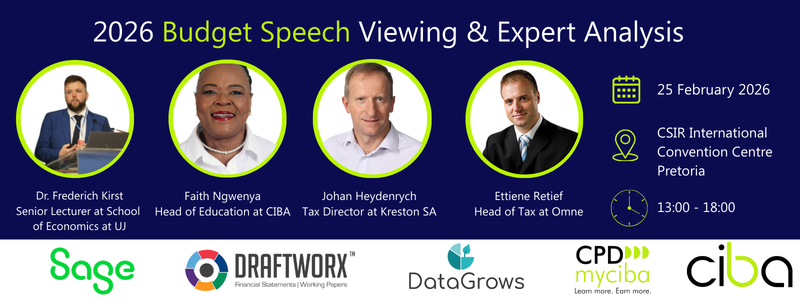
South Africa’s 2026 National Budget Speech will set the tone for the country’s economic direction, tax landscape, and fiscal priorities. With potential tax increases and key policy shifts on the horizon, finance professionals cannot afford to simply watch the speech, you need to interpret it.
That’s why CIBA is hosting a live Budget Speech Viewing & Expert Analysis Event designed to unpack the announcements as they happen. Join us in Menlyn for an afternoon of insight, analysis, and meaningful professional connection.
🎙️ Our expert panel includes:
Johan Heydenrych, Tax Director at Kreston SA
Ettiene Retief, Head of Tax at Omne
Prof. Phindile Nkosi, Director of the Public & Environmental Economics Research Centre (PEERC)
Together, they will translate policy into practical takeaways for your clients, your advisory role, and your strategic planning.
🍸 After the session, enjoy a cocktail networking event to engage with peers and discuss the road ahead for South Africa’s economy.
📅 Date: Tuesday, 25 February 2026
📍 Venue: CSIR international Convention Centre, Pretoria
⏰ Time: 13:00 – 16:00 (Networking 16:00 – 17:30)
💼 CPD: 3 Units (Taxation)
💰 In-person ticket: R350
💻 Prefer online? Book the virtual option for R250.
Why attend?
✔ Understand real-time tax implications from top experts
✔ Gain clarity on anticipated tax changes
✔ Learn how fiscal decisions will affect SMEs, compliance, and advisory
✔ Strengthen your strategic insights for 2026
✔ Connect with other finance professionals and leaders
➡️ Secure your seat for the in-person event here



Trending