When Your Assets Refuse to Sit Still
This article will count 0.25 units (15 minutes) of unverifiable CPD. Remember to log these units under your membership profile.
When Accounting Meets Living Things
Most accounting standards are built for assets that behave themselves. You buy them. You use them. They wear out. You depreciate them. End of story. Agriculture refuses to play along.
In agriculture, assets are alive. They grow even when no one is watching. They change value without being sold. They produce again and again. Sometimes they reproduce. Sometimes they die. And sometimes their value changes simply because the weather changed its mind.
This is exactly why IAS 41 exists.
IAS 41 was created because traditional accounting models could not explain what really happens in agricultural businesses. Cost accounting tells you what you spent, but in agriculture, what you spent often has very little to do with what the asset is now worth.
What IAS 41 Is Really Trying to Do
IAS 41 applies to agricultural activity, not just to animals and plants. That distinction matters more than most people realise.
Agricultural activity means managing biological transformation for economic benefit. In plain language, this means the business is actively involved in growing, breeding, cultivating, or harvesting living assets to make money.
A simple example makes this clear.
If you catch fish in the ocean, you are harvesting nature. You did not grow the fish. IAS 41 does not apply.
If you run a fish farm, feed the fish, control breeding, monitor growth, and decide when to harvest, IAS 41 applies. Same fish. Completely different accounting.
IAS 41 is not about whether something is alive. It is about whether the business is managing life as part of its operations.
The Cast of Characters: Who’s Who in IAS 41
IAS 41 introduces a few key terms that you must understand properly.
A biological asset is a living animal or plant used in agricultural activity. This includes cows, sheep, chickens, trees, vines, and similar items.
Biological transformation is the change that happens because the asset is alive. Growth, milk production, fruiting, breeding, and degeneration all fall into this category.
Agricultural produce is what you harvest from the biological asset. Milk, eggs, fruit, timber, wool — once harvested, these items are no longer alive for accounting purposes.
These definitions may sound simple, but misusing them causes most IAS 41 errors in practice.
When Does a Biological Asset Go on the Balance Sheet?
IAS 41 requires three conditions before recognition. The business must control the asset. It must be likely that future economic benefits will flow to the business. And the value of the asset must be measurable reliably.
If one of these is missing, the asset does not belong in the financial statements.
This is especially important in agriculture, where informal arrangements, communal land, or shared livestock are common.
The Rule That Makes Everyone Uncomfortable
Here is the part of IAS 41 that separates it from almost every other standard.
Biological assets are measured at fair value less costs to sell, both at initial recognition and at every reporting date thereafter.
This means profits and losses can arise even when nothing is sold. A calf growing into a cow creates value. A drought can destroy value. A disease outbreak can wipe out months of growth overnight.
Agricultural produce is measured at fair value at the moment of harvest. From that moment on, IAS 41 steps away and inventory rules take over.
This approach feels strange to accountants trained on cost models. But it reflects economic reality. Growth has value. Risk has consequences. Agriculture lives with both every day.
Why This Matters for Real Clients
In Africa, agriculture is not theoretical. It feeds families, supports SMEs, creates jobs, and anchors rural economies. Many agricultural businesses are small, informal, and exposed to huge risks.
If IAS 41 is applied badly, financial statements swing wildly without explanation. Tax planning becomes dangerous. Funders lose trust. Owners make poor decisions.
If IAS 41 is applied properly, the numbers tell a real story. Not a perfect story, but an honest one.
Before you can tell that story properly, however, you must first answer a critical question: what exactly are you accounting for?
Join Us for the 2026 National Budget Speech Viewing & Expert Analysis. 25 February 2026 | CSIR international Convention Centre, Pretoria
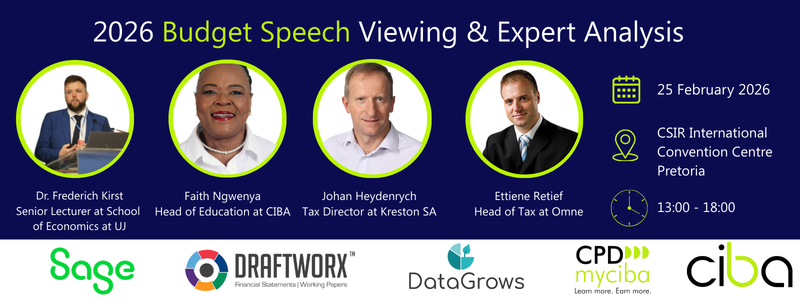
South Africa’s 2026 National Budget Speech will set the tone for the country’s economic direction, tax landscape, and fiscal priorities. With potential tax increases and key policy shifts on the horizon, finance professionals cannot afford to simply watch the speech, you need to interpret it.
That’s why CIBA is hosting a live Budget Speech Viewing & Expert Analysis Event designed to unpack the announcements as they happen. Join us in Menlyn for an afternoon of insight, analysis, and meaningful professional connection.
🎙️ Our expert panel includes:
Johan Heydenrych, Tax Director at Kreston SA
Ettiene Retief, Head of Tax at Omne
Prof. Phindile Nkosi, Director of the Public & Environmental Economics Research Centre (PEERC)
Together, they will translate policy into practical takeaways for your clients, your advisory role, and your strategic planning.
🍸 After the session, enjoy a cocktail networking event to engage with peers and discuss the road ahead for South Africa’s economy.
📅 Date: Tuesday, 25 February 2026
📍 Venue: CSIR international Convention Centre, Pretoria
⏰ Time: 13:00 – 16:00 (Networking 16:00 – 17:30)
💼 CPD: 3 Units (Taxation)
💰 In-person ticket: R350
💻 Prefer online? Book the virtual option for R250.
Why attend?
✔ Understand real-time tax implications from top experts
✔ Gain clarity on anticipated tax changes
✔ Learn how fiscal decisions will affect SMEs, compliance, and advisory
✔ Strengthen your strategic insights for 2026
✔ Connect with other finance professionals and leaders
➡️ Secure your seat for the in-person event here


Choose Your Path to Exclusive Insights
Stay ahead in the world of accounting with premium content designed for professionals like you. Access expert articles, industry trends, and essential resources. Become a CIBA member and claim your CPD hours from CIBA.
CIBA Member Access
R250.00 FREE!
100% Discount when you become a CIBA Member. Join now to claim your CPD Hours. Register here: https://accounts.myciba.org/register