Changing a Company’s Financial Year-End: A Practical Reality Check for CBAP’s
This article will count 0.25 units (15 minutes) of unverifiable CPD. Remember to log these units under your membership profile.
Changing a company’s financial year-end often sounds like a small administrative decision. In practice, it is a formal legal change that affects compliance, annual returns, and the credibility of the financial statements. This is one of those areas where things quietly go wrong , not because the accounting is difficult, but because the process is misunderstood.
For CBAPs, this is exactly where practical knowledge matters more than theory.
A Year-End Is a Registered Fact, Not an Accounting Preference
A company’s financial year-end is not something that lives only in the accounting records. It is a registered detail held by the Companies and Intellectual Property Commission (CIPC). Until CIPC approves a change, the company’s year-end remains exactly what is on the register, no matter what the accounting software or draft financial statements say.
This is where many problems start. The year-end is changed internally, financial statements are prepared to a new date, and only later does someone realise that CIPC was never informed. At that point, the mismatch creates penalties, rejected filings, and uncomfortable questions during an independent review or audit.
The 15-Month Rule: Shorter Is Fine, Longer Is Not
The Companies Act allows companies to change their financial year-end, but it does not allow unlimited flexibility. The rule is simple but often misunderstood. When a year-end is changed, the resulting financial period may be shorter than 15 months, but it may not be longer than 15 months.
This means a company can safely shorten a year to move from one date to another, but it cannot stretch the period beyond the 15-month limit. The only time a longer period is allowed is in the first year after incorporation. After that, the limit applies strictly.
As a CBAP, counting the months before anything is submitted is a non-negotiable step. If the proposed change creates a period longer than 15 months, CIPC will reject it, regardless of the business reason behind the request.
When the Change Will Not Go Through
In practice, year-end changes are often delayed or rejected not because of the date itself, but because the company is not compliant. CIPC will not process a year-end amendment if annual returns are outstanding, penalties are unpaid, or the company has moved into deregistration status.
This means the administrative housekeeping must be done first. Trying to change the year-end without fixing compliance issues is simply wasted effort.
How the Year-End Is Changed in Practice
The actual process is straightforward. The company must submit an amendment through CIPC eServices, propose the new year-end, pay the prescribed fee, and wait for confirmation. What matters most is understanding that the change is not effective on submission. It is only effective once CIPC approves it.
From a professional perspective, this means you should not finalise or issue financial statements to the new year-end until that approval is in hand. Drafting is one thing. Issuing is another.
What Must Change in the Annual Financial Statements
Once the year-end change is approved, the financial statements must tell the full story. Preparing the numbers to the new date is only part of the job. The notes to the AFS must clearly explain that the year-end has changed, what the previous year-end was, what the new year-end is, and whether the current period is shorter than usual. The reason for the change should also be disclosed.
This disclosure is not a technical extra. It is essential context for anyone reading the statements. When the period is shorter than twelve months, users must understand that comparisons are not like-for-like. Without this explanation, ratios, trends, and performance analysis become misleading.
Annual Returns Must Follow the New Year-End
One of the most common practical failures is forgetting to realign annual return dates after a year-end change. Once CIPC approves the new year-end, annual returns are calculated from that date. If filings continue to follow the old year-end, penalties are almost guaranteed.
Many clients believe that changing the year-end in the financial statements automatically updates everything else. It does not. SARS, CIPC, and the accounting records each require deliberate alignment.
A Scenario Seen Far Too Often
A company decides to align its year-end with SARS at the end of February. The financial statements are prepared to 28 February, signed, and issued. Months later, annual return penalties appear. The reason is simple: CIPC still reflects a December year-end.
The accounting work was technically correct. The compliance process was not.
Where the CBAP Adds Real Value
This is not about paperwork. It is about professional oversight. A CBAP who understands the year-end change process will check the CIPC register before finalising financial statements, confirm approval, ensure disclosures are correct, and align compliance deadlines. This is where you prevent problems before they reach the client’s inbox as penalties and notices.
Clients rarely understand the 15-month rule, the approval requirement, or the disclosure implications. That knowledge sits squarely with the professional.
In Closing
Changing a financial year-end is allowed, common, and often sensible. Doing it halfway creates more problems than leaving things as they are. When handled properly, with CIPC approval, correct disclosures, and aligned filings, it becomes a clean and defensible change.
For CBAPs, this is one of those areas where getting the basics right makes all the difference.
Join Us for the 2026 National Budget Speech Viewing & Expert Analysis. 25 February 2026 | CSIR international Convention Centre, Pretoria
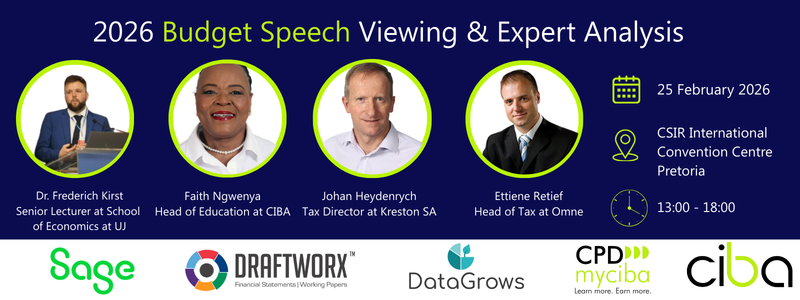
South Africa’s 2026 National Budget Speech will set the tone for the country’s economic direction, tax landscape, and fiscal priorities. With potential tax increases and key policy shifts on the horizon, finance professionals cannot afford to simply watch the speech, you need to interpret it.
That’s why CIBA is hosting a live Budget Speech Viewing & Expert Analysis Event designed to unpack the announcements as they happen. Join us in Menlyn for an afternoon of insight, analysis, and meaningful professional connection.
🎙️ Our expert panel includes:
Johan Heydenrych, Tax Director at Kreston SA
Ettiene Retief, Head of Tax at Omne
Prof. Phindile Nkosi, Director of the Public & Environmental Economics Research Centre (PEERC)
Together, they will translate policy into practical takeaways for your clients, your advisory role, and your strategic planning.
🍸 After the session, enjoy a cocktail networking event to engage with peers and discuss the road ahead for South Africa’s economy.
📅 Date: Tuesday, 25 February 2026
📍 Venue: CSIR international Convention Centre, Pretoria
⏰ Time: 13:00 – 16:00 (Networking 16:00 – 17:30)
💼 CPD: 3 Units (Taxation)
💰 In-person ticket: R350
💻 Prefer online? Book the virtual option for R250.
Why attend?
✔ Understand real-time tax implications from top experts
✔ Gain clarity on anticipated tax changes
✔ Learn how fiscal decisions will affect SMEs, compliance, and advisory
✔ Strengthen your strategic insights for 2026
✔ Connect with other finance professionals and leaders
➡️ Secure your seat for the in-person event here


Choose Your Path to Exclusive Insights
Stay ahead in the world of accounting with premium content designed for professionals like you. Access expert articles, industry trends, and essential resources. Become a CIBA member and claim your CPD hours from CIBA.
CIBA Member Access
R250.00 FREE!
100% Discount when you become a CIBA Member. Join now to claim your CPD Hours. Register here: https://accounts.myciba.org/register