Not Everything You Buy Is an Expense
This article will count 0.25 units (15 minutes) of unverifiable CPD. Remember to log these units under your membership profile.
Every business uses assets to operate. These assets help the business earn income. Some assets are used up quickly, like stationery. Others are used for many years. These long-term assets are called fixed assets.
In this article, we will explain what a fixed asset is, what depreciation means, and how it works in practice. We will use a simple example of buying a computer for R20,000.
What Is a Fixed Asset?
A fixed asset is something a business buys and uses for more than one year to help it earn income.
Examples include:
Computers
Vehicles
Machinery
Furniture
Buildings
A fixed asset is not bought to sell. It is bought to use.
If you buy stock to sell to customers, that is inventory. If you buy a laptop to use in your office, that is a fixed asset.
The Important Parts of a Fixed Asset
When we talk about fixed assets, there are a few important words you must understand.
1. Cost
The cost is the amount you pay to buy the asset.
This includes:
The purchase price
Delivery costs
Installation costs
If you buy a computer for R20,000 and there are no extra costs, then the cost is R20,000.
2. Useful Life
The useful life is how long the business expects to use the asset.
This is not always the same as the physical life. It is how long the asset will be useful to the business.
For example:
A computer may physically last 5 years.
But the business may replace it after 3 years.
So the useful life is 3 years.
3. Residual Value
The residual value (also called scrap value) is what you expect to sell the asset for at the end of its useful life.
If you think you can sell the computer for R2,000 after 3 years, that is the residual value.
If you think it will be worth nothing, then the residual value is zero.
4. Depreciation
Depreciation is the process of spreading the cost of the asset over its useful life.
Instead of recording the full cost as an expense in year one, we spread it over the years the asset is used.
This matches the cost of the asset with the income it helps to earn.
Depreciation is an expense in the income statement.
5. Accumulated Depreciation
Accumulated depreciation is the total depreciation recorded from the date the asset was bought up to now.
It is not an expense for the year. It is the total amount of depreciation over time.
It is shown in the statement of financial position and reduces the value of the asset.
Example: Buying a Computer for R20,000
Let us now work through a simple example.
Cost: R20,000
Useful life: 3 years
Residual value: R0
We will use the straight-line method.
Step 1: Calculate Depreciation Per Year
Formula:
Depreciation per year =
(Cost − Residual value) ÷ Useful life
So:
(R20,000 − R0) ÷ 3 = R6,667 per year (rounded)
Each year, we will record R6,667 as depreciation.
Year 1
Journal Entry
At the end of Year 1:
Debit: Depreciation expense R6,667
Credit: Accumulated depreciation R6,667
Depreciation expense goes to the income statement.
Accumulated depreciation goes to the statement of financial position.
How It Shows in the Financial Statements
Income Statement (Year 1)
Depreciation expense: R6,667
This reduces profit.
Statement of Financial Position (End of Year 1)
Computer (at cost): R20,000
Less: Accumulated depreciation: (R6,667)
Carrying amount: R13,333
The carrying amount is the cost minus accumulated depreciation.
Year 2
In Year 2, we do the same thing again.
Journal Entry
Debit: Depreciation expense R6,667
Credit: Accumulated depreciation R6,667
Now the total accumulated depreciation is:
R6,667 (Year 1)
R6,667 (Year 2)
= R13,334
Statement of Financial Position (End of Year 2)
Computer (at cost): R20,000
Less: Accumulated depreciation: (R13,334)
Carrying amount: R6,666
The asset is now worth much less in the books.
Year 3
In Year 3, we record depreciation again.
Debit: Depreciation expense R6,666 (adjusted slightly for rounding)
Credit: Accumulated depreciation R6,666
Total accumulated depreciation is now R20,000.
Carrying amount = R20,000 − R20,000 = R0
The asset is now fully depreciated.
Important Things to Remember
Depreciation does not mean cash is leaving the business.
The cash was paid when the asset was bought.Depreciation is an accounting adjustment.
It spreads the cost over time.The cost of the asset never changes in the accounting records.
It stays at R20,000.Accumulated depreciation increases every year.
The carrying amount decreases every year.
Why Depreciation Is Important
Depreciation ensures that:
Expenses are matched to the income they help to earn.
Profit is not overstated in the first year.
Assets are not shown at unrealistic values.
Financial statements are fair and reasonable.
If we did not depreciate the computer, profit in Year 1 would be too low if we expensed everything, or too high in later years if we ignored the cost completely.
Depreciation creates balance.
Final Thoughts
Fixed assets are essential for running a business. But they lose value over time. Depreciation is the method we use to reflect that loss in value in a structured and fair way.
By understanding cost, useful life, residual value, depreciation, and accumulated depreciation, accountants can ensure that financial statements present a true picture of the business.
Even though the concept sounds technical, the idea is simple:
Spread the cost of the asset over the years it is used.
Once you understand that principle, depreciation becomes much easier to apply in practice.
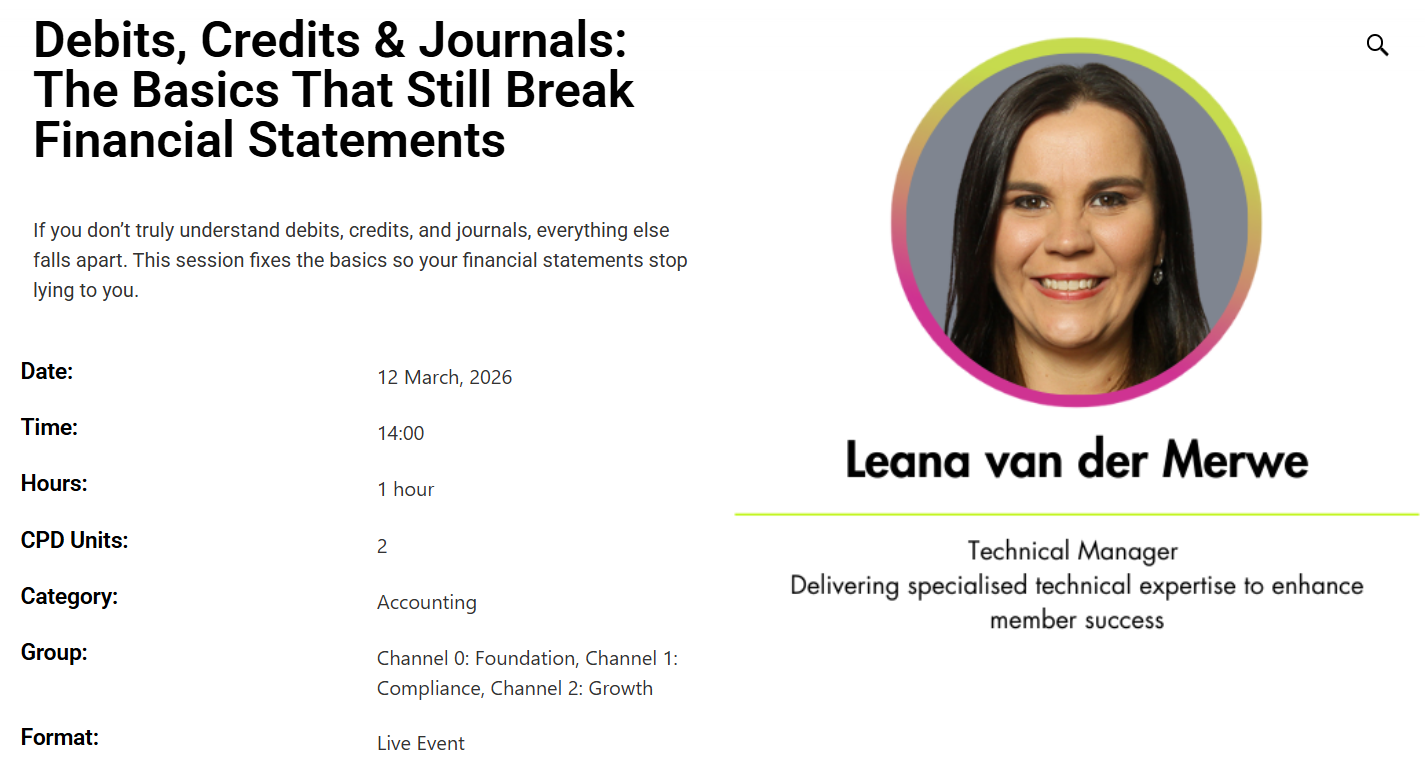
Live and Recorded CPD
Debits, Credits & Journals: The Basics That Still Break Financial Statements
📅 12 March 2026 | ⏰ 14:00 | 🕒 1 Hour | 🎓 2 CPD Units
💻 Live Online |Free for All CIBA Member | Everyone else: R230 (VAT incl.)
Most financial statement errors don’t come from IFRS.
They come from weak fundamentals.
If debits and credits still feel mechanical…
If journals are being posted without fully understanding the impact…
If year-end adjustments make you nervous…
This session fixes it.
Join Leana van der Merwe, Technical Lead at CIBA, for a practical, no-nonsense session that rebuilds your accounting foundation so your financial statements stop lying to you.
Register and Access CPD Here


Choose Your Path to Exclusive Insights
Stay ahead in the world of accounting with premium content designed for professionals like you. Access expert articles, industry trends, and essential resources. Become a CIBA member and claim your CPD hours from CIBA.
CIBA Member Access
R250.00 FREE!
100% Discount when you become a CIBA Member. Join now to claim your CPD Hours. Register here: https://accounts.myciba.org/register