This article will count 0.25 units (15 minutes) of unverifiable CPD. Remember to log these units under your membership profile.
In many small and medium businesses, one person often does everything. They raise invoices, receive payments, capture transactions, reconcile the bank account, and sometimes even approve payments. It feels efficient. It feels practical. And for a while, it often works.
Until it does not.
Segregation of duties is one of the most basic and powerful internal controls in any business. It is also one of the most misunderstood. Many clients think it is only for large corporates or that it requires hiring more staff. As a CBAP advising clients, your role is to explain this concept clearly and help clients apply it in a way that suits their size and risk.
At its core, segregation of duties means that no single person should control a process from start to finish.
What segregation of duties really means
Segregation of duties means splitting important tasks between different people so that one person cannot do all of the following:
· Start a transaction
· Approve the transaction
· Record the transaction
· Check that the transaction is correct
When one person can perform all these steps, the business is exposed to risk.
A simple way to explain this to a client is to say that the person who does the work should not be the same person who checks the work.
This principle applies across the business. It applies to money coming in, money going out, stock, payroll, customer information, and access to systems.
Segregation of duties is not about distrust. It is about good governance. Even honest people make mistakes, and controls exist to catch those mistakes before they become serious problems.
Why segregation of duties is so important
Segregation of duties matters because it reduces risk. It reduces the risk of errors, fraud, theft, and manipulation of information.
When duties are properly separated, problems are more likely to be detected early. When duties are not separated, problems can continue unnoticed for long periods of time.
From an advisory point of view, segregation of duties protects the business owner, the employees, the financial information, and the reputation of the business. It also makes external processes easier, such as independent reviews, audits, tax submissions, and due diligence.
A business that relies only on trust, without controls, is vulnerable.
Why clients struggle to implement segregation of duties
Clients often resist segregation of duties for three main reasons.
· They believe the business is too small.
· They trust their staff completely.
· They believe they do not have enough people.
All of these reasons are understandable. None of them remove the risk.
Segregation of duties does not always mean employing more staff. Often it means changing responsibilities, adding review steps, or involving the owner or director at key points in a process.
As a CBAP, your role is not to create complex systems. Your role is to help clients put reasonable controls in place that match their business size and level of risk.
What can go wrong when duties are not separated
When segregation of duties is weak or absent, several problems can occur.
The most common issue is errors. Payments may be captured incorrectly, invoices may be duplicated, or reconciliations may be done incorrectly. When the same person captures and reviews information, mistakes are far less likely to be identified.
Another major risk is fraud. If one person can create suppliers, load bank details, approve payments, and reconcile the bank account, they can steal money and hide it. This risk is especially high in small businesses where controls are informal.
There is also a risk of manipulation. Financial results can be adjusted to make performance look better or worse than it really is. This leads to poor decisions, incorrect tax calculations, and loss of trust.
A further risk is over dependence on one individual. When all financial knowledge sits with one employee, the business is exposed if that person resigns, becomes ill, or is suddenly unavailable.
Finally, there is regulatory and professional risk. Weak controls make it harder to support financial information. This can lead to problems with SARS, lenders, investors, and professional engagements such as independent reviews.
Practical examples clients understand
Clients understand segregation of duties best when it is explained through simple examples.
In the cash receipts process, the person who receives money should not be the same person who records it in the accounting system. Someone else should check that the amounts received match what was recorded.
In the payments process, the person who prepares a payment should not be the person who approves it. Even in electronic banking systems, approval must be separate.
In payroll, the person who captures salary information should not be the person who releases payments or reconciles payroll to the general ledger.
In stock management, the person who orders stock should not be the same person who receives and records the stock without review.
In system access, the person who uses the system daily should not be the person who controls user access and permissions.
These examples help clients see that segregation of duties is about checks and balances, not unnecessary red tape.
What happens when segregation of duties is ignored
When segregation of duties is ignored, problems usually surface late. The consequences are often serious.
Losses tend to be larger because issues continue over time. Trust between owners and staff breaks down. Insurance claims may be rejected because controls were weak. Professional advisors are often forced to deliver bad news that could have been avoided.
In many cases, there were warning signs such as missing documents, delays in providing information, unexplained adjustments, or defensive behaviour. Proper segregation of duties often brings these issues to light much earlier.
How CBAPs can advise clients in a practical way
CBAPs should start by helping clients identify their highest risk areas. These usually include cash, payments, payroll, and system access.
In very small businesses, the owner or director should be involved in approval and review steps. A simple monthly review of bank reconciliations, payment reports, and exception reports already adds a strong control.
Clients should also be encouraged to document their processes, even if they are simple. Written procedures improve consistency and accountability.
Segregation of duties should be reviewed regularly. As a business grows or systems change, roles and controls must be updated.
The real value of segregation of duties
Segregation of duties builds confidence. It gives business owners peace of mind. It supports reliable financial information. It protects honest employees from suspicion. It makes professional work easier and more defensible.
Most importantly, it turns trust into something that is supported by structure and oversight.
For CBAPs, segregation of duties is not just a technical concept. It is a practical advisory tool that helps clients run stronger, safer, and more sustainable businesses.
When explained clearly and applied sensibly, segregation of duties is one of the most valuable pieces of advice a CBAP can give any client, regardless of size.
Join Us for the 2026 National Budget Speech Viewing & Expert Analysis. 25 February 2026 | CSIR international Convention Centre, Pretoria
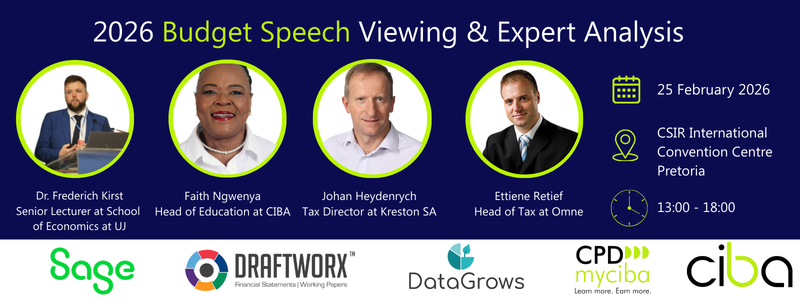
South Africa’s 2026 National Budget Speech will set the tone for the country’s economic direction, tax landscape, and fiscal priorities. With potential tax increases and key policy shifts on the horizon, finance professionals cannot afford to simply watch the speech, you need to interpret it.
That’s why CIBA is hosting a live Budget Speech Viewing & Expert Analysis Event designed to unpack the announcements as they happen. Join us in Menlyn for an afternoon of insight, analysis, and meaningful professional connection.
🎙️ Our expert panel includes:
Johan Heydenrych, Tax Director at Kreston SA
Ettiene Retief, Head of Tax at Omne
Prof. Phindile Nkosi, Director of the Public & Environmental Economics Research Centre (PEERC)
Together, they will translate policy into practical takeaways for your clients, your advisory role, and your strategic planning.
🍸 After the session, enjoy a cocktail networking event to engage with peers and discuss the road ahead for South Africa’s economy.
📅 Date: Tuesday, 25 February 2026
📍 Venue: CSIR international Convention Centre, Pretoria
⏰ Time: 13:00 – 16:00 (Networking 16:00 – 17:30)
💼 CPD: 3 Units (Taxation)
💰 In-person ticket: R350
💻 Prefer online? Book the virtual option for R250.
Why attend?
✔ Understand real-time tax implications from top experts
✔ Gain clarity on anticipated tax changes
✔ Learn how fiscal decisions will affect SMEs, compliance, and advisory
✔ Strengthen your strategic insights for 2026
✔ Connect with other finance professionals and leaders
➡️ Secure your seat for the in-person event here



Trending