IFRS for SMEs vs ISRS 4410: Know the Difference
This article will count 0.25 units (15 minutes) of unverifiable CPD. Remember to log these units under your membership profile.
Getting Compilation Reports Right: Clearing Up the IFRS for SMEs and ISRS 4410 Confusion
In practice, some of the most common technical questions are not the most complex ones. They are often the ones where two standards seem to overlap. One such question is this: When preparing a practitioner’s compilation report for an SME, which standard should you use?
Many practitioners hesitate between IFRS for SMEs and ISRS 4410 (Revised). The uncertainty is understandable. Both are mentioned in the same engagement, both are important, and both appear in the final report.
The answer is simple. You do not choose between them. You use both. Each one serves a different purpose.
Why This Question Matters
This may seem like a small technical point, but it is not. It affects how your work is understood by clients, regulators, and other users of financial statements.
If the roles of these standards are not clear, it can lead to:
Incorrect wording in your report
Confusion about whether assurance is provided
Misunderstanding of your responsibilities as a practitioner
For professionals working with SMEs, where compilation engagements are common, this distinction is essential.
Two Standards with Different Roles
The confusion falls away once you understand that these standards operate in different areas.
The Financial Reporting Framework: IFRS for SMEs
The IFRS for SMEs Accounting Standard is the foundation of the financial statements.
It sets out:
How transactions are recognised
How assets and liabilities are measured
What must be disclosed
How the financial statements are presented
In simple terms, IFRS for SMEs determines what the financial statements look like.
It does not tell you how to perform your work as a practitioner. It focuses only on the preparation and presentation of the financial information.
The Engagement Standard: ISRS 4410 (Revised)
ISRS 4410 (Revised) deals with the work performed by the practitioner.
It provides guidance on:
How to carry out a compilation engagement
The responsibilities of the practitioner
The documentation required
How the compilation report should be structured
It also makes it clear that a compilation engagement:
Does not provide assurance
Is not an audit
Is not a review
In simple terms, ISRS 4410 tells you how to do the work and how to report on it.
How They Work Together in Practice
In a typical SME engagement, both standards are applied together, but in different ways.
Management first decides on the financial reporting framework. In many cases, this is IFRS for SMEs. This decision determines how the financial statements must be prepared.
The practitioner then assists management in preparing those financial statements in line with that framework.
At the same time, the practitioner performs the compilation engagement in accordance with ISRS 4410 (Revised). This governs the approach taken and the responsibilities involved.
Finally, the practitioner issues a compilation report. This report refers to both standards, each for its own purpose.
What a Proper Compilation Report Should Show
A properly drafted compilation report will clearly refer to both standards.
It will indicate that:
The engagement was performed in accordance with ISRS 4410 (Revised)
The financial statements were prepared in accordance with IFRS for SMEs
Management is responsible for the financial statements
No audit or review has been performed
No opinion or conclusion is expressed
This clarity is important. It ensures that users understand exactly what work has been done and what has not been done.
A Simple Way to Remember
If you need a quick way to remember the difference, think of it like this:
· IFRS for SMEs explains what the financial statements must contain.
· ISRS 4410 explains how you compile and report on those financial statements.
Keeping this distinction in mind will help you apply both standards correctly.
Common Mistakes in Practice
In practice, mistakes often happen in subtle ways.
Some practitioners:
Refer only to IFRS for SMEs and leave out ISRS 4410
Use wording that suggests some level of assurance
Do not clearly explain management’s responsibility
These errors can create confusion and increase professional risk. Clear and accurate reporting is essential.
Why Getting This Right Protects You
Clear reporting protects both you and your client.
When your report clearly states:
The standard used for the engagement
The framework used for the financial statements
The absence of assurance
you reduce the risk of misunderstanding and strengthen the credibility of your work.
Final Thoughts
Compilation engagements are an important service for SMEs. They provide structured financial information without the cost and complexity of an audit or review.
As a practitioner, your role is to ensure clarity at every step.
You must be clear about:
What framework is used to prepare the financial statements
What standard governs your work
What your report communicates to users
When you understand and apply the difference between IFRS for SMEs and ISRS 4410 (Revised), your work becomes clear, compliant, and professionally sound.
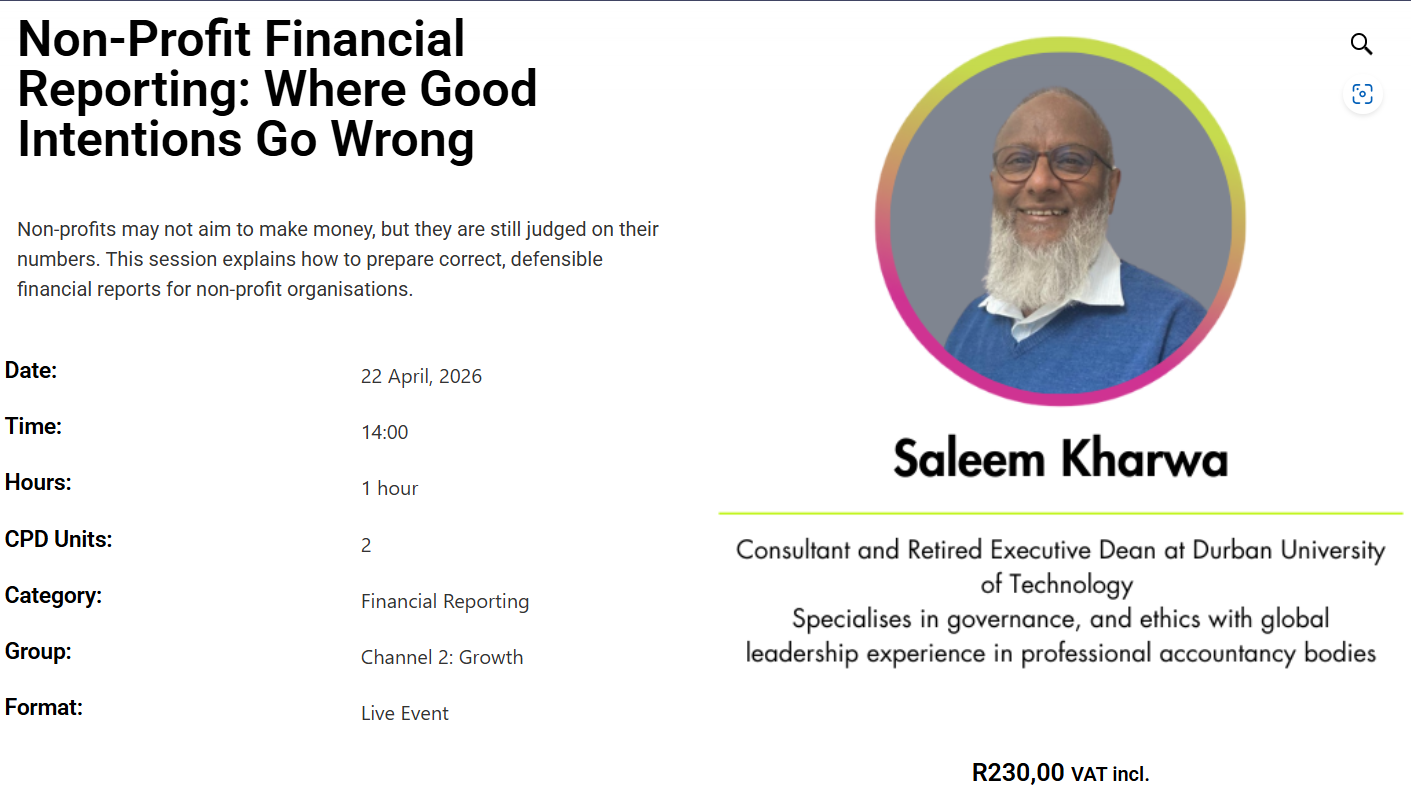
🎓 CPD | What You Don’t Know About Non-Profit Reporting Can Cost You
Non-profits are not judged on profit, but they are judged on their numbers. If your reporting is unclear, incomplete, or incorrect, it raises red flags with funders, regulators, and auditors.
Join this practical 1-hour live CPD session where you will learn how to prepare financial reports that are accurate, transparent, and defensible. We unpack how to correctly treat donations and grants, manage restricted and unrestricted funds, and avoid the common mistakes that create real risk.
📅 22 April 2026
⏰ 14:00
🕒 1 Hour | 2 CPD Units
💰Free CIBA Channel 2 subscribers | R230 (VAT incl.) everyone else
👤 Presented by Saleem Kharwa
If you work with non-profits, this session will give you the confidence to report properly and protect both your organisation and your professional reputation.
👉 Book your spot here now


Choose Your Path to Exclusive Insights
Stay ahead in the world of accounting with premium content designed for professionals like you. Access expert articles, industry trends, and essential resources. Become a CIBA member and claim your CPD hours from CIBA.
CIBA Member Access
R250.00 FREE!
100% Discount when you become a CIBA Member. Join now to claim your CPD Hours. Register here: https://accounts.myciba.org/register