How One “Yes” Can Cost Your Career in Municipal Finance
This article will count 0.25 units (15 minutes) of unverifiable CPD. Remember to log these units under your membership profile.
A Director of Community Services receives a call from the mayor. There’s an urgent clean-up campaign. A supplier has already been identified. The instruction is simple: “appoint them immediately”.
No tender process is followed. No documentation is signed. Just a verbal instruction and a sense of urgency. The director approves the R800,000 expenditure.
Months later, the Auditor-General flags the transaction as irregular. The mayor denies giving the instruction. The director is charged with financial misconduct, receives a final written warning, and is required to repay the full amount.
One decision. One moment of pressure. One very expensive consequence.
Why this matters for every accountant
Governance is often treated as a compliance exercise, something administrative and procedural. In reality, it is far more serious. It directly affects your career, your credibility, and your earning potential. In government, once your name is linked to irregular expenditure or governance failures, the consequences extend far beyond a single organisation. Your professional reputation becomes exposed.
Importantly, the issue is not a lack of legislation. South Africa has strong frameworks in place through the Municipal Finance Management Act (MFMA), the Municipal Systems Act, and the Constitution. The challenge lies in implementation and accountability.
For accountants, this creates both a risk and an opportunity. Those who understand and apply governance properly become highly valuable. Those who ignore it often learn the consequences the hard way.
From compliance officer to value protector
Business accountants working in government are not just responsible for reporting numbers. They play a critical role in protecting financial integrity and enabling economic value. In practice, this means ensuring that:
Money is spent correctly
Processes are followed
Risks are identified early.
You are not just recording decisions. You are often the last checkpoint before those decisions create financial and legal consequences.
The mistakes that create real risk
While governance frameworks are detailed, the mistakes that cause the most damage are often simple and repeated.
Actingon unlawful or verbal instructions
One of the most common risks arises when officials act on instructions from political office bearers without verifying legality. An instruction may sound reasonable or urgent, but if it bypasses proper processes, it becomes a problem.
For example, approving a supplier without following procurement procedures, even under pressure, can result in irregular expenditure. When the matter is later investigated, the official who approved it carries the responsibility, not the person who gave the instruction.
💥Officials are accountable to the municipality and the law, not to individuals.
Failing to disclose conflicts of interest
Conflicts of interest are often misunderstood or underestimated. Many assume that as long as they act fairly, there is no issue. However, the law focuses on disclosure, not intention.
If a relative, friend, or known associate is involved in a bid process, this must be declared. Even indirect relationships can compromise the integrity of the process.
💥Failure to disclose creates immediate risk, regardless of whether any wrongdoing was intended.
Approving expenditure outside the budget
Another frequent mistake is treating budgets as flexible guidelines rather than legal limits. In municipal finance, expenditure must align strictly with an approved budget.
Spending outside of these parameters—no matter how justified it may seem—results in unauthorized expenditure. This is automatically flagged during audits and must be accounted for.
💥The principle is straightforward: if it is not budgeted, it is not permitted.
Manipulating procurement processes
Procurement remains one of the highest-risk areas. Common issues include splitting contracts to avoid tender thresholds, bypassing supply chain management (SCM) procedures, or awarding contracts to non-compliant suppliers. For instance, dividing a large contract into smaller amounts to remain below approval limits may appear clever in the short term. In reality, it is easily detected and classified as irregular expenditure.
💥The MFMA requires procurement to be fair, transparent, competitive, and cost-effective. Deviating from this framework exposes both the organisation and the individual involved.
Ignoring audit findings
Audit findings are not administrative formalities. They are formal indicators of risk and non-compliance.
When issues raised by the Auditor-General are not addressed, they often recur. This repetition escalates the severity of the problem and may result in additional charges.
💥Accounting officers are required to implement corrective actions and report back on progress. Failure to do so is itself a breach of responsibility.
The overlooked risk for advisors
Advisors and consultants of government are not exempt from accountability. There is a common assumption that providing advice limits responsibility. This is incorrect. If an advisor recommends or supports actions that lead to irregular expenditure or non-compliance, they can be investigated, held jointly liable, or even blacklisted from doing business with the public sector.
💥This changes the role of a business accountant significantly. Clients are not just paying for technical answers, they are paying for protection from risk.
Recognising the warning signs early
In many cases, problems are visible long before they become audit findings. Common red flags include repeated use of emergency procurement, incomplete documentation, consistent use of the same suppliers, and pressure to bypass processes. These indicators suggest deeper control weaknesses. Identifying and addressing them early can prevent larger issues from developing.
A practical approach to staying compliant
Avoiding these risks does not require complex systems. It requires discipline and consistency. As a business accountant, you should ensure that:
All instructions are documented and legally compliant
Procurement processes are followed without exception
Conflicts of interest are fully disclosed
Spending aligns strictly with approved budgets
Audit findings are treated as priority actions.
These steps are simple, but they are often where failures occur.
Final reflection
Most governance failures do not begin with deliberate misconduct. They start with small decisions—often made under pressure or with the intention of helping. “It’s just this once” is a common justification.
However, in regulated environments, one exception is often enough to trigger serious consequences. The distinction between a high-risk accountant and a trusted professional lies in one habit: the willingness to question, verify, and follow the process, every time.
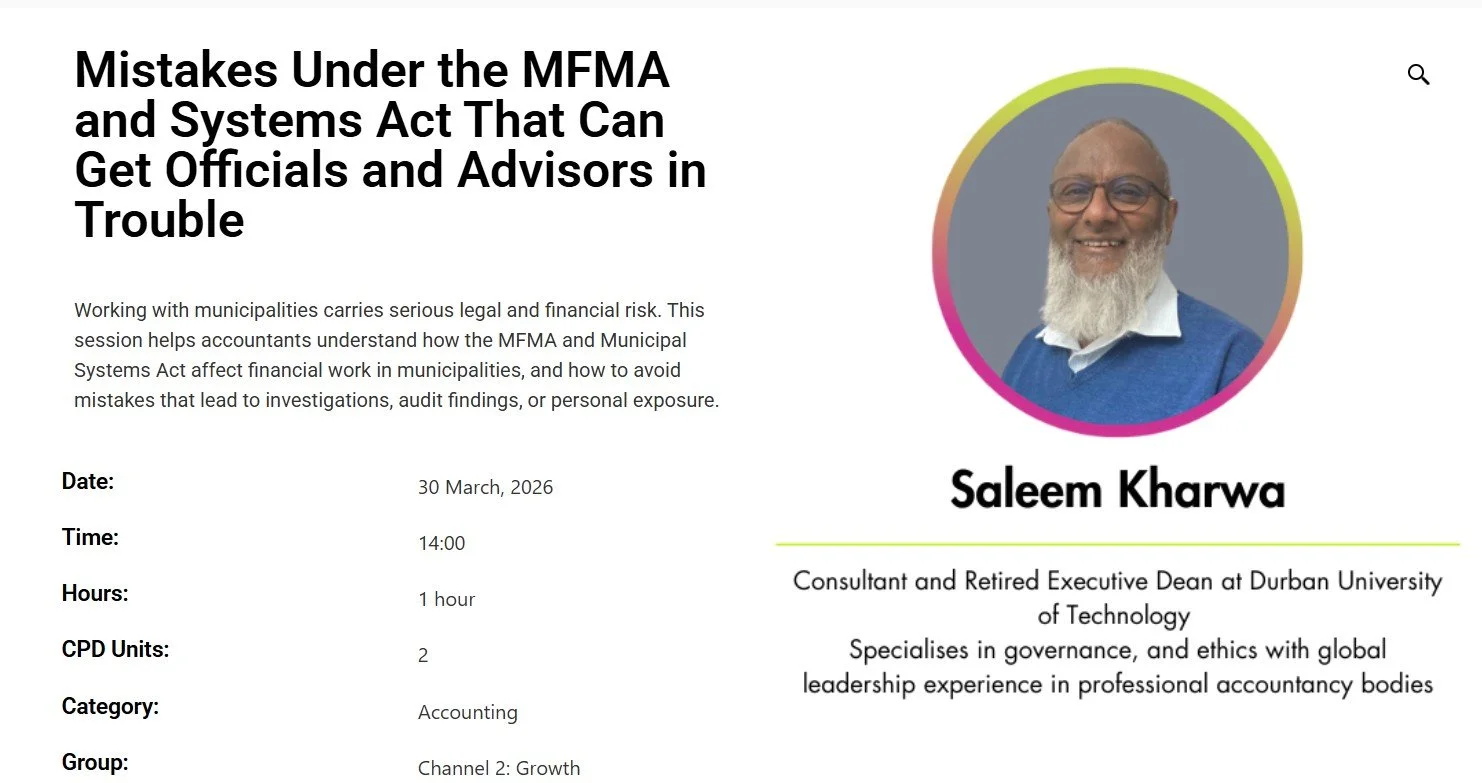
Enroll to CIBA’s Mistakes Under the MFMA and Systems Act That Can Get Officials and Advisors in Trouble webinar and learn how to build trust with clients and protect your carrier in local government.
What will set you apart
By attending this event, you will learn:
Where municipalities and advisors are most exposed under the MFMA and Systems Act, how poor financial processes create risk, and how to work safely within these laws. This will position you as reliable professional who can support compliance and accountability without creating personal risk.


Choose Your Path to Exclusive Insights
Stay ahead in the world of accounting with premium content designed for professionals like you. Access expert articles, industry trends, and essential resources. Become a CIBA member and claim your CPD hours from CIBA.
CIBA Member Access
R250.00 FREE!
100% Discount when you become a CIBA Member. Join now to claim your CPD Hours. Register here: https://accounts.myciba.org/register