Trust Accounting Mistakes Under the LPA That Can End Your Career
This article will count 0.25 units (15 minutes) of unverifiable CPD. Remember to log these units under your membership profile.
Trust accounting under the Legal Practice Act 28 of 2014 is one of the most heavily regulated areas in South African legal practice, and one of the most commonly mismanaged. The mistakes are often technical in nature, but the consequences are anything but.

The Legal Framework: More Layers Than Most Practitioners Realise
Trust accounting for legal practitioners is governed by an interlocking set of obligations that goes well beyond a single piece of legislation. The Legal Practice Act 28 of 2014 (LPA) provides the primary statutory framework, while LPC Rules 54 and 55 add granular compliance requirements covering everything from record-keeping to reconciliation timelines. The Legal Practitioners Fidelity Fund (LPFF) imposes its own conditions, and any assurance engagement on trust accounts must be conducted in accordance with the International Standard on Assurance Engagements (ISAE 3000).
Section 86 of the LPA distinguishes between five categories of trust-related accounts. The general trust account (s86(1)) holds daily client funds. The pooled interest account (s86(2)) directs interest to the Fidelity Fund. Separate investment accounts (s86(3)) direct interest back to the client. Investments made on specific client instruction (s86(4)) retain their trust character even when invested. And the firm's business account (s86(5)) holds only the firm's own funds. Knowing which account to use for which purpose is not a detail, it is a foundational compliance requirement.
Trust Accounts and Trust Accounting Are Not the Same Thing
Before examining where things go wrong, it is worth clarifying a distinction that trips up many practitioners and the accountants who serve them. A trust account is a specialised financial instrument, a designated bank account used to hold client money separately from the firm's operational funds. Trust accounting, by contrast, is the administrative and reporting process of tracking, recording, and managing those accounts in compliance with regulatory obligations.
You can hold the right bank account and still fail completely on the accounting side. The LPC scrutinises both. Practitioners who assume that simply opening a trust account at an approved bank satisfies their obligations are exposed to serious risk.
The Six Mistakes That Lead to Serious Trouble
LPC inspections and auditor findings under ISAE 3000 surface the same cluster of failures with consistent regularity. These are not exotic edge cases, they are everyday errors made in busy practices where compliance is treated as an afterthought.
Mixing trust and business funds is the most fundamental breach a practitioner can commit. Client money is not the firm's money. The moment trust funds are deposited into or used to supplement the business account, for any reason, even temporarily, the practitioner has violated one of the core principles of the LPA. This is also a reportable irregularity that an auditor is obligated to disclose.
Late or inaccurate reconciliations represent a close second in terms of frequency. Rule 54 of the LPC Rules requires monthly trust reconciliations, and the requirement is not aspirational. The reconciliation must balance the trust cashbook against the trust ledger (maintained per client) and against bank statements. Where a practice is unable to provide a signed, accurate reconciliation at short notice, for instance, when applying to cease holding a trust account, the 30-day window under Rule 54 quickly becomes a crisis.
Unauthorised transfers from trust to business occur when firms draw fees before issuing an invoice or before amounts are legitimately due. Trust money may only be transferred to the business account once it has been invoiced and the amount is payable. Premature transfers, even where the fees are genuinely owed, constitute non-compliance.
Paying interest to the wrong LPFF account is a more technical failure but no less consequential. Interest on pooled trust funds must be paid to the LPFF in accordance with the firm's specific loan agreement terms. Practitioners must confirm the correct payment account details directly with the LPFF, not assume they know the account, and should review loan statements and consult LPFF representatives to verify exact payment amounts and procedures.
Poor documentation of mandates leaves practitioners vulnerable during audits. Where a client has instructed the firm to invest funds under s86(3) or s86(4), that instruction must be documented. Without written mandates, auditors cannot verify that account categories have been applied correctly, and the firm is exposed to findings of non-compliance regardless of actual intent.
Inadequate record-keeping undermines everything else. Rule 54 prescribes a specific set of records that must be maintained: the trust cashbook, a trust ledger per client, a trust creditors list, bank statements, deposit slips, payment instructions, and reconciliations. All of these must be retained for a period of seven years. Practices that cannot produce complete records on inspection have no defence.
What the Auditor Is Actually Checking
Trust account audits are not administrative box-ticking exercises. Under ISAE 3000, the engagement provides reasonable assurance, a high standard. The auditor tests trust transactions, verifies trust balances, and confirms compliance with both the LPA and the LPC Rules. An assurance report and annual statement must be submitted to the LPC.
Critically, auditors who identify reportable irregularities, including fraud or theft, misappropriation of trust money, non-compliance with the LPA or LPC Rules, or any conduct that endangers client funds, are obligated to report these. A practitioner cannot rely on goodwill or a long-standing auditor relationship to smooth over compliance failures. The reporting obligation runs to the regulator, not to the client.
The Consequences of Getting This Wrong
Non-compliance with trust accounting obligations under the LPA is not a matter of administrative inconvenience. The consequences are serious, career-ending, and in some cases criminal.
LPC disciplinary action can result in suspension or striking off the roll. A practitioner who loses their Fidelity Fund Certificate cannot practise. Financial penalties compound the damage, and where funds have been misappropriated, even where the practitioner believed they were entitled to the money, criminal charges may follow. The reputational damage to the practice and the individual extends well beyond the formal regulatory process.
The purpose of these rules is not bureaucratic. Trust accounts exist to protect clients, to ensure that their money is safe, traceable, and not misused. The profession's credibility depends on the public's confidence that practitioners handle client funds with integrity. Every compliance failure, however unintentional, erodes that confidence.
What This Means for Me as an Accountant or Finance Professional
If you are an accountant or financial manager servicing a legal practice, or running your own practice that handles client funds. the obligations described in this article are not someone else's problem. Many accounting professionals find themselves deeply embedded in the trust accounting function of their clients' law firms, either as the person maintaining the books, preparing the reconciliations, or advising on compliance. That role carries real exposure.
As the person closest to the numbers, you are often the first line of defence against the mistakes that lead to LPC findings. If the trust cashbook is not being maintained properly, if reconciliations are being skipped, or if trust-to-business transfers are happening without proper invoicing, you will see it before the auditor does. That gives you both the opportunity and the professional responsibility to raise it. Silence in the face of a known compliance failure is not a neutral position.
For accountants running their own practices, the same principles apply wherever client funds are held. The specific regulatory framework may differ depending on the nature of your practice, but the underlying discipline, keep client money separate, reconcile regularly, document everything, and never draw fees before they are properly due, is universal. Trust accounting under the LPA is a masterclass in what sound financial stewardship looks like, and its lessons extend well beyond the legal profession.
A Compliance Checklist for Your Practice
Use this checklist as a monthly review tool. It covers the core obligations under the LPA and LPC Rules 54 and 55 and maps directly to the most common findings in trust account audits.
Account structure
Trust accounts are held at an approved bank and correctly categorised (s86(1) to s86(4))
Business funds (s86(5)) are held in a separate account with no co-mingling of client money
All client mandates for separate investments (s86(3) or s86(4)) are documented in writing
Monthly reconciliations
Trust cashbook is updated and balanced at month-end
Trust ledger is maintained per individual client
Trust creditors list is current and complete
Bank statement reconciliation is signed by the practitioner
Reconciliation is filed and accessible for LPC inspection
Transfers and payments
No transfers from trust to business have been made without a valid, issued invoice
Interest on pooled trust funds has been paid to the correct LPFF account
LPFF payment account details have been confirmed against the loan agreement, not assumed
Record-keeping
All trust accounting records (cashbook, ledger, creditors list, bank statements, deposit slips, payment instructions, reconciliations) are retained and indexed
Records are stored securely and will be accessible for the full seven-year retention period required under Rule 54
Annual assurance
The trust account assurance engagement (ISAE 3000) has been scheduled with a registered auditor
The assurance report and annual statement have been submitted to the LPC within the required timeframe
How AI Can Help You Avoid Trust Accounting Mistakes
Artificial intelligence is not a substitute for professional judgement in trust accounting, but it is increasingly a practical tool for reducing the administrative burden and catching errors before they become findings. Here is how accounting professionals are beginning to put it to work.
Automated reconciliation checking. AI-assisted accounting tools can be configured to flag discrepancies between the trust cashbook, client ledgers, and bank statement balances in real time, rather than waiting for month-end. This means anomalies — missing entries, unmatched transactions, or unexpected balance movements — are surfaced immediately rather than discovered during an audit.
Document and mandate management. AI tools with document processing capabilities can extract, categorise, and store client mandates and payment instructions automatically, ensuring that the paper trail required under Rule 54 is complete and retrievable. For practices managing large volumes of client files, this eliminates one of the most common audit vulnerabilities: the instruction that was given verbally and never documented.
Compliance calendars and alerts. AI-powered practice management tools can be set to generate automatic reminders for monthly reconciliation deadlines, LPFF interest payment dates, and annual audit preparation milestones. These are the kinds of administrative tasks that fall through the cracks in busy practices — and that tend to show up as findings when they do.
Drafting and reviewing correspondence. When practitioners need to respond to LPC queries, prepare reconciliation sign-off documentation, or communicate with auditors, AI writing tools can assist in drafting accurate, complete, and professionally worded documents. This is particularly useful for sole practitioners who do not have a support team.
The key principle when using AI in a regulated environment is verification. AI tools reduce the risk of human error, but they do not eliminate the practitioner's personal accountability. Every reconciliation still needs to be reviewed and signed. Every mandate still needs to be checked. AI accelerates the process — it does not replace the professional responsibility that sits behind it.
Key Takeaways
Trust money is never the firm's money. It must be kept strictly separate from business funds at all times, regardless of fees owed or operational pressures.
Monthly reconciliations are mandatory under Rule 54, not optional. They must be signed by the practitioner and available for LPC inspection at any time.
Transfers from trust to business are only permitted once fees are invoiced and due. Premature transfers constitute non-compliance, even where the amounts are legitimately owed.
All trust accounting records — cashbooks, ledgers, bank statements, reconciliations, and payment instructions — must be retained for seven years.
Non-compliance carries consequences that include LPC disciplinary action, suspension or striking off, loss of the Fidelity Fund Certificate, financial penalties, and potential criminal charges.
CIBA Is Here to Help You Stay on the Right Side of the Law
Trust accounting is a specialised field, and the regulatory obligations attached to it require both technical knowledge and ongoing professional development. As a CIBA member, you have access to CPD resources, including courses covering trust accounting and compliance under the Legal Practice Act, designed to keep you current, competent, and protected.
Whether you are an accountant supporting a legal practice, a practitioner managing your own trust account, or a financial manager navigating complex regulatory obligations, CIBA's technical support team is available to assist. Reach out to technical@myciba.org, or explore the full range of trust accounting CPD on the CIBA learning platform at cpd.myciba.org.
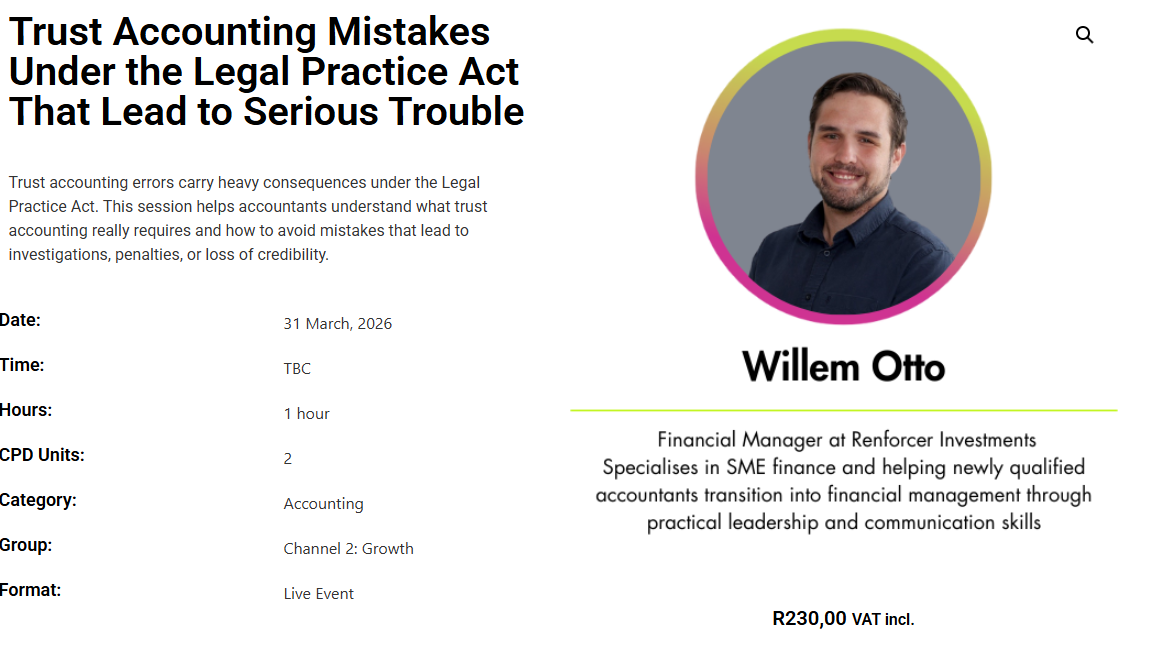
CPD Session: Trust Accounting Mistakes Under the Legal Practice Act That Lead to Serious Trouble
By attending this event, delegates will learn:
Delegates will learn where trust accounting usually goes wrong, what compliance rules matter most, and how to work safely within the Legal Practice Act. This allows them to protect themselves, support legal practices properly, and avoid being caught in serious compliance failures.
Event breakdown:
Why trust accounting carries serious risk
Key trust accounting rules under the Legal Practice Act
Common trust accounting mistakes
Where accountants and firms are exposed
Record-keeping and control failures
How investigations and audits are triggered
Practical steps to reduce trust accounting risk
🎓 2 CPD Units
💰 Free CIBA Channel 2 & R230 VAT incl. everyone else
Register Here

Choose Your Path to Exclusive Insights
Stay ahead in the world of accounting with premium content designed for professionals like you. Access expert articles, industry trends, and essential resources. Become a CIBA member and claim your CPD hours from CIBA.
CIBA Member Access
R250.00 FREE!
100% Discount when you become a CIBA Member. Join now to claim your CPD Hours. Register here: https://accounts.myciba.org/register