This article will count 0.25 units (15 minutes) of unverifiable CPD. Remember to log these units under your membership profile.
In January 2026, a litre of 95 petrol cost R20.75 in Gauteng. Many businesses built their budgets on a number close to that. It was a fair assumption: crude oil was cheap and pump prices had just come down.
In late February, the United States and Israel attacked Iran. Oil prices rose at once, and by April Brent crude averaged more than US$100 a barrel, up from about US$61 in January. Pump prices followed from April, and in May the Reserve Bank raised interest rates by a quarter of a percentage point. On 7 October, the same litre of petrol cost R30.25, about 46% more than in January.
Any budget signed off in January was out of date within weeks. The accountant who prepared it did nothing wrong. The method failed, because it allowed for one set of numbers and one version of the future.
Budget season for 2027 is here. Before you approve the numbers, ask a more useful question: what will we do if the assumptions behind this plan stop holding?
Risk and uncertainty are different things
Accountants often use the two words as if they mean the same thing. The difference changes how you plan.
Risk is when you know the possible outcomes and can estimate the odds. If a client's bad debts have run at about 4% of debtors for five years, that history gives you a reasonable starting point, adjusted for what is happening in the economy now.
Uncertainty is when you cannot put reliable odds on the outcome, or cannot even list the outcomes. Nobody preparing a budget in January 2026 could have told you the probability of a war in the Gulf.
A budget still needs one central set of assumptions. The trouble starts when management treats that set as the only future worth preparing for. The chance that the year turns out exactly like the budget is close to zero.
Uncertainty can also go your way. If you budgeted to sell 120,000 units and sold 150,000, profit rises, but you may run short of stock, staff or the cash to fund the growth.
Why changing one number at a time falls short
Many of us test a budget with sensitivity analysis. What if sales drop by 10%? What if costs rise by 5%? It is useful for finding the drivers that matter most, but it changes one variable at a time.
Real shocks move several lines at once. The 2026 fuel increases did not stay in the fuel line. Delivery costs went up and suppliers raised their prices. Interest rates followed, so the overdraft cost more. Customers under pressure took longer to pay. Scenario planning lets you test those changes together, the way they happen in real life.
How to build three scenarios
Start with three versions of next year:
• Base case: what you think is most likely.
• Worst case: several bad things happen at the same time.
• Best case: things break your way.
Describe what happens in each case before you add numbers. Then choose the five or six drivers that matter most to the business, set a value for each and run every scenario through to profit and to cash.
Case study: Thaba Distribution (a fictional business)
Thaba Distribution delivers building supplies around Gauteng. Its 2026 forecast shows turnover of R12 million, cost of sales of R8.4 million, transport costs of R960,000 and other overheads of R1.8 million. It pays R105,000 interest on an average overdraft of R1 million, which leaves a profit of R735,000. Customers pay in 55 days on average.
Its accountant sets three scenarios for 2027:
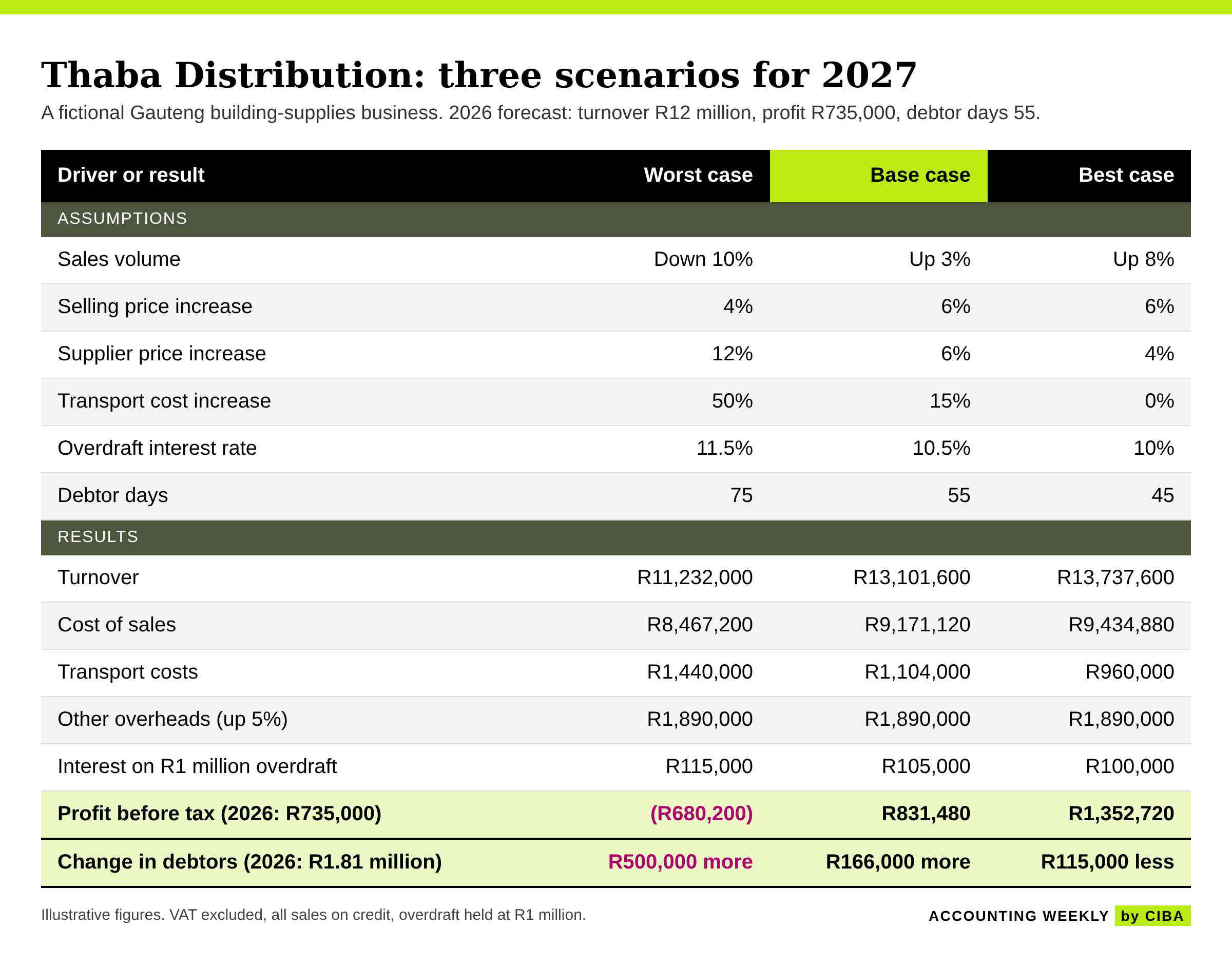
The base case looks comfortable: profit rises a little and the extra money tied up in debtors is small. A single-number budget would have stopped there.
The worst case tells a different story. Volumes fall, suppliers raise prices faster than Thaba can pass them on, transport costs rise by half (less than petrol rose between January and October 2026) and customers take almost three weeks longer to pay. A profit of R735,000 becomes a loss of about R680,000, and slower payments tie up another R500,000 in debtors.
None of those changes is extreme on its own. Together, they turn a profitable year into a loss. Changing one line at a time would not have shown that.
Neither figure tells you how much Thaba would need to borrow. That depends on when money comes in and goes out, how much cash and stock the business holds and how long suppliers give it to pay. A monthly cash flow forecast for the worst case shows both the size of the shortfall and the month it arrives.
With that forecast in hand in October, the owner can talk to the bank about a facility before it is needed, review delivery charges and chase overdue accounts sooner. A bank responds far better to a request backed by a scenario than to a phone call when the account is already over its limit.
The best case needs planning too. Faster collections release cash, but higher volumes may need more stock and another delivery vehicle.
Decide your response before you need it
A scenario is only useful if it changes what you do. For each case, agree on three things in advance.
The trigger. What would tell you that you are moving into the worst case? "Debtor days above 65, measured at each month-end" is a trigger. "When collections get difficult" is not.
The response. If the trigger happens, what do you do? Call overdue customers earlier, review credit limits, ask for deposits on new orders, renegotiate delivery charges or delay the new vehicle.
Who decides. Give a named person authority to act within agreed limits. A response that has to wait for three meetings arrives after your competitors have already moved.
Look for actions that help in most scenarios: better collections, a realistic cash buffer and less reliance on one large customer. Be honest about trade-offs. A fixed-price supply contract protects you if prices rise, but you lose out if they fall.
Then test each major response against the business's longer-term plans. Does it fit the strategy, can customers, staff and lenders live with the consequences, and does the business have the people and money to carry it out? A price increase may protect margins but push away customers who are already under pressure.
Finally, keep the annual budget as the yardstick for accountability, and run a rolling forecast alongside it. Update the base case each quarter, or each month when costs move fast, and revisit the other scenarios when a key assumption shifts.
Watch your own thinking
Scenario planning also guards against four habits most of us share.
Anchoring. Last year's number becomes the starting point, even when the drivers have changed. Start from the drivers instead of last year's total.
Confirmation bias. We notice evidence that supports the plan we already like. Ask a colleague to argue for the worst case.
Overconfidence. Experience, or one past success, is treated as proof. Write down the evidence behind each major assumption.
Sunk cost. We keep funding a failing project because of what we have already spent on it. Judge each project on what it will cost and earn from today.
What this means for your clients and your career
Accounting software and AI already prepare reports, and they can now help build models too. They cannot check whether the assumptions make sense for this business, or sit with an owner and ask: "What will you do if this happens?"
If you work in practice, scenario planning can become a defined advisory service: the client's main exposures, a monthly cash forecast and a response plan. A client whose worst case included a fuel shock, with a plan ready, will remember who helped them. That is work you can charge for.
If you work in commerce, it is how you move from reporting what happened to helping decide what happens next. Finance teams that bring three scenarios to the budget meeting get invited to the next one.
Implementation checklist: before you approve the 2027 budget
This week
☐ List the five or six drivers that move profit and cash the most.
☐ Compare the past 12 months' actuals with budget and note what caused the biggest variances.
☐ Mark which drivers carry risk (you can estimate the odds) and which carry uncertainty (you cannot).
Build the scenarios
☐ Describe the base, worst and best case in a few sentences each.
☐ Set a value for each driver in each case, and move the drivers together.
☐ Write down the evidence behind each major assumption.
☐ Run every scenario through to a monthly cash flow forecast.
☐ Note when the worst case runs short of cash, and by how much.
Plan the response
☐ Set a measurable trigger for each scenario, with how and when it is measured.
☐ Agree the response and who has authority to act.
☐ Check each major response against strategy, stakeholders and available resources.
☐ Speak to the bank about facilities before you need them.
☐ Start the actions that help in most scenarios now.
During the year
☐ Check your triggers every month.
☐ Update the rolling forecast each quarter, or each month when costs move fast.
☐ Record why results differed from the forecast, for next year's assumptions.
For more practical sessions on strategy, risk and decision-making, see the CIBA CPD


Trending