This article will count 0.25 units (15 minutes) of unverifiable CPD. Remember to log these units under your membership profile.
Most business owners know two words for a business in trouble: business rescue and liquidation. There are four options, and the wrong choice costs owners and creditors money. The accountant is usually the first person who can tell them which one fits.
The signs usually reach the accountant first. Debtor days creep from 45 to 80. Stock piles up. The VAT return is late because money set aside for SARS paid the wages. Then the owner asks: "Would business rescue buy us some time?"
It might. Business rescue is one of four routes: an informal turnaround, a compromise with creditors under section 155 of the Companies Act, formal business rescue or liquidation. The right choice depends on how deep the distress runs and whether the business can still be saved. Accountants are well placed to answer both questions.
Start with the business behind the numbers
Take a small wholesaler whose sales are steady but whose cash is disappearing. Customers now take 80 days to pay instead of 45. Slow-moving stock fills the warehouse, and tax money is covering payroll. The owner believes one more loan will solve the problem. Your job is to test that belief before anyone mentions business rescue.
First ask what the financial statements do not show. Does the business depend on a few key staff or one supplier? It happens more often than you would think that a key supplier turns out to be owned by the biggest competitor. Is a production bottleneck or poor management draining cash? Has the market moved on while the business stood still? Is the company meeting its compliance obligations?
Then look at the numbers across five areas together: efficiency (debtor days and stock days), sensitivity (how far the business trades above break-even, and what a 10% rise in key costs would do), liquidity, solvency and profitability. A healthy gross margin means little if the cash is tied up in old debtors and dead stock.
Next, rewrite the balance sheet in the terms creditors use. Split the assets into those pledged as security and those that are free, and the liabilities into secured, preferent (such as SARS and employees) and concurrent creditors. The free assets show how much room there is to manoeuvre. Treat this as a first look; a formal ranking of claims can change the picture.
Finally, apply the legal test. Under section 128 of the Companies Act, a company is financially distressed if it is reasonably unlikely to pay its debts as they fall due in the next six months, or reasonably likely to become insolvent within that time. Scoring models such as the Altman Z-score add a quick warning signal, but the original model was built for listed manufacturers and fits small private companies less well.
Is there a viable business to save?
A turnaround or a rescue needs evidence. Do customers still want the core product or service? Is there a sales pipeline that can support future cash generation? Can costs come down without breaking the operation? Is there a legal or regulatory obstacle that cannot be overcome?
Return to the wholesaler. If its customers are still profitable, the old debtors can be collected and the excess stock can be cleared, an informal turnaround may be enough. If the underlying business works but its historical debt makes recovery impossible, a compromise with creditors or formal business rescue deserves a closer look. If the operation cannot generate cash even after restructuring, liquidation is the responsible route.
Distress on its own does not make a company a candidate for business rescue. Some owners want it only to hold creditors off for a few months. That wastes money, delays the inevitable and can expose directors to claims for reckless trading.
Four options, four different decisions
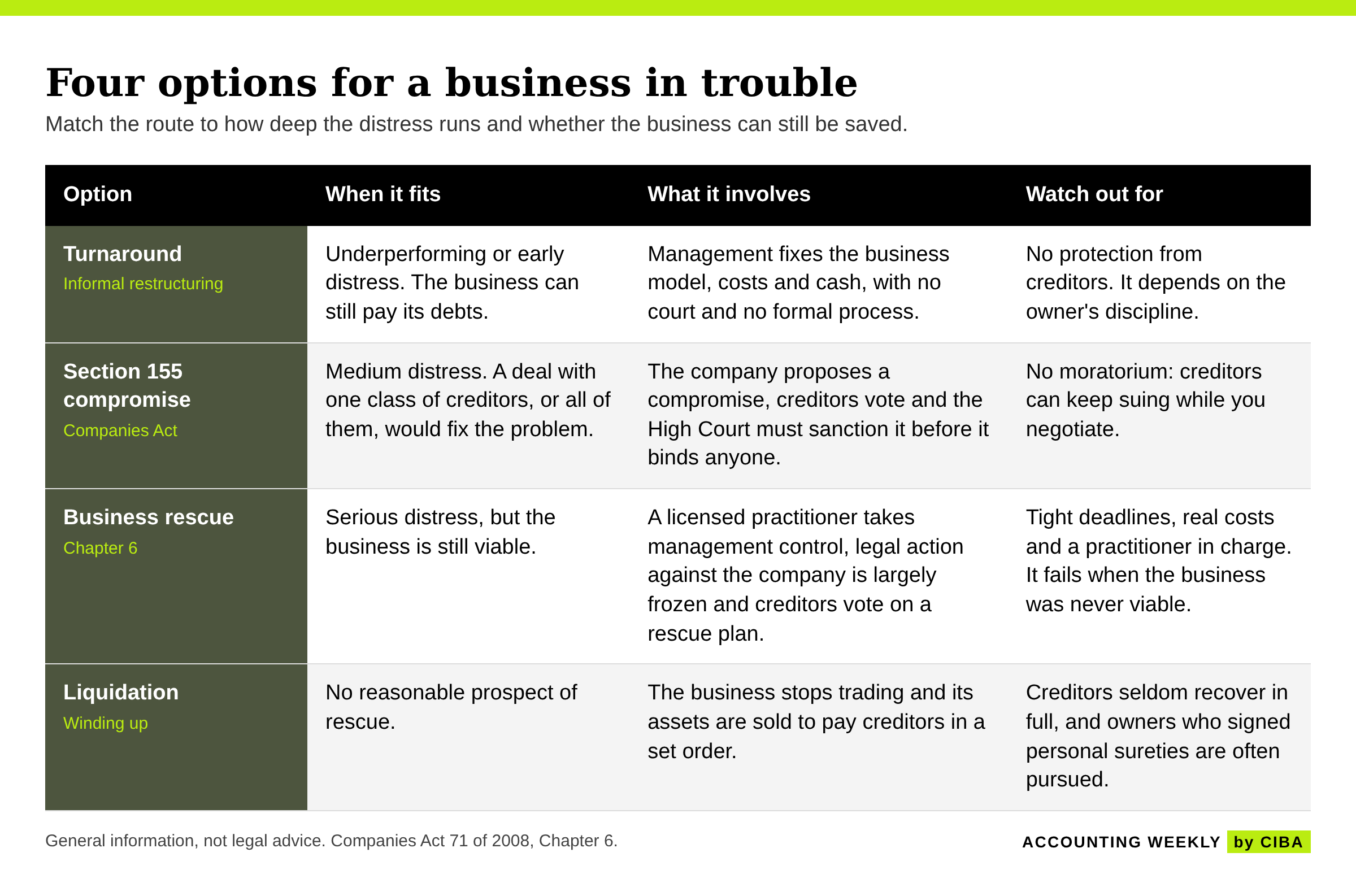
A turnaround is usually the least disruptive choice, as long as creditors can be managed and the owner is willing to make hard changes. It needs no court and no practitioner.
A section 155 compromise suits a business whose main problem is its debt. The company can strike a deal with all its creditors or with one class, for example only the concurrent creditors, without going into business rescue. The proposal must be supported by a majority in number of the creditors voting, representing at least 75% in value, and then sanctioned by the High Court. Until then, creditors can keep enforcing their claims.
Business rescue gives the strongest protection and the tightest timetable. The board starts it by filing a resolution with CIPC, or a creditor or other affected person can apply to court. A licensed practitioner must be appointed within five business days and takes over management control. The practitioner must publish a rescue plan within 25 business days of appointment, unless that period is extended, and creditors then vote on it. The plan passes with the support of more than 75% of the creditors' voting interests that were voted, including at least half of the independent creditors' votes. If rescue becomes impossible along the way, the process can still aim for a better return to creditors than an immediate liquidation.
Directors also have a duty that is often ignored. If the board has reasonable grounds to believe the company is financially distressed and does not start business rescue, section 129(7) requires it to tell every affected person in writing, setting out the criteria and its reasons.
Liquidation is seldom the clean exit owners expect
Owners often see liquidation as a way to walk away. Take a company with assets recorded at R1 million and liabilities of R750,000: R250,000 owed to the bank (secured), R250,000 to preferent creditors and R250,000 to concurrent creditors. On paper it is solvent. Now see what happens when the assets are sold.
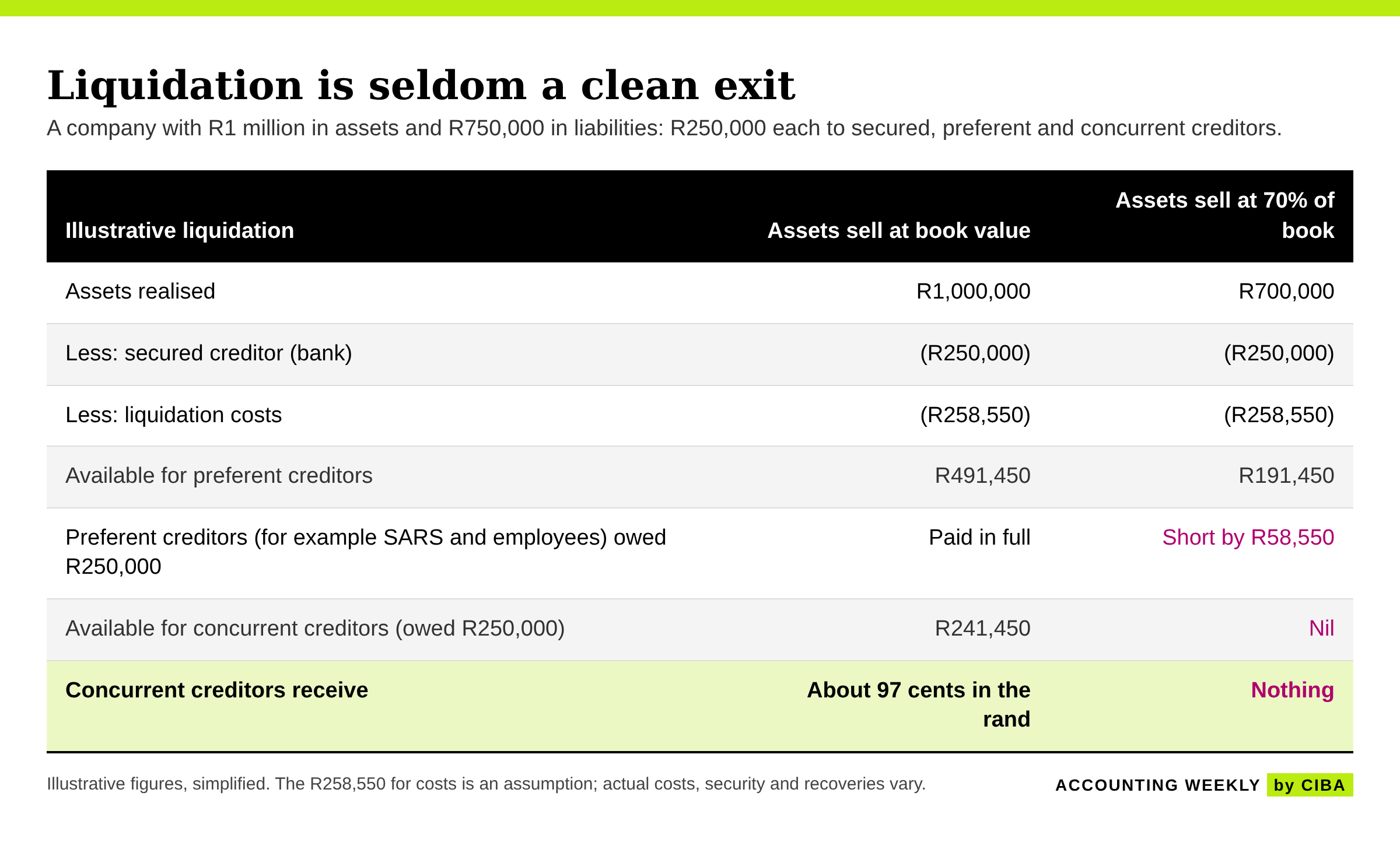
Even at book value, the concurrent creditors fall short. If the assets fetch 30% less, which is common in a forced sale, they receive nothing and the preferent creditors are short too. Personal sureties do not fall away when the company closes, so unpaid creditors often turn to the owner. This comparison is also at the heart of business rescue: when creditors vote on a plan, they are choosing between that plan and liquidation.
Know where your own fees stand
If a client goes into business rescue, fees you were owed before it started rank as ordinary unsecured claims, near the back of the queue. Work you do for the practitioner after rescue begins may count as post-commencement finance, which ranks ahead of those older unsecured claims, but behind the practitioner's own costs and employees' pay during the rescue. Whether a particular fee qualifies depends on what was agreed and when, so settle the scope, authority and payment terms with the practitioner in writing before you start.
SARS loses ground too. In liquidation, certain tax debts are preferent. In business rescue, the court held in CSARS v Beginsel (2013) that tax owed before rescue began ranks as an ordinary unsecured claim.
A turnaround is a people project
When an informal turnaround is possible, start with the business model. Which products or services earn a sustainable margin, and which only keep people busy? Separate the core business from the non-core services and the nice-to-haves, and cut the nice-to-haves that consume cash. Know the business's capacity (rooms in a guesthouse, hectares on a farm, billable hours in a practice) and what drives its profit and its costs. In an accounting practice, staff who are paid for eight hours but bill six run at 75% utilisation.
Set a few measurable targets and track them in the monthly management accounts. For the wholesaler, that could mean bringing debtor days back to 50, clearing stock older than 90 days, keeping any single customer below 10% of the debtors book and paying VAT and PAYE on time from a separate account.
Then manage the people. Plans fail when owners and staff resist them. A change model such as ADKAR (awareness, desire, knowledge, ability and reinforcement) helps. The owner first has to see the problem and want to fix it. Only then will new knowledge turn into action, and regular feedback on results keeps the change in place.
What this means for you
If you work in practice, you are often the first to see distress and the person the owner trusts most. Knowing the four options lets you advise early, while the cheaper routes are still open, and refer to a business rescue practitioner or insolvency attorney when formal steps are needed.
If you work in commerce, the same analysis helps you raise the alarm with management and the board before the choices narrow.
This article is general information, not legal advice. Clients facing formal insolvency proceedings should consult a licensed business rescue practitioner or an insolvency attorney.
Implementation checklist: when a client shows signs of distress
Spot the signs
☐ Track debtor days, stock days and cash against the last 12 months.
☐ Check whether VAT, PAYE and supplier payments are being made on time.
☐ Ask about staff, suppliers, market changes and compliance, not only the numbers.
Assess the distress
☐ Analyse efficiency, sensitivity, liquidity, solvency and profitability together.
☐ Rewrite the balance sheet: pledged and free assets; secured, preferent and concurrent creditors.
☐ Apply the six-month financial distress test in section 128.
☐ Test viability with a realistic cash flow forecast and evidence: business model, sales pipeline, legal certainty.
Choose the route
☐ Match the level of distress to turnaround, a section 155 compromise, business rescue or liquidation.
☐ Prepare a realistic estimate of what creditors would receive in liquidation.
☐ Remind the board of its section 129(7) duty if it decides against business rescue.
☐ Refer to a licensed practitioner or attorney before any formal step.
Act and follow through
☐ Agree your own fee terms in writing if the client enters business rescue.
☐ For a turnaround, set measurable targets and track them monthly.
☐ Plan how owners and staff will be brought along, not only what will change.
For more practical sessions on business rescue, risk and practice management, see the CIBA CPD.




Trending