This article will count 0.25 units (15 minutes) of unverifiable CPD. Remember to log these units under your membership profile.
Your client's family trust has held one house since 2009. No bank account, no financial statements, and nobody has read the deed in years. Now she has heard the trust rules are changing. Her question: "Am I in trouble?"
On 7 August 2026, the Department of Justice published the draft Regulation of Trusts Bill, 2026 for comment. It will replace the Trust Property Control Act of 1988. It is not law yet, but the direction is clear. Here is what changes, what it means for you, and what CIBA told the Department in its submission of 11 September 2026.
What the Bill changes for trusts
The Bill turns the Master from a keeper of documents into an active supervisor. For trustees, that means more paperwork, more cost and less room for error. Very little in the Bill makes running a trust easier. These are the key changes.
Yearly financial statements for every trust
Today, many family trusts never prepare financial statements. Under section 20, every trust must prepare financial statements each year, unless the trust instrument itself requires otherwise and the trust qualifies for the prescribed exemption. The exemption is based on aggregate inflows and outflows of trust property, with the threshold still to be prescribed by the Minister. A trust that has never prepared statements must do so within six months after the Act starts. The Master can also demand them at any time, with one month to comply.
The impact: A dormant trust holding one house may have to prepare annual financial statements each year, unless it qualifies for the exemption based on the prescribed threshold or its trust instrument provides otherwise.
A new annual return to the Master
Section 21 adds a yearly return to the Master, with a fee. It comes on top of the ITR12T that goes to SARS. What the return must contain, and what it will cost, is still to be set in regulations.
The impact:Two regulators, two annual filings and two sets of deadlines.
Ten days to report beneficial ownership changes
Trusts already lodge a beneficial ownership register with the Master. Section 23 now requires every change to be recorded and lodged within 10 days. This covers founders, trustees and beneficiaries, including beneficiaries who are not named in the deed but can be identified.
The impact: A death, marriage, birth or trustee resignation may trigger the 10-day reporting period where it results in a change to the trust's beneficial ownership information.
Deed amendments on hold until the Master acts
Under section 6, trustees cannot use an amended deed until it has been lodged and the Master has acknowledged it. The beneficial ownership register must be up to date before the amendment can even be lodged. Anything done under an unlodged amendment is invalid, and the trustee is personally liable for any loss.
The impact: A trustee cannot exercise powers or perform duties arising from an amendment until the amendment has been lodged with the Master and the Master has acknowledged the lodgement. The Bill does not prescribe a period within which the Master must acknowledge the lodgement.
The Master can appoint an independent trustee in certain circumstances
Section 10(4) lets the Master appoint an independent trustee, even if the deed says otherwise, when all the trustees are related, all are beneficiaries, and the trust does business with third parties. Section 10(3) also lets the Master add co-trustees where needed for proper administration.
The impact: A trust that meets the statutory conditions could have an independent trustee appointed by the Master, with the trustee entitled to remuneration under section 24.
Tighter control over who may be a trustee
Section 9 widens the list of people who may not act as trustees, and the Chief Master will keep a public register of disqualified trustees. Section 26 allows the Master to remove a trustee in specified circumstances, including where the trustee's estate is placed under business rescue or debt review, or where the trustee fails to perform satisfactorily a duty imposed by the Act. A resignation only takes effect once the Master acknowledges it. Trustees must keep trust records for five years after they leave office.
The Impact: Becoming a trustee gets harder, leaving gets slower, and holding the office gets riskier.
More duties in day-to-day running
All trust money must go into a separate trust bank account (section 18), and trust property must be clearly marked as trust property (section 19). Trustees must, to the extent appropriate in the circumstances of the trust, have regard to 15 specified factors when exercising their investment powers under section 16, while applying a prudent-investor standard. Every trustee must give the Master a physical address and an email address, and report changes within 14 days (section 7).
The impact: Informal habits, such as running trust money through a trustee's own account, will no longer be tolerated.
Investigations paid for by the trust
Section 12 lets the Master demand a full account from trustees and appoint an investigator. The cost of the investigation is normally paid from the trust's income, or from its assets if income is not enough.
The impact: A dispute or failure to respond can lead to an investigation. The costs are generally paid from trust income or, if insufficient, trust property, although the Bill provides for the costs to be directed to the trustee or the person who requested the investigation in specified circumstances.
Personal fines and possible jail
The Master can issue compliance notices and then administrative fines (sections 33 and 34). Trustees must pay these fines personally, not from the trust. An appeal goes to the Director-General, whose decision is final. Criminal penalties of up to R10 million and five years in prison apply to failures such as not using a trust bank account or not marking trust property (section 35).
The impact: Trustees face potentially serious personal consequences for specified non-compliance. Administrative fines apply to failures to comply with compliance notices, while criminal offences apply to specific conduct listed in section 35.
The bottom line
The Bill does not make life easier for trusts. It adds yearly costs, tighter deadlines and personal risk. It offers no simpler rules for small or dormant trusts beyond an exemption that is still undefined. Much of the detail, including fees, thresholds and fine amounts, is left to regulations that have not been published yet.
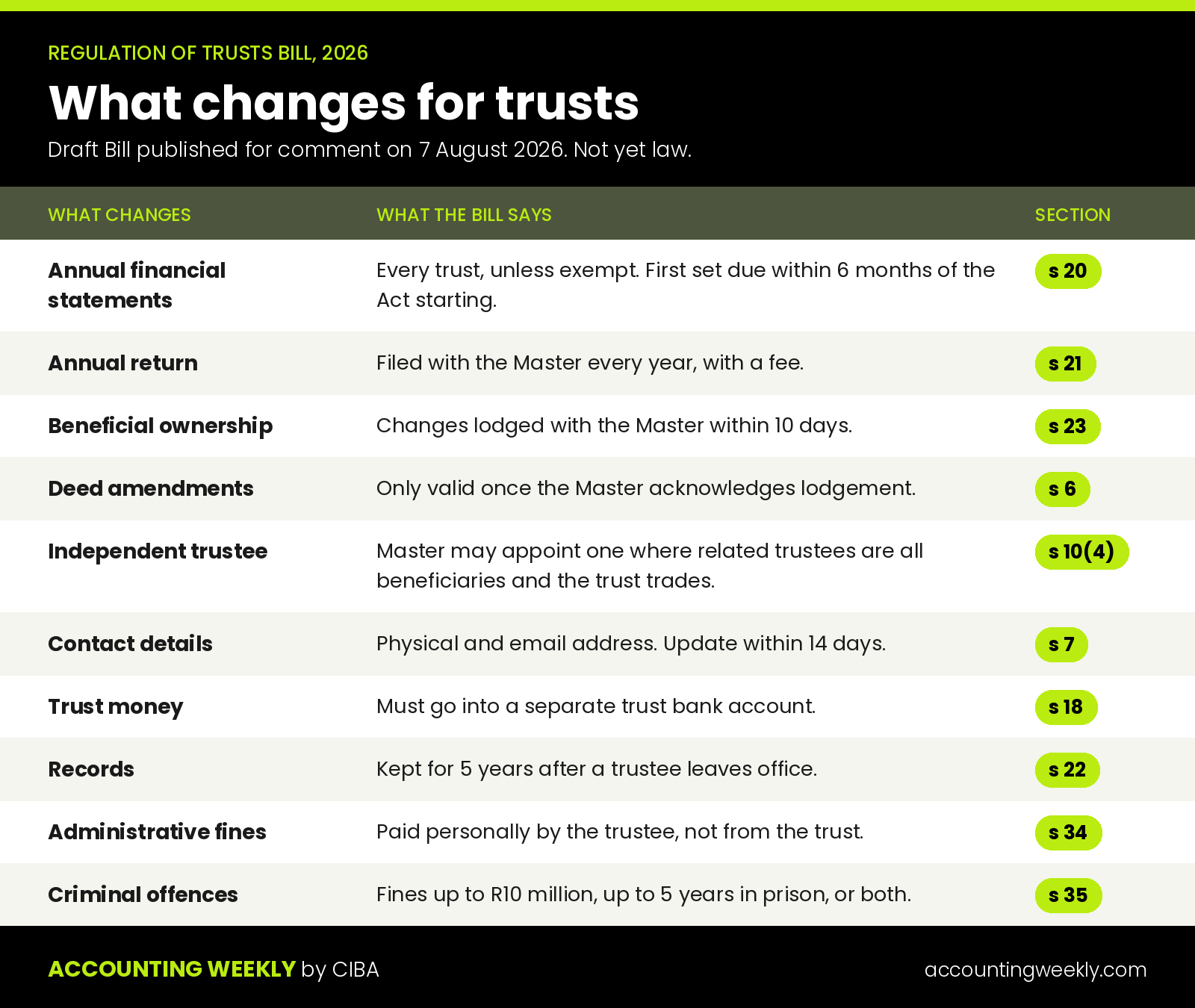
The image below sums up the key changes at a glance.
What it means for your practice
More work, and a new fee. Many trusts you only touch at tax time will need yearly financial statements. That is recurring income, if you price it well. Warn clients early that statements and an annual return will become a normal yearly cost.
More deadlines. The Master's return and the 10-day rule sit on top of SARS. The 2026 trust filing season already runs to 22 January 2027. Set up a simple way for clients to tell you when a trustee or beneficiary changes.
More personal risk. If you act as a trustee, fines come from your own pocket. Section 15(2) also cancels deed clauses that protect trustees from liability for poor care. Check your indemnity cover and your fee.
Grey areas. The Bill does not say who may prepare or review trust statements, and section 30 only mentions auditors. Its definition of beneficial owner could also catch an accountant who runs a trust's administration. If you provide trust services, your FICA duties still apply, as set out in FIC Guidance Note 7A.
What CIBA told the Department
CIBA supports replacing the 1988 Act and strong anti-money laundering rules. It welcomes the Master's new supervisory role, the risk assessment in section 13, the prudent investor rules and the independent trustee. Its message is simple: build the Act properly, don't just make it stricter.
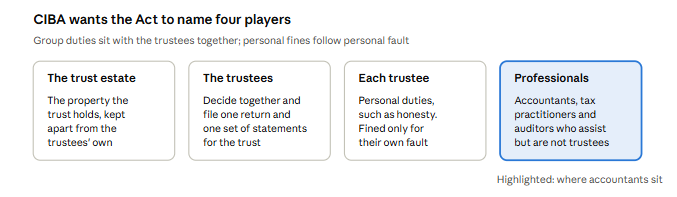
Fix who is responsible. The Bill keeps saying "a trustee must", even for single tasks like filing an annual return. As CIBA notes, a trust with five trustees does not need five returns. CIBA wants the Act to name four separate players.
Match the rules to the risk. Today a R300,000 trust for a child and a R50 million trading trust face the same rules. CIBA wants a risk-based approach across the whole Act, and a better exemption test than cash flow alone. It proposes a four-level reporting ladder.
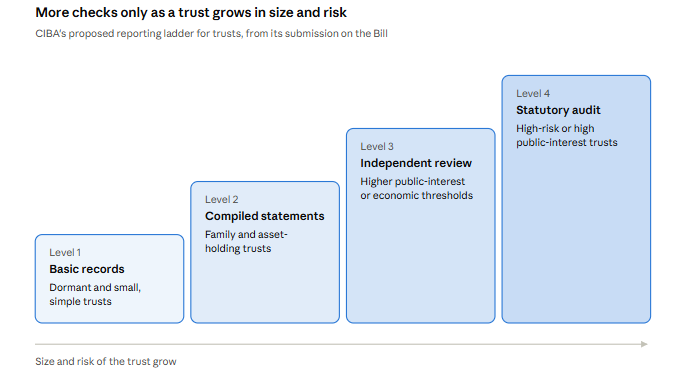
To make the ladder work, CIBA asks for ‘accounting officer’ and ‘independent reviewer’ to be defined, and for the reporting framework, thresholds and qualifying requirements to be prescribed only after consultation with all relevant parties, including professional bodies.
Protect professionals. CIBA wants trusts to be able to indemnify and insure trustees, as companies can under section 78 of the Companies Act. It also wants a safe harbour, so that preparing statements, doing tax work or filing documents does not make an accountant a trustee or beneficial owner.
Punish fault, not paperwork. Penalties should rise step by step from honest error to fraud. CIBA also flagged drafting errors, including two subsections numbered 6(4) in a clause linked to a criminal offence.
Finally, CIBA recommends renaming the law the Trusts Act, 2026, extending the comment period and publishing the draft regulations for comment. It has offered to help the Department design the accounting and assurance rules.
What to do now
List your trust clients. Note which lack financial statements, a trust bank account or a current beneficial ownership register. Our guide to beneficial ownership for trusts explains what the register needs.
Collect trustee contact details, including email addresses, for the Master.
Price a yearly trust package that covers statements, the annual return, register updates and the ITR12T.
Review your own trusteeships and your indemnity cover.
Tell clients early. The accountant who warns them first keeps the work.
When trust law changes, trustees will call the accountant who understands the new rules first. Make sure that is you.
Join CIBA and we'll show you how to turn trust compliance into steady, year-round income. myciba.org



Trending